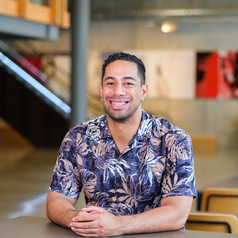
Lecturer in Sport and Recreation, Auckland University of Technology Dion Enari is a Lecturer at the School of Sport and Recreation, Faculty of Health and Environmental Sciences at Auckland University of Technology. He also has a PhD from Bond University, Gold Coast with a Master of International Relations and Lefaoali’i (high talking Chief) title from Lepa, Samoa. His research interests include Sport Management, Sport Leadership, mental health, Pacific language, indigenous studies, and trans-nationalism.
Postdoctoral Researcher in Anthropobiology and Genomics, Université de Toulouse III – Paul Sabatier Yvette Running Horse Collin is a Marie Skłodowska Curie IEF post-doctoral researcher in the AGES group. Her project is titled: MethylRIDE: Charting DNA Methylation Reprogramming of Ice Age Horses in the Face of Global Climate Change and Extinction. She is interested in the fields of equine genomics, archelogy, paleontology, metagenomics, indigenous studies, sustainability and climate change. Yvette is an enrolled member of the Oglala Lakota Nation (Oglala Sioux Tribe). For more than a decade, she has received specialized training from a number of Lakota traditional knowledge bearers in advanced indigenous sciences, environmental practices, and medicines. Within her culture, these categories of traditional indigenous knowledge are selectively passed to candidates who are viewed as capable of learning, practicing and holding such knowledge in a manner that is preserved accurately for the benefit of the People of her Nation, and as appropriate, for the world. Yvette received her B.A. from The Johns Hopkins University, and a Joint M.A. from New York University. She completed her PhD work at the University of Alaska Fairbanks (Phi Kappa Phi International Honors Society, Golden Key International Honors Society.) Her doctoral research, which was sponsored by multiple UAF Indigenous Studies Fellowship awards and an Andrew W. Mellon Foundation Dissertation Fellowship, focused on the history of the horse in the Americas and its relationship with First Nation Peoples. Upon completion of her doctorate in 2017, Yvette served her Nation as an appointed Presidential Ambassador, and continued her work as an Administrator for the Black Hills Sioux Nation Council. As is aligned with her cultural protocols, Yvette spent the past three years returning her research back to the communities who participated in her doctoral study. In many cases, this took the form of physically returning representative herds of the descendants of the original horses of such Peoples to their communities and actively participating with elders in teaching and sharing the traditions and science surrounding them.
PhD Candidate in Political Science, University of Iowa Willow’s research focuses on gender, conflict, and international institutions. Some of her current research projects include examining how states' commitments to the UN Treaty CEDAW influence women’s rights over time; how rebel commitments to human rights affect violence against civilians, particularly violence against women; how natural disasters influence women’s political trust in their government in post-disaster countries; and how different peace agreements after civil war can influence the duration of peace as well as create a sense of healing for citizens. Overall, she is curious about how gender influences and is influenced by institutions and the outcomes created by these institutions for women. She hopes to add to the current field by engaging on a deeper level with feminist literature and institutional design to help create solutions to issues for women. Willow graduated summa cum laude from the University of Kentucky with a bachelor’s degree in Political Science, as well as two minors in Gender & Women Studies and International Studies. She holds a master’s degree from the University of Iowa in Political Science and is working to complete her Graduate Certificate in Gender Women’s and Sexuality Studies in addition to her Ph.D. in Political Science.
Nottingham Research Fellow in the Department of Philosophy, University of Nottingham I am a Research Fellow at the University of Nottingham working on philosophy of parenthood and reproductive ethics. I have published on a number of topics within these spheres in journals such as Bioethics and the Journal of Applied Philosophy, and my book 'The Philosopher's Guide to Parenthood: Storks, Surrogates and Stereotypes' was published in 2023 by Cambridge University Press.
Visiting Research Fellow, Centre for the Understanding of Sustainable Prosperity (CUSP), University of Surrey Steve’s research interests intersect the moral, psychosocial, economic and political dimensions of the transition to sustainable prosperity. In addition to his research at the University of Surrey, he is part of the State of Tipping Points working group based at the Global Systems Institute, University of Exeter. This working group is producing the first State of Tipping Points Report to be launched at the COP 28 Conference, December 2023. Linked to this, Steve is on the editorial team of a special issue of Earth System Dynamics journal. Steve’s PhD at the University of Surrey, supervised by Ian Christie, Alex Penn and Birgitta Gatersleben, addressed knowledge gaps in the field of climate politics and policy advocacy in the UK. He developed a typology and method for mapping the UK ‘ecosystem’ of actors, qualitatively analysed 100 expert views on the transition to net zero carbon, and argued for a more radical, science- and equity-based ‘rapid transition’ to net zero by 2035 at the latest. Steve has authored a variety of peer-reviewed papers, book chapters, policy papers, articles and blogs. He was expert reviewer to the UN IPCC’s Second-Order Draft of Working Group III Sixth Assessment Report (AR6-WG3), and to the Swiss National Science Foundation.
Lecturer in Environmental Politics, Lancaster University The core of my interest is about the politics of environmental technology. I want to understand the relationship between how we develop and use technology in response to environmental problems on one hand, and political processes at varying scales in society on the other. I am a social scientist, with a background in engineering, innovation policy, innovation studies and science & technology studies (STS), and most recently cultural political economy. Much of my work is done in multi- and interdisciplinary collaborations, spanning social science, natural science, engineering and the humanities. I am a qualitative researcher, and favoured data sources include documents and interviews.