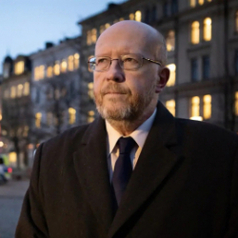
Professor, Department of History, L’Université d’Ottawa/University of Ottawa Professor Grabowski's research includes the issues surrounding the extermination of the Polish Jews as well as the history of Jewish-Polish relations during the 1939-1945 period. He is the author of several monographs, including Hunt for the Jews. Betrayal and Murder in German-Occupied Poland (Indiana University Press, Bloomington & Indianapolis, 2013) which won the Yad Vashem International Book Prize in 2014. Professor Grabowski has recently completed a project dealing with the involvement of the Polish “Blue” and criminal police in the Holocaust. His forthcoming research focuses on the open ghettos in the Generalgouvernement. A recipient of the 2014 Faculty of Arts Professor of the Year Award, he teaches survey courses and graduate and undergraduate seminars on the history of the Holocaust.
Chair for Family Philanthropy, Grand Valley State University Michael Moody joined the Johnson Center in 2010 as the Frey Foundation Chair for Family Philanthropy, the world’s first endowed chair for family philanthropy. In this role, Michael pursues a comprehensive, international program of applied research, training, and other activities to lift up family philanthropy. Trained as a cultural sociologist, Michael has served as an accessible guide to the rapidly evolving and complex world of philanthropy and social innovation for over 30 years, helping diverse audiences see the vital role that giving plays in society and in their own lives. Michael is co-author of the books Understanding Philanthropy: Its Meaning and Mission, The Philanthropy Reader, and Generation Impact: How Next Gen Donors Are Revolutionizing Giving, as well as a variety of other publications. Michael is a frequent speaker at venues across the U.S. and worldwide, and a sought-after commentator on philanthropic trends and research. His work has been featured in the New York Times, Washington Post, Forbes, Chronicle of Philanthropy, Stanford Social Innovation Review, and elsewhere. Previously, Michael was one of the first employees of Indiana University’s renowned Center on Philanthropy, held faculty positions at Boston University and the University of Southern California, and ran Moody Philanthropic Consulting. Michael holds degrees from Indiana University and the University of Chicago, and a doctorate in sociology from Princeton.
Professor of Private International Law and EU law, University of Aberdeen Justin's research explores several themes in private international law and EU law. He is able to provide lead supervision across a range of topics relating to his research. His published work explores the balance between individual freedoms and the rights of EU Member States to govern their socio-economic affairs. Publications span several iterations of the problem, including in respect of European company law, defamation, online gambling, and the recognition of same-sex relationships. Justin's current research explores several facets of the prevention of Strategic Lawsuits Against Public Participation (SLAPP) in the European Union and the United Kingdom. In particular, the work explores how private international law rules can be deployed to suppress freedom of expression. The research was prompted by the redaction and deletion of press reports in an EU member state following vexatious threats of libel suits in jurisdictions in which a legal defence may have been beyond the prospective defendants' means. Justin's academic contributions in this area are accompanied by extensive public engagement with a view to supporting efforts to instigate legal reform.
Lecturer in Commercial Law, University of Aberdeen Dr Francesca Farrington is a Lecturer of Commercial Law at the University of Aberdeen. Her research analyses the relationship between legal reforms and development outcomes from a global and pluralist legal perspective by adopting critical approaches to law and economics, comparative law, and jurisprudence. In addition, her research investigates the substantive and procedural barriers to the attainment of justice, with especial emphasis on transnational proceedings involving power asymmetries which may shield corporations from scrutiny. She is a member of the Anti-SLAPPs Research Hub at the University of Aberdeen and the Rule of Law and Economic Development (ROLED) Working Group at McGill University. She was recently appointed as an Associate on the POPBACK project (funded by the NORFACE network) which examines democratic backsliding and the crisis of the rule of law in the European Union from a multi-disciplinary perspective.
Assistant Professor, Photography, Utah State University Jared Ragland is a fine art and documentary photographer and former White House photo editor. He currently serves as Assistant Professor and Photography Area Coordinator at Utah State University. His collaborative, socially-engaged work critically confronts issues of identity, marginalization, and the history of place.
Professor of Criminology, University of South Wales Fiona Brookman is Professor of Criminology at the University of South Wales, UK. She received her PhD from Cardiff University in 2000. She conducts research mainly in the areas of policing, violence and homicide. She is also interested in narrative and visual criminology. She has extensive experience of conducting in-depth interviews with violent offenders as well as with detectives and forensic scientists. She has undertaken ethnographic research of homicide investigation in the UK and US, which has included spending hundreds of hours shadowing homicide detectives, and following cases from crime scene to court. Fiona has over 80 publications including those in international journals and numerous chapters in edited collections, including The Oxford Handbook of Offender Decision Making (Oxford: 2017), In Their Own Words (Oxford: 2013) and Narrative Criminology (New York: 2015). She is lead editor of the Handbook of Homicide (Wiley: 2017) and author of Understanding Homicide (Sage: 2022) (2nd edition). Fiona is Director of the Criminal Investigation Research Network (https://criminology.research.southwales.ac.uk/cirn/). CIRN aims to advance knowledge on the theory and practice of major crime investigation. The network brings together leading academics from around the world with expertise in major crime investigation and senior investigating officers and practitioners at the forefront of developing practice and strategy. Fiona is a member of a Home Office Expert Advisory Panel on Serious Violence Policy and Editorial Board Member of the American Journal of Criminal Justice.