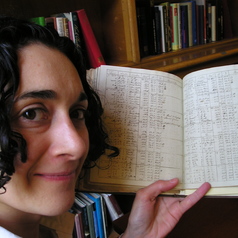
ARC DECRA Climate Research Fellow, School of Earth Sciences, University of Melbourne Dr Joëlle Gergis is a climate research scientist and writer working with Professor David Karoly at the University of Melbourne, Australia. Her research focuses on reconstructing Southern Hemisphere climate variability over the past 200–1,000 years using annually-resolved tree rings, corals, ice cores and historical records. From 2009–2012 she led the Australian Research Council Linkage funded South-Eastern Australian Recent Climate History (SEARCH) project; a landmark initiative, spanning the sciences and the humanities to reconstruct the region’s climate variability from first European settlement in 1788. Since 2009 Joëlle has led the international Past Global Changes (PAGES) working group on Australasian climate variability of the past 2,000 years (Aus2K). This involved coordinating the development of the region’s 1,000 year temperature reconstruction for input into the Intergovernmental Panel on Climate Change (IPCC) Fifth Assessment Report. Joëlle received her PhD in high-resolution palaeoclimatology from the University of New South Wales in 2006. Since 2003 she has authored over 60 articles on climate variability and change publications. Her work has been covered on national and international television (SBS World News, ABC, TVNZ), radio (ABC Radio National, AM, Bush Telegraph, Science Show, RRR) and print media (The Guardian, The Australian, The Age, Sydney Morning Herald and Australian Geographic). In 2007 she was one of three national finalists for the 2007 Eureka Prize for Young Leaders in Environmental Issues and Climate Change, and was one of nineteen Wentworth Group of Concerned Scientists’ Science Leaders Scholarship recipients selected nationwide. Professor Tim Flannery, the 2007 Australian of the Year, was one of her mentors during the program aimed at training outstanding young scientists to help bridge the communication gap between science and public policy. In 2012 Joëlle was awarded an Australian Research Council (ARC) Discovery Early Career Researcher Award (DECRA) fellowship, and her team won the 2014 Eureka Prize for Excellence in Interdisciplinary Scientific Research – informally known as the ‘Oscars of Australian Science’. Most recently Joëlle was awarded the 2015 Dean’s Award for Excellence in Research in the Faculty of Science at the University of Melbourne.
Lecturer in Education, University of Newcastle David Roy is a lecturer in Education and Creative Arts at the University of Newcastle. His research interests are in pedagogy and homeschooling, drama and arts learning, and dyspraxia and inclusion in Education. He was nominated for the 2006 Saltire/TES Scottish Education Publication of the Year and won the 2013 Best New Australian Publication for VCE Drama and/or VCE Theatre Studies. His most recent text is 'Teaching the Arts: Early Childhood and Primary’ (2015) published by Cambridge University Press.
Research Scientist of Forest Ecology, University of Washington I am a forest ecologist with a specialty in fire ecology. My main interests are in the effects of fire and other disturbances on forest dynamics, climatic change on forest ecosystems, and fuel treatment options to mitigate wildfire effects. I work with the Pacific Wildland Fire Sciences Laboratory (U.S. Forest Service) in Seattle, Washington and live full-time in the Methow Valley near Winthrop, Washington.
Winthrop Professor of Law, University of Western Australia Professor Stephen Smith was Federal Member for Perth for the Australian Labor Party from March 1993 until September 2013. In a distinguished career spanning 20 years in the Australian Federal Parliament, Professor Smith served as the Minster for Defence, and prior to that, as Minister for Foreign Affairs. In opposition, Professor Smith held a range of Shadow Ministerial positions including Shadow Minister for Trade, Shadow Minister for Resources and Energy, Shadow Minister for Communications, Shadow Minister for Health, Shadow Minister for Immigration, Shadow Minister for Industry, Infrastructure and Industrial Relations and Shadow Minister for Education and Training. Professor Smith is from Narrogin, in rural Western Australia and spent his early years in Narrogin and Southern Cross. He received his secondary school education at Christian Brothers High School Highgate in Perth. Professor Smith completed his Bachelor of Arts and Bachelor of Laws at the University of Western Australia and has practised as a Barrister and Solicitor in Perth. He then completed a Master of Laws in Public International Law at London University, and subsequently lectured and tutored in Law in London. From 1983 to 1987 Professor Smith was Principal Private Secretary to the Attorney-General of Western Australia. From 1987 to 1990 he was the State Secretary of the Western Australian Branch of the Australian Labor Party. During 1991 and 1992, Professor Smith was Special Adviser to the Prime Minister of Australia and Senior Adviser to the Deputy Prime Minister and Treasurer of Australia, Paul Keating. He is Chair of the Asia Desk of Perth Law firm Lavan Legal and a member of the Government and Public Sector Advisory Board for Ernst and Young Australia. He is a board member of the Perth USAsia Centre. Professor Smith is also on the board of Hockey Australia and maintains an active interest in cricket, hockey and Australian rules football. He is a proud member and keen supporter of the Fremantle Dockers football club.
Visiting Distinguished Professor of Environmental Studies, Brown University, USA, and Distinguished Professor, Public Health and Medical Anthropology, University of the Witwatersrand I was trained in Asian Studies, with my early field research in Peninsular Malaysia. Over the past four decades, I have worked as a medical anthropologist and social historian of medicine on questions of public health among diverse populations in Australia, east and southeast Asia, and increasingly in Africa. My fields of research include questions of gender, sexuality and reproductive health; infectious and chronic disease; access to and ideologies of medical and health care; and disability and inequality. My sustained commitment to build research capacity includes my life long work with higher degree students in and from resource-poor settings, my involvement in CARTA (Collaboration for Advanced Research and Training in Africa), and from 1988 to the present, my continuous collaboration with the WHO Special Programme for Research and Training in Tropical Disease. My broad interests extend to interdisciplinary collaborations in the social and biosciences, humanities and creative arts, for social justice, human rights, and sustainability. My key works include, in medical anthropology, Surface Tensions: Surgery, Bodily Boundaries and the Social Self; and in social history, Sickness and the State: Health and Illness in Colonial Malaya, 1870-1940. My latest work – The Routledge Handbook in Medical Anthropology – undertaken with Elizabeth Cartwright (Idaho State University) and Anita Hardon (University of Amsterdam) – was published in May 2016.
Reader in Neuroprosthesis, Newcastle University I am a reader in biomedical engineering and came to Newcastle in 2010 to develop world class collaborations between the school of EEE and the Institute of Neuroscience. I have a BSc (1st class) and MRes in applied physics from Liverpool University, and a PhD in bioimaging from the Japan Advanced Institute for Science and Technology. After some time in the software industry, I did two post-doctoral projects at Imperial College before getting an RCUK fellowship in 2005. From 2005-2010 I was a lecturer and then senior lecturer in Imperial College, before coming to Newcastle. In my time I have had numerous research awards and published numerous papers in the key journals in the biomedical field. At the heart of these efforts is my pioneering use of CMOS-micro-LED optoelectronics in combination with optogenetic gene therapy solutions. These will lead to highly advanced forms of prosthetic intervention not previously possible. This has led to a number of highly cited papers in key biomedical engineering journals. Furthermore I have explored impact through patient trials and commercial translation. To achieve my aims I have been part of a number of large research consortia. Between 2010-2014 I coordinated the FP7 OptoNeuro project. More recently I am the engineering team leader on the £10M CANDO project to develop a next-generation prosthesis for epilepsy. Currently I have a large highly dedicated team of RAs, and PhD students.