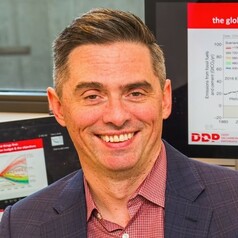
Research Fellow in Energy and Climate Policy, Columbia University Dr. Chris Bataille has been involved in energy and climate policy analysis for 26 years as a researcher, energy systems and economic modeler, analyst, writer, project manager, managing consultant, and founding partner. His career has been focused on the transition to a globally sustainable energy system, more recently technology and policy pathways to net-zero GHG emissions by all sectors by 2050-‘70 to meet the Paris Agreement goals. He is an Associate Researcher at the Institute for Sustainable Development and International Relations (IDDRI.org) in Paris working on the Deep Decarbonization Pathways project (DDPinitiative.org), and an Adjunct Professor at Simon Fraser University. Chris was a Lead Author for the Industry Chapter of the 6th cycle of the IPCC Assessment Report 2019-2022, as well as the Summary for Policy Makers and Technical Summary. He manages an ongoing global project to review technology and policy options for net-zero decarbonization of heavy industrial sectors, including the global Net Zero Steel project (netzerosteel.org), which has produced facility level, geospatial net zero pathways for the global steel industry. Chris is continuing his focus on industrial decarbonization at CGEP.
Carlos Gardeazábal Bravo’s scholarship intersects contemporary Latin American literature and film, the cultural politics of emotion, human rights narratives, ecocriticism, and critical theory. Examples of such intersections are the co-edited volume (with Kevin Guerrieri) Human Rights in Colombian Literature and Cultural Production: Embodied Enactments (Routledge 2022) and two academic dossiers published last year on humanitarianism and representations of violence. Gardeazabal Bravo is currently an Assistant Professor of Spanish at the University of Dayton’s Department of Global Languages and Cultures, where he collaborates in the Latinx and Latin American Studies program. He teaches a wide variety of courses on Latin American culture, human rights narratives, and race and ethnic studies. He received his Ph.D. in Spanish studies specializing in Latin American Literature, and a Graduate Certificate in Human Rights from the University of Connecticut (2018). Prior to this, he earned an MA in Hispanic Linguistics from the Instituto Caro y Cuervo and a BA in philosophy from the Universidad Nacional de Colombia.
My research focuses on issues around Chinese governance, state-society relations and political economy, particularly in thr policy fields of cultural heritage and demographic change.
I am Associate Professor in Private Law and Technology and Principal Investigator of the ERC Starting Grant HUMANads, focused on understanding the impact of content monetization on social media and on reinterpreting private law fairness in the context of platform governance. Between 2016-2021 I was Assistant Professor at the Faculty of Law at Maastricht University, and during February 2018 - February 2019, I was a Niels Stensen fellow and visited the University of St. Gallen (The Institute of Work and Employment) and Harvard University (The Berkman Center for Internet and Society). I'm also a non-residential fellow of the Stanford Transatlantic Technology Law Forum. My research follows three main themes: Content/web monetization and social media governance - the Internet is helping regular users make money in ways that did not exist 10 years ago, such as influencer marketing or ad revenue. In this context, I use doctrinal legal methods to critically reflect on existing and desirable regulatory frameworks surrounding online harms (e.g. content moderation; platform discretion; misleading advertising). To bring together complementing disciplines contributing to this field, I also established and coordinate, with Jerry Spanakis, the Computational Social Media research group. Privacy, cryptography and decentralization - it is expected that the new age of the Internet will be rooted in technologies meant to enhace privacy, or decentralize decision-making. In this context I use legal and social science approaches to the study of cryptocommunities (e.g. dark web market places). Digital monitoring tools for consumer protection - the enforcement of law through public interest technology is one of the most essential legal topics of the coming decade. By collaborating with experts in Natural Language Processing and Privacy and Security, I am contributing to the development of tools which can be used by public institutions (e.g. detecting influencer marketing business models on Instagram). I have the priviledge of supervising four very talented researchers in their PhD research: Thales Bertaglia (computer scientist working on computational social media studies), Maastricht University Constanta Rosca (legal scholar working on dark patterns and EU consumer law), Maastricht University Alex Sotropa (legal scholar working on computational antitrust and consumer protection), VU Amsterdam Jacob van de Kerkhof (legal scholar working on freedom of expression in US/EU), Utrecht University
Charlène Aubinet is a postdoctoral researcher in the Psychology and Neuroscience of Cognition Research Unit and in the Coma Science Group – GIGA-Consciousness at ULiège. She was graduated in 2020, with a PhD on residual language abilities in patients with disorders of consciousness. Her postdoctoral research mainly aims to dissociate language and consciousness impairment and recovery in these post-comatose patients with severe brain injury. Her interests include the validation of behavioral and language-specific assessment tools, neuroimaging research and language rehabilitation in this challenging population, as well as consciousness and implicit/explicit language processes.