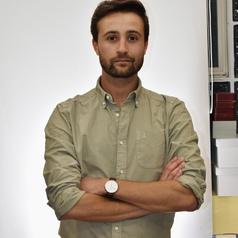
Doctorando en biomedicina y oncología molecular, Universidad de Oviedo Graduado en Ciencias Biomédicas por la Universidad de Lleida. Promoción 2013 - 2017 Máster en Biomedicina y Oncología Molecular por la Universidad de Oviedo. Promoción 2017-2018 Doctorando en el Programa de Doctorado Oficial en Biomedicina y Oncología Molecular de la Universidad de Oviedo, investigando en cáncer y envejecimiento en el Laboratorio del Doctor Carlos López Otín
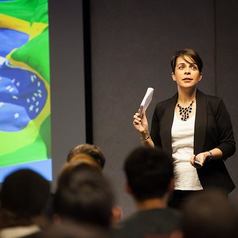
Senior lecturer, UNSW Sydney Deborah Barros Leal Farias is a Brazilian-born Senior Lecturer of Politics and International Relations at UNSW Sydney, and co-director of its Globalisation and Governance Network.
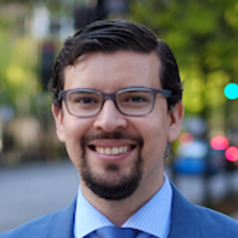
Associate Professor of Computer Science, Affiliate Professor of Information Science, University of Colorado Boulder Daniel Acuña is an Associate Professor in the Department of Computer Science at the University of Colorado at Boulder. He leads the Science of Science and Computational Discovery Lab. He works in science of science, a subfield of computational social science, and A.I. for science. He writes papers and builds web-based software tools to accelerate knowledge discovery. Daniel’s research aims to understand historical relationships, mechanisms, and optimization opportunities of knowledge production. Daniel harnesses vast datasets about publications and citations and applies Machine Learning and A.I. to uncover rules that make publication, collaboration, and funding decisions more successful. Recently, he has been interested in biases in artificial intelligence and developing methods for detecting them. In addition, he has created tools to improve literature search, peer review, and detect scientific fraud. He has been funded by NSF, DDHS, Sloan Foundation, and DARPA through the SCORE project, and his work has been featured in Nature News, Nature Podcast, The Chronicle of Higher Education, NPR, and the Scientist. In addition to his research, Daniel enjoys building communities around science of science and research integrity. He co-organizes the Science of Science Summer School (S4), the Computational Research Integrity (CRI-CONF) conference, and the Computational Research Integrity competitions. In addition, he is part of the ACM’s Diversity, Equity, and Inclusion (DEI) council, contributing to the social justice initiative on publications, awards, and peer review. Before joining Syracuse University, Acuña studied a Ph.D. in Computer Science at the University of Minnesota - Twin Cities and was a postdoctoral researcher at Northwestern University and the Rehabilitation Institute of Chicago. During his graduate studies, he received a NIH Neuro-physical-computational Sciences (NPCS) Graduate Training Fellowship, NIPS Travel Award, and a CONICYT-World Bank Fellowship. Daniel was born in Santiago, Chile, where he attended the University of Santiago.
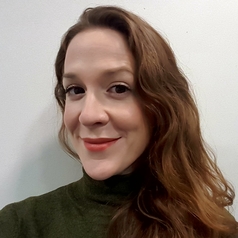
Postdoctoral Researcher, Trinity College Dublin, Trinity College Dublin Prior to commencing her PhD under the supervision of Professor Robbie Gilligan at Trinity College Dublin's School of Social Work and Social Policy, Derina spent three years living on the Thailand-Myanmar border. There she collaborated with refugee and migrant groups on culturally appropriate and sustainable psychosocial care programmes for children and youth. Prior to this Derina ran her own play therapy practice in Dublin. Derina obtained her Bachelor of Arts (Honours) in Psychology from University College Dublin, and studied Play Therapy and Psychotherapy at the Children’s Therapy Centre with Eileen Prendiville. Derina's PhD research explored the lives of young people growing up in legal and social marginalisation on the Thailand-Myanmar border. Drawing from 11 months' fieldwork, the research provides a glimpse into the realities of growing up in displacement and lack of documentation; as an “illegal migrant”, facing restricted mobility, limited access to education and other essential services, narrow migrant labour market demands, and everyday vulnerability to exploitation and poverty. The research revealed nuanced insights into the legal and social precarity which characterises the young people's lifeworlds and ways of being in the world, and the normalisation of suffering and struggle in the quest to create a better future for them and their families. Within this extreme adversity, optimism and pragmatism, resistance and endurance, determination and flexibility emerged as key facets of the young people’s engagement in their worlds, as well as their agency and resilience in the face of certain uncertainty., Derina continues to work at Trinity College Dublin, as a postdoctoral researcher at the School of Medicine (Paediatrics) and Trinity Research in Childhood Centre, and as project manager of the Horizon 2020 funded energy efficiency socio-economic research project CONSEED.
Visiting Researcher, University of Huddersfield My PhD examined the historical, sociological and cultural machinations of cricket in southern England, with a particular emphasis upon the philosophical origins of amateurism, how amateurism was used as a means of class distinction and the influence this had upon the development of regional identities. My post-doctoral work aims to investigate (amongst other things) the links between social class, the suburbanisation process and cultural change. I am also writing a social history of English cricket, with a particular emphasis upon amateur cricket – the game as played and watched by the vast majority of the sport's followers – and the relationship this level of cricket had with the so-called 'first class' game.
Music psychologist, University of Cambridge My research examines musical behavior at the intersection of personality, social, and cognitive science. It begins from that standpoint that differences in musical experience are not random, but are rather tied to various psychological and cultural processes. Recently, our work has shown that personality and cognitive styles predict musical preferences and musical ability. We also explore a range of other topics including musical talent and skill in autism, how music is linked to resilience and well-being, and whether music can increase empathy and communication skills.