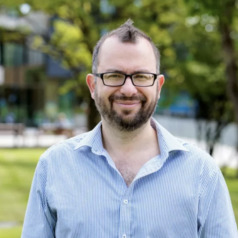
Professor of Nutrition Science and Policy, Tufts University Paul F. Jacques is Senior Scientist and Team Leader of the Nutritional Epidemiology Team at the HNRCA. His research interests include B vitamins, whole grains, flavonoids, hydration, diet patterns and diet quality, and their relation to maintenance of metabolic, cognitive and physical function with aging. Jacques has published more than 300 peer-reviewed manuscripts of original research over his career and has made many important discoveries in the field of nutritional epidemiology.
Associate Professor of English, Arizona State University Patrick Bixby (he/him/his) is an associate professor of English in the New College of Interdisciplinary Arts and Sciences at Arizona State University. After earning a BA in psychology from the University of California, Los Angeles and a MA in English from California State University, Long Beach, Bixby completed his PhD in English at Emory University in 2003. He served as visiting assistant professor of literature at Claremont McKenna College for one year and then joined the faculty of ASU’s New College, where he has held a number of posts. In 2017, after directing several graduate programs and then serving as director of graduate studies for the college, he took a role building partnerships between the university and Arizona tribal communities, as well as other universities around the globe. Most recently, in 2021, he became the program lead for the BA in Disability Studies. In addition to these duties, he currently serves as vice president of the Samuel Beckett Society and resident director of the USAC summer school program at NUI Galway. Bixby's scholarly interests span a variety of fields, including Irish studies, modernist studies, postcolonial theory and criticism, Continental philosophy, and issues of travel, mobility, and the body. He teaches courses in these fields and in the history of the novel, the history of film, the history of literary criticism, twentieth-century thought, postmodernism, and methods of interdisciplinary research. His essays have appeared in journals such as Modernism/Modernity, Modernist Cultures, Irish Studies Review, and the Journal of Beckett Studies, as well as in collections such as A History of Irish Modernism (Cambridge UP, 2019), A History of the Modernist Novel (Cambridge UP, 2015), Beckett in Context (Cambridge UP, 2013), and Beckett and Ireland (Cambridge UP, 2010). Bixby's latest book, License to Travel: A Cultural History of the Passport (U of California P, 2022), investigates the unyielding paradox of the document: even as it promises independence and mobility, escape and safe haven, the passport also serves as an essential tool of government surveillance and state power, purportedly assuring homeland security and the controlled movement of individuals across national boundaries. The study investigates this paradox by drawing on a range of sources, including literary history and modern art, archival documents and contemporary journalism, international law and theories of cosmopolitanism.
Phil Tomlinson is Professor of Industrial Strategy and Deputy Director of the Centre for Governance, Regulation & Industrial Strategy (CGR&IS) in the School of Management at the University of Bath. His research explores the interplay between economic governance, innovation, regional development and place-based industrial strategy. He has published widely and extensively, with over 80 career research publications in leading academic journals, books and book chapters, industry reports and media outlets. Professor Tomlinson has held several external appointments including with the UK All- Party Parliamentary Manufacturing Group (APMG), the Independent Local Industrial Strategy Review Panel for Swindon and Wiltshire LEP (SWLEP) and he is currently a member of the West of England’s Skills Advisory Panel (SAP). He is an Editor for the journal Competition and Change, and he is the Policy Debates Editor at Regional Studies.
Professor of Sociology, University of Surrey Paul Hodkinson is Professor of Sociology at the University of Surrey. His research focuses on fathers and fathering, youth cultures, pathways through adulthood and experiences of digital social media spaces. He is particularly interested in understanding people's experiences of contemporary life course journeys and transitions. His books include 'New Fathers, Mental Health and Digital Communication' (with Ranjana Das), 'Sharing Care: Equal and Primary Carer Fathers and Early Years Parenting' (with Rachel Brooks), 'Media, Culture and Society', 'Ageing and Youth Cultures' (with Andy Bennett), 'Youth Cultures: Scenes, Subcultures and Tribes' (with Wolfgang Deicke) and 'Goth: Identity, Style and Subculture'. He is currently co-editor of the journal, Sociology, and was previously co-editor of Sociological Research Online.
Associate Professor of History, University of Stirling I was born in St Petersburg, Russia and began my university career at the Hebrew University of Jerusalem, where I pursued two concurrent degrees in History and Violin Performance. I received my PhD in Medieval History from the Centre for Medieval Studies at the University of Toronto (2008). Before joining Stirling in 2018, I spent two years as a postdoctoral fellow at the Economic Growth Center, at Yale University (2008-10), three years as a Mellon Fellow and faculty lecturer at McGill University, Montreal (2010-3) and five years as a lecturer and then senior lecturer at the University of Kent (2013-8). When outside a classroom or his office, I enjoy listening to and playing music (be it Classical, Jazz, Rock or Folk), tasting ales and whiskies (the more obscure the better), cooking, and hiking (the further away from 'Civilization' the better). I love languages and have always been attracted to their beauty, written or spoken. My scientific creed and research interests Rather than seeing myself as an historian in the ‘traditional’ sense, I view myself as a ‘scientist of the past’, trained to work across disciplines and collaborate with colleagues in sciences, to promote a unified knowledge and science of the past. In my research, I use historical knowledge as a powerful tool to understand some of the most important issues and challenges that the human race and its wider bio-ecological environment face today. My principle research interests fall into two main categories. Firstly, I am interested in the history of natural environment, economy, health, and society of the late-medieval world, with a particular focus on the British Isles within the wider North Atlantic context, and Central Asia within the wider Eurasian context. My first monograph Bread and Ale for the Brethren: The Provisioning of Norwich Cathedral Priory, c.1260-1536 (2012) offers a re-interpretation of the decline of feudal system in England, through the prism of food production and consumption by local landlords. My second monograph Experiencing Famine: A Fourteenth-Century Environmental Shock in the British Isles , recently published with Brepols, examines the Great European Famine of 1315-17 (arguably the single worst subsistence crisis in Europe in the last two millennia) as a case-study to answer the most pressing question ‘What creates famine?’ In addition, I have authored (and in some cases co-authored) 34 articles on various topics related to environmental, economic and social history of late-medieval world. Secondly, in recent years I have expanded my interests in these topics to a global ‘deep history’ perspective, all the way from early hunters-gatherers to our contemporary world. These topics are among the most pressing and complex socio-economic, environmental and political issues that scientists, NGOs and policy makers are struggling with today. Before these issues can be solved, we need a better understanding of their determinants and dynamics in a long-run historical context. I am currently working on two large-scale monograph projects. The one will examine the historical roots of global economic inequality, in a very long run. It argues that we cannot fully appreciate the phenomenon of global economic inequality, unless we study the development of socio-economic and cultural institutions from a ‘deep history’ perspective, which follows this development from early hunter-gatherer societies to our contemporary world. The other monograph is a global history of the single most notorious killer: plague - all the way from the Late Neolithic Period until sporadic outbreaks in the 21st century. This book, too, takes a deep history perspective, to answer some most pressing questions related to the phenomenon of ‘emerging diseases’, such as ‘What makes some diseases so deadly?’ ‘What is the relationship between emerging diseases and a wider bio-ecological and climatic environment?’ ‘What makes those diseases fade and disappear – or, by contrast – re-emerge again?’ I welcome enquiries from prospective research students interested in the environmental, economic, social and medical history of late-medieval and early modern British Isles and other parts of the European and North Atlantic world. Publications