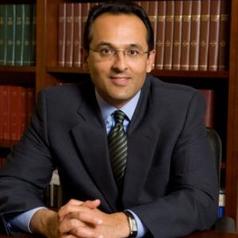
Chief of Medicine, University of Michigan Sanjay Saint, MD, MPH, is the George Dock Professor of Internal Medicine at the University of Michigan, the Director of the VA/University of Michigan Patient Safety Enhancement Program and the Chief of Medicine at the Ann Arbor VA Medical Center. His research focuses on preventing healthcare-associated infection, implementation science, and medical decision-making. He has authored over 275 peer-reviewed papers with nearly 100 appearing in the New England Journal of Medicine, JAMA, Lancet or the Annals of Internal Medicine. He is a Special Correspondent to the New England Journal of Medicine, an editorial board member of the Annals of Internal Medicine, and an elected member of the American Society for Clinical Investigation (ASCI). He received the Mark Wolcott Award for Clinical Excellence as the Department of Veterans Affairs National Physician of the Year. He is also the lead author of a book recently published by Oxford University Press entitled: “Preventing Hospital Infections: Real-World Problems, Realistic Solutions.” He received his Medical Doctorate from UCLA, completed a medical residency and chief residency at the University of California at San Francisco (UCSF), and obtained a Masters in Public Health (as a Robert Wood Johnson Clinical Scholar) from the University of Washington in Seattle. He has been a visiting professor at over 60 universities and hospitals in the United States, Europe, and Japan, and has active research studies underway with investigators in Switzerland, Italy, Japan, Australia, and Thailand.
Lecturer, Department of Social Inquiry, La Trobe University Sara is a cultural sociologist. Her research interests include work, identity, disenchantment and authenticity. Her forthcoming book is about the significance of work in the lives of contemporary Australians, with a focus on vocation and the work ethic. Sara is co-convenor of the TASA Cultural Sociology Thematic Group. She also undertakes research in higher education pedagogy.
Samuel is an ESRC funded doctoral researcher based in the Sussex Centre for the Study of Corruption (SCSC) interested in party funding regimes and corruption in Western Europe. His thesis is titled: Party Funding Regimes and Corruption: Linkages, Relationships and Trends. The research is a comparative study of three advanced democracies in Western Europe (Denmark, France and the UK) and investigates whether a certain type of party funding regime (e.g. public or private funding) leads to the prevalence of a certain type of corruption. There has been little research - academic or otherwise - which attempts to investigate these linkages, the hypothesis is that certain types of party funding regime are not necessarily more corrupt than other types; but that perhaps different types of corruption occur in different types of party funding regime. It is important to understand more about how democracy is funded and how that might lead to specific types of corrupt practices.
I am currently working on the following areas in macroeconomics: social welfare measures derived from utility, implications of distorted steady states (including inflation bias) and distortionary shocks (e.g. UIP shocks) , stability under alternative monetary regimes, monetary and fiscal policy interaction, fiscal policy as a stabilisation tool, optimal debt stabilisation, alternative fiscal institutions, equilibrium exchange rates, and the methodology of macroeconomics.
Dr Sarah Kaine lectures in HRM and IR in the UTS Business School. Her research focuses on several broad themes: employee representation, the development and exercise of employee voice, the formal and informal regulation of employment relations and HRM and sustainability. Specifically Sarah is interested in innovation in employment regulation – beyond the bounds of traditional labour law, Corporate Social Responsibility and its link to industrial relations and the role of leadership in promoting sustainability and CSR. Prior to becoming an academic Sarah worked as an industrial relations practitioner and a consultant to not-for-profit organisations.
Sara Hagemann is Assistant Professor at London School of Economics and Political Science, where she joined the European Institute in September 2009. In her work, Sara draws on a mix of academic and policy experience as she has held research and policy positions in Brussels, Copenhagen and London. Sara has published extensively on European affairs, in particular on transparency and accountability in political systems, EU policy-making processes, EU treaty matters, the role of national parliaments, and the consequences of EU enlargements. Sara is a frequent commentator on EU affairs in both international and national media. She is the Co-Founder and General Editor of the LSE’s popular European Politics blog EUROPP. Before joining LSE, Sara worked as a Policy Analyst at the Brussels-based European Policy Centre (EPC), where she was responsible for its Political Europe programme. She has also held posts at the Centre for European Policy Studies (CEPS), and in the Danish Ministry of Foreign Affairs. Sara is the Co-Founder and former Managing Director of VoteWatch.eu (www.votewatch.eu) an online initiative that monitors EU decision-makers’ voting records. She is currently the Treasurer and Vice-Chair of the organisation. Sara has been awarded an ESRC Impact Accelerator Grant through the LSE’s Institute of Public Affairs, due to commence in September 2016 until July 2018.