


 Fast Retailing Raises Full-Year Forecast After Uniqlo Owner Beats Q3 Profit Estimates
  Goldman Sachs Says China Competition Weighs More on EU Growth Than Trade Deficit
  Samsung Chairman Lee Jae-yong Expected to Meet Nvidia CEO Jensen Huang on AI and Chip Partnership
  Levi Strauss Raises 2026 Outlook After Q2 Earnings Beat, Shares Drop Despite Strong Results
  SK Hynix Soars 13% in Nasdaq Debut After Record $26.5 Billion IPO
  Deutsche Bank Fined A$2 Million by ASIC Over OTC Derivatives Reporting Errors
  US Inflation Expected to Ease in June, but Fed Rate Hike Risks Persist Amid Middle East Tensions
  Mastercard Explores Sale of Majority Stake in UK Payments Firm Vocalink: Report
  Samsung to Launch First Yongin Chip Plant by 2029 as South Korea Speeds Up Semiconductor Hub
  Muji Owner Ryohin Keikaku Stock Soars After Raising Full-Year Earnings Forecast
  TSMC Q2 Revenue Surges 36% as AI Chip Demand Powers Growth Ahead of Earnings
  Paramount-Warner Bros. Discovery Merger Faces Lawsuit From 12 States
  Goldman AM Sees Strong Buyout Opportunities in Japan, South Korea and Australia
  DOJ Grand Jury Investigates UAW President Shawn Fain Ahead of Union Election
  Vietnam’s population hit the 100 million milestone. Where’s it headed?




China is attempting to recover the first ever soil and rock samples from the lunar far side. The surface mission, Chang’e 6, named after the Chinese Moon goddess Chang’e, is a predecessor to the successful sample return mission, Chang’e 5, and a part of the Chinese lunar exploration programme.
The mission is set for launch using a long March 5 rocket at the Wenchang satellite launch centre in Hainan province on May 3. The spacecraft due to land on the Moon is projected to weigh 3,200kg carrying scientific equipment from France, Italy and the European Space Agency.
Chang’e 5 was the first lunar sample-return mission since the Soviet Union’s Luna 24 in 1976. Chang’e 5 was hugely successful, returning 2kg of material from the near side. This material led to important scientific discoveries, such as the youngest lunar material ever discovered. Previously we only had much older samples returned from the Apollo missions and sampled meteorites. The younger material retrieved by Chang’e 5 helped scientists confirm the predicted ages of impact craters on the Moon.
The spacecraft will reach the Moon in approximately 53 days and aims to collect around 2kg of material from 2m below the surface. Chang’e 6 will attempt to land in the southern hemisphere, specifically, the southern portion of the Apollo crater, which resides within the South Pole-Aikin impact basin.
This impact basin, created by a large meteorite crashing into the Moon, is thought to be the largest (2,400km), deepest (6.2-8.2km) and oldest (4.3 billion years old) on the Moon.
Large meteorite collisions with the surface of the Moon can potentially strip away the crust – outermost layer of the surface – and eject fragments of deeper-forming materials. This means that studying the basin could help us learn more about what resides in the depths of the Moon.
These deeper-forming materials, known as mantle-like material or dunite, are dominated by a mineral called olivine. Mantle-like materials in the Solar System, let alone the lunar meteorite record or returned samples, are extremely rare.
Potential discoveries
One of the first mantle fragments of the Moon has been recently discovered in a meteorite, named Northwest Africa 11421. This small fragment (0.7cm in length) is thought to have formed at a depth of roughly 88km below the surface of the Moon (give or take 22km).
However, contamination of meteorites from Earth’s atmosphere can result in anomalous results, especially in the hydrogen contents of the sample.
While Apollo 17 also brought back an olivine-rich sample, it is not yet clear whether or not this material is derived from the mantle. In any case, these samples may be similar to those brought back from the Chang’e 6 mission.
Scientists haven’t been able to determined the mineral abundances and chemistry of the Moon’s mantle. Lunar mantle material will provide a window into fundamental planetary processes such as unravelling the timing and mechanisms of the Moon’s geological evolution.
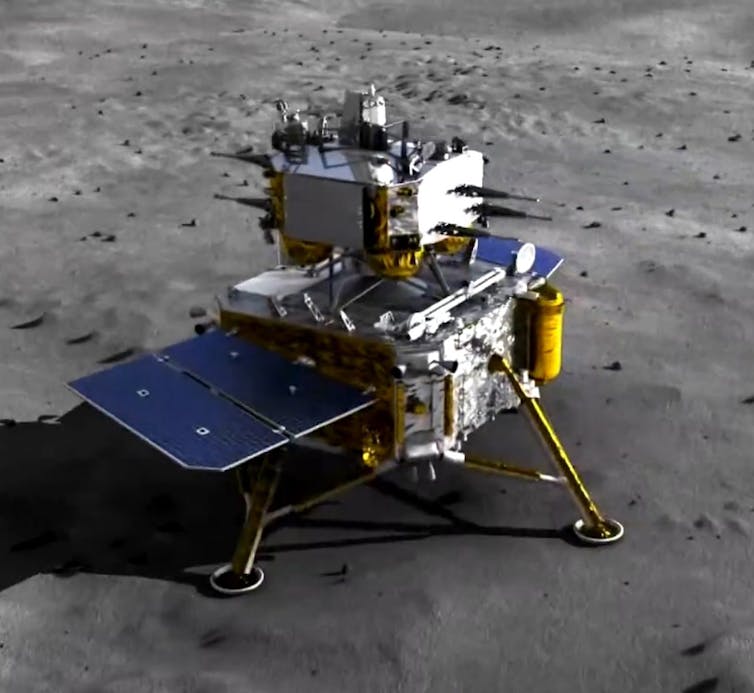
Artist’s impression of the lander. wikipedia, CC BY-SA
Chang’e 6 is one of the most exciting missions of 2024, and scientists dearly hope for a successful launch this week. Many of us, including myself, are extremely excited to see the preliminary results.
And the journey for Chinese lunar exploration doesn’t end there. In 2026, Chang’e 7 is similarly heading to the south polar region of the Moon. However, Chang’e 7 will carry 21 scientific payloads, inclduing a relay satellite, an orbiter, a lander, a rover, and a small flying probe, with the aim of landing the first lunar rover.
This mission will also carry “mini-hopping probes” to investigate the permanently shadowed regions of the Moon where ice made of water may reside – a potentially crucial resource for future crewed missions to the Moon.
These missions solidify China’s hopes of send humans back to the Moon by 2030. It is a truly fascinating time in planetary science and exploration.







