


 Kevin Warsh Faces Early Fed Test as Inflation Risks Challenge Rate-Cut Expectations
  RBNZ Holds Interest Rates Steady but Signals More Hikes Ahead in 2026
  BoE Policymaker Alan Taylor Signals No Need for Interest Rate Hike Amid Iran War Inflation Risks
  Vietnam Prioritizes Fiscal Stimulus as Monetary Policy Space Narrows
  Oil Prices Rise as Iran-Israel Tensions Ease Following Trump-Led Ceasefire Push
  Canada-Indonesia Trade Pact Gains Momentum as Carney and Prabowo Discuss Economic Cooperation
  South Korea Central Bank Holds Interest Rates Steady Amid Inflation Concerns
  Dollar Near Two-Month High as Strong U.S. Jobs Data Boosts Fed Rate Hike Expectations
  BOJ Signals Possible Rate Hike as Middle East Tensions Fuel Inflation Concerns
  BOK Seen Holding Interest Rates Steady as Inflation Risks Rise in South Korea
  Indian Companies Battle Rising Costs as Oil Prices, Freight Rates and Inflation Pressure Margins in 2026
  RBI Holds Interest Rates at 5.25%, Cuts India Growth Forecast Amid Rising Global Risks
  US-Iran Gulf Clash Raises Oil Market and Defense Stock Concerns


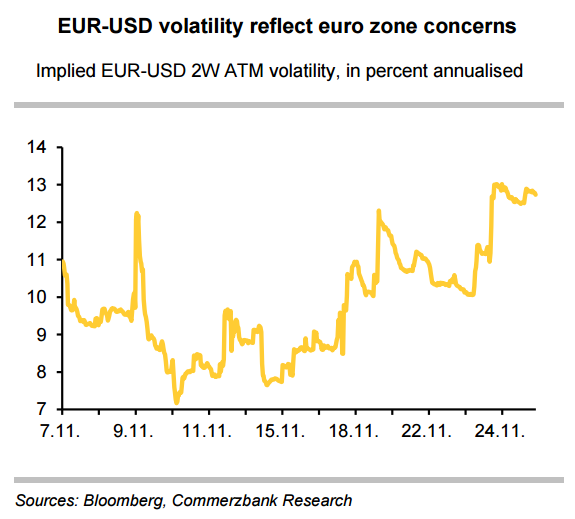
ECB meeting on 8th December will be largely influenced by developments in Italy's politics as we head into Italian referendum scheduled to take place on 4th December. At its semi-annual financial stability report last week, the ECB expressed concern regarding the possible unrest a 'No' vote could cause in the financial markets. ECB's Vice-President Vítor Constâncio underlined that the central bank would react to “shocks” caused by the Italian referendum.
Prime Minister Matteo Renzi has renewed pledge to resign if he loses the upcoming constitutional referendum. Opinion polls indicate a 4-5pp lead for the 'No' side, but polling uncertainty and a large share of undecided voters mean that the actual results can go either way.
A 'No' vote may not be a big surprise but is still likely to have a major impact on Italian politics, the banking sector and financial markets. The Italian government has been struggling to address weakness in the banking sector even before the referendum. A 'No' vote would weaken the government and make efforts even harder, while capital for the banks via the private sector would be even harder to find.
A 'Yes' vote on the other hand, will be a better start, but it will be hard to see any quick improvements in the Italian outlook. Markets are likely to retain a cautious view on Italian assets, at least until the political situation and foremost the outlook for the banking system clears.
The implied EUR-USD volatility recently rose to the levels seen during the rather volatile US election night. Italian politics may become decisive for the ECB meeting on 8th December. ECB stands ready to temporarily step up purchases of Italian government bonds if referendum rocks market. The European Central Bank meets on Dec. 8 and is widely expected to extend its bond-buying program.
"We expect the ECB to announce an extension of its bonds purchasing programme beyond March 2017 at its last meeting of the year. This step is likely to become even more urgent if it has to stop a further rise of yields on Italian government bonds," said Commerzbank in a report.
EUR/USD was trading at 1.0640 at around 1215 GMT. FxWirePro's Hourly EUR Spot Index was at 58.6504 (Neutral) and Hourly USD Spot Index was at 25.7542 (Neutral) at 1215 GMT. For more details on FxWirePro's Currency Strength Index, visit http://www.fxwirepro.com/currencyindex.







