


 Thailand Inflation Remains Negative for 10th Straight Month in January
  China Extends Gold Buying Streak as Reserves Surge Despite Volatile Prices
  Elon Musk’s Empire: SpaceX, Tesla, and xAI Merger Talks Spark Investor Debate
  Global Markets Slide as AI, Crypto, and Precious Metals Face Heightened Volatility
  U.S. Stock Futures Slide as Tech Rout Deepens on Amazon Capex Shock
  South Korea’s Weak Won Struggles as Retail Investors Pour Money Into U.S. Stocks
  Bank of Japan Signals Readiness for Near-Term Rate Hike as Inflation Nears Target
  Dollar Steadies Ahead of ECB and BoE Decisions as Markets Turn Risk-Off
  Gold and Silver Prices Slide as Dollar Strength and Easing Tensions Weigh on Metals
  U.S.-India Trade Framework Signals Major Shift in Tariffs, Energy, and Supply Chains


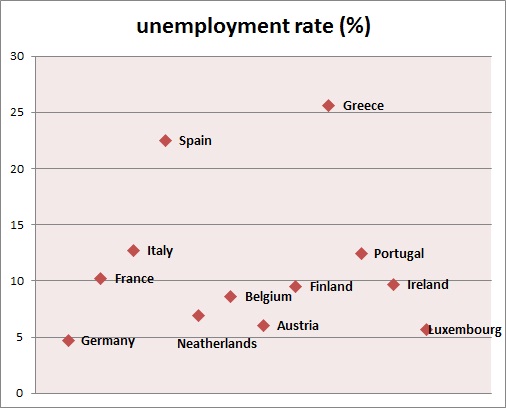
At the peak of the crisis, unemployment in U.S. was hovering around 10%, which is clearly not being considered as healthy and Federal Reserve has taken unprecedented steps in monetary policy easing to tackle the unemployment, since dual mandate of FED includes maximum employment possible under price stability. Unemployment rate in Euro zone currently stands at 11.1%.
However on the other hand European Central Bank (ECB) has also taken up unconventional policy easing but at the sake of fragmentation.
However, without any central co-ordination from the fiscal side ECB alone is unlikely to succeed even if it wants to lower unemployment.
As of now, it is quite clear from the unemployment rate that Euro zone is far away from economic activities which can be labelled as normal.
European Central Bank (ECB) and fiscal authorities need not only to focus on monetary policy fragmentation but employment fragmentation.
- As of latest report, unemployment rates are extremely fragmented. While unemployment rate is at 4.7% in Germany, 5.5% in Malta, 5.7% in Luxembourg, 6% in Austria, rates are way higher in France (10.2%), Italy (12.7%) and Spain (22.5%). We are not even talking Greece and youth unemployment.
Unless this issue is tackled, Euro zone will keep facing challenges from Euro-skeptics, who are clearly on the rise across Europe.













