It makes no sense to keep exploiting natural resources to feed an ever-consuming market, but this remains the nature of high-street fashion. Resources are finite - as is the space for landfill - but too often clothes shopping is about buying cheap soulless garments that end up being thrown away and not recycled.
The modern fashion business is too often about forgettable commodities that exist solely for the sake of consumption. And in 2020, online sales grew at their fastest rate since 2007. Given that online shopping returns often end up in landfill without even making it to anyone’s wardrobe, this looks like a step in the wrong direction.
Many argue that, after the pandemic, we need to shift towards a circular economy in which waste and pollution are removed from the system. Here, then, are four examples of clothing businesses that have been using lockdown to put this ideal into practice.
Making children sustainable
Marketers view the early years of childhood as a golden opportunity for getting mums and dads to buy more stuff – not least because young children grow so fast. New parents are targeted with endless cute clothes and commodities for child-rearing, being constantly told that such purchases are essential to good parenting.
Many parents do turn to sharing networks to get some of the things they need secondhand – but one designer has come up with a different answer. London-based Ryan Mario Yasin, who won the James Dyson Award in 2017 for innovative problem solving, designs clothes that grow with the child.
Inspired by the Japanese fashion designer Issey Miyake, who developed flexible pleating initially for ballet dancers, this revolutionary concept applies engineering principles to material.
Yasin’s children’s garments, which are branded Petit Pli, stretch to fit kids aged three months to three years – offering parents a sustainable alternative to disposable clothing. More recently he has also added unisex adult clothing to his collection, marketing this new range as clothes that are built to last.
Vigga is another operator that is trying to make children’s clothing more sustainable, but in a different way. The Danish company offers a subscription-based rented clothing line for infants and small children.
Parents who subscribe to this service receive clothing every three months in the early years as their baby grows, and less frequently thereafter. When the clothes are returned to Vigga, they are washed and repaired for further use. This reflects a circular system where every garment is used several times, ensuring a lower environmental impact.
A different kind of mall
In the small Swedish city of Eskiltuna, a few kilometres west of Stockholm, is the world’s first recycling mall. Known as ReTuna Återbruksgalleria, all the clothes sold are recycled, while other products, including foods, are organically sourced or sustainably produced. The mall opened in 2015 and is deliberately located next to the town’s recycling centre, which makes it a convenient destination for the shops in the mall to pick up materials for their businesses.
The idea was driven by local politicians with the ambition for Eskilstuna to be a good example of addressing the challenges of sustainability. Store owners and employees go through all the donated goods to see what can be repaired, fixed and converted for selling.
With close links to the local school, the mall also provides workshops, lectures and themed days to educate wider society on sustainability practice. And note that this encourages people into the physical space - a strategy that could be useful to draw shoppers back to UK high streets after the pandemic.
The ‘For Days’ model
US clothing firm For Days was inspired by the volume of clothing hoarded in consumer wardrobes. In acknowledging that we need to buy less, For Days encourages customers to send their old clothes in the post. It doesn’t matter whether they were made by For Days in the first place, and people receive money-off vouchers for new items in return.
The whole approach is that nothing ends up in landfill. For Days sorts the donated clothes into colours and then mechanical recyclers convert them into new materials to be used to make new clothes. Clothes can be donated in any condition – which is important, considering the low quality of many fast-fashion garments. For Days is also carbon neutral, minimising waste with reusable packaging and carbon offsetting.
If the circular economy is to succeed, of course, consumers have to embrace it. The inevitable problem is that each of these four models is slightly more expensive than the mass market, and the rock-bottom prices of fast-fashion clothes have reduced the threshold that the average consumer would see as the maximum they would pay for something.

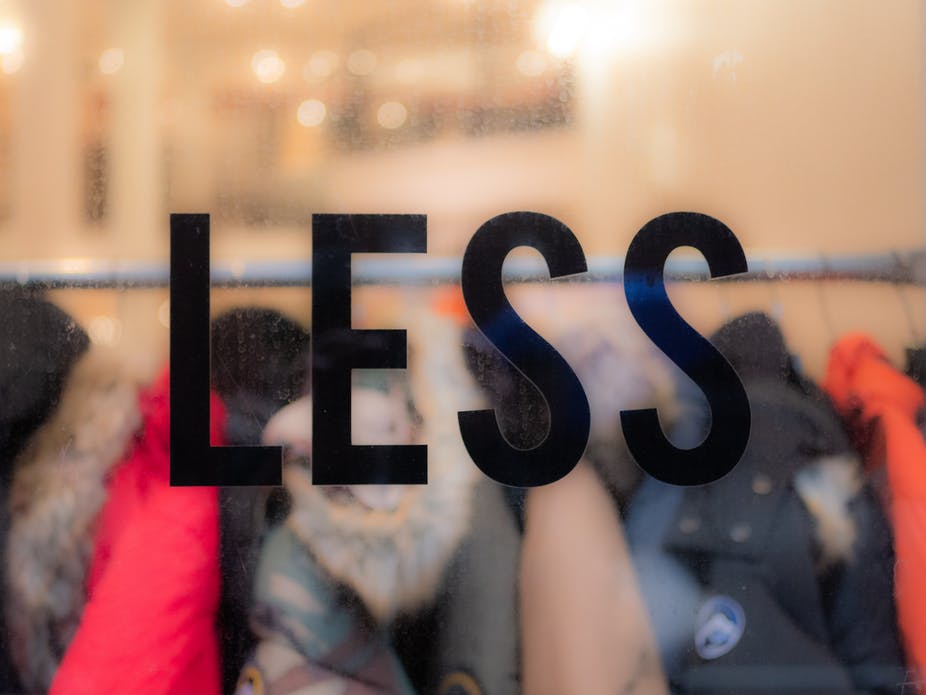
Enough already. Becca McHaffie/Unsplash, CC BY-SA
The trouble is that these higher prices reflect the true cost of resources, production and so on. So while such enterprises will attract consumers who are particularly concerned about sustainability and their carbon footprints, there will be limits to what they can achieve.
To get the majority of consumers onboard and truly move towards a circular economy, mass-market brands need to start pushing in the same direction. As the pandemic hopefully begins to move into the past, that is the big challenge for the future.