


 Goldman Sachs Raises USD/JPY Forecast, Sees Yen Weakness Persist Through 2027
  Gold Surges Past $4150 on Dovish Fed Signals and Weak Jobs Data; Bullish Outlook Prevails
  Morgan Stanley Says China’s Reusable Rocket Progress Poses Long-Term Challenge to SpaceX
  Venezuela Appoints Felix Plasencia to Lead Foreign Relations and Trade
  Republican Senator Lindsey Graham Dies at 71, Leaving South Carolina Senate Seat Vacant
  Israeli Strikes Kill Six in Gaza as Ceasefire Talks Continue in Cairo
  Iranian Missile Strike on UAE Oil Tankers Kills Indian Crew Member in Strait of Hormuz
  Vietnam’s population hit the 100 million milestone. Where’s it headed?
  Goldman Sachs Says China Competition Weighs More on EU Growth Than Trade Deficit
  USA at 250: the Black American struggle for life, liberty and the pursuit of happiness
  Morgan Stanley Names Marks & Spencer Top European Retail Pick, Sees Strong Upside
  Bernstein Names IAG, Ryanair as Top European Airline Stocks Ahead of Earnings
  EU Ministers Split as Support Grows for Ban on Trade With Israeli West Bank Settlements
  JPMorgan Cuts Gold Price Forecast, Sees Bullion Reaching $4,500 by End of 2026


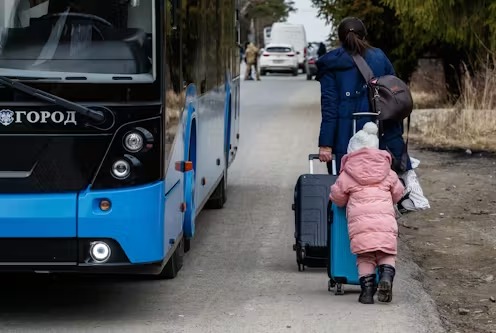
According to the latest available data, around 3.7 million Ukrainians are internally displaced, while nearly 6.5 million have registered as refugees globally. With 1.13 million, Germany has taken in the largest cohort.
Swift and decisive measures were taken to bring Ukrainian refugees into Germany in 2022: shortly after the Russian offensive began, Ukrainian arrivals were granted immediate employment rights and social benefits, including medical care.
Unlike other asylum seekers in Germany, Ukrainians have also been permitted to travel back and forth to their country of origin without losing their entitlements.
These expedited policy changes granted Ukrainian refugees privileges that were not extended to others. For example, in 2015, many Syrian refugees who had travelled on foot through the Balkans, Hungary and Austria were pushed back at the German border after Germany decided to reintroduce border controls.
This unequal treatment shows how Ukrainian refugees have been positioned as uniquely deserving arrivals to Europe. Ukraine’s martial law also prohibits most men aged 18-60 from leaving the country, meaning the majority of international refugees are women and children.
Studies have shown that gender plays a significant role in the experiences of displaced people. It can influence policy decisions that directly affect them, and impacts how they are represented, understood and integrated into host countries.
Our research, published in December 2023, set out to interrogate how Ukrainian women are portrayed in German public media, and what this can tell us about how Germany perceives its refugee population.
Gendered depictions of Ukrainian refugees
In our study, we analysed 79 articles on female Ukrainian refugees from two high circulation German news outlets, Der Spiegel and Die Zeit, published during the first year of the latest Ukrainian conflict. We found that the dominant discourse presents Ukrainian women in Germany as keeping children safe, and as willing, able workers who will contribute to their host’s economy.
Notably, early reports also paid significant attention to Ukrainian women’s aspirations, future plans, and dreams, as well as the practical compromises they make in pursuing them. Some of these attributes are emphasised in profiles that have appeared elsewhere in German media.
The welcome guest: ‘Mary Poppins’ refugees
We identified and explored five key characteristics that appear in the media depictions of displaced Ukrainian women: they are familiar, educated, hard-working, grateful and welcome.
One interview with Lena, a Ukrainian woman, is recounted as follows: “‘We are very grateful,’ says Lena. Every few minutes she says thank you for anything or everything.”
Lena is also quoted as saying “we want to be useful for Germany and for ourselves.” The article states that she wants to “learn the language, earn money and pay taxes. She wants to be a part of this society and give something back as soon as she can.”
Ukrainian women are often presented as productive participants in the German labour market, or they express their aspiration to do so in the near future. Another interviewee says “I have completed my B1 German course, now B2 follows… I’ve already been promised a job in a hospital near Frankfurt am Main, but I still need the professional permit and a few other documents. It takes a long time.”
Ukrainian women are also portrayed as willing to assist with maintaining their hosts’ ideals and values of cooperation, diplomacy and education. For instance, one Ukrainian woman is quoted as saying “I myself am more useful to Ukraine when I’m here. I earn money with my work and send some of it home, among other things, I donate to the Ukrainian army.”
It is crucial to note that these interviews and stories are filtered through media outlets for a German audience. One journalist’s reporting on a Ukrainian woman’s desire to study at university is especially telling: “It’s as if the 22-year-old wanted to give a personal response to the violence unleashed by Russia in her homeland: more education, more international understanding, more Europe.”
While such reporting may, admirably, aim to humanise refugees, it can lead to unrealistic expectations. Focusing on their potential for providing economic or cultural benefits can obscure the challenges they face as humans seeking shelter from conflict.

Mary Poppins arrives in London. IMDB
Over the course of our research, we concluded that the ideal female refugee would be something akin to Mary Poppins, from the well known Disney 1964 musical fantasy film of the same name: she arrives unexpectedly, brings little baggage, is well spoken, well mannered, and able to fit into her hosts’ lives, leaving only positive impacts. She is, in her own words, “practically perfect in every way”.
Idealised stereotypes cut both ways
Portrayals such as these are ultimately harmful to all displaced people. By uplifting one group, they cast a shadow on those who do not fit the bill, but they also raise expectations of the contributions refugees can make. Those who are unable to fit into this “practically perfect” category for a variety of reasons – be they economic, professional or cultural – may find themselves excluded or vilified.
Likewise, idealised constructions of Ukrainian women displaced by conflict may also work against them, obscuring the important challenges they face, such as the slow and difficult process of getting Ukrainian qualifications recognised in Germany.
Our study aims to sidestep the “common sense” ideas about displaced people that often dominate public policy and debate. These tend to focus more on what refugees can bring to the table than their intrinsic right to universal protection.







