


 USA at 250: the Black American struggle for life, liberty and the pursuit of happiness
  Gold Surges Past $4150 on Dovish Fed Signals and Weak Jobs Data; Bullish Outlook Prevails
  Trinidad Businessman Dominic Hadeed Appeals Detention Over Alleged Assassination Plot
  Sara Duterte Impeachment Trial Opens, Putting 2028 Philippine Election in Focus
  Goldman Sachs Says China Competition Weighs More on EU Growth Than Trade Deficit
  Morgan Stanley Says China’s Reusable Rocket Progress Poses Long-Term Challenge to SpaceX
  Gold Pulls Back After Hitting $4,180 as Geopolitical Risk Sends Crude Higher
  Bank of America Upgrades T-Mobile to Buy, Says LEO Satellite Fears Are Overdone
  US Appeals Court Limits ICE Detention Without Bond Hearings After 90 Days
  Bayer Wins Major U.S. Supreme Court Roundup Lawsuit, Shares Surge
  Apple Sues OpenAI, Former Employees Over Alleged Trade Secret Theft
  Brazil Court Bars Flavio Bolsonaro From Visiting Jair Bolsonaro Ahead of Election
  Citi Raises TSMC Price Target as AI Chip Demand Strengthens Growth Outlook
  ICC Says Darfur War Crimes Probe Reaches Breakthrough in Sudan Investigation



Agriculture is rated among the most dangerous industries by the International Labour Organization, and not just for adults.
Children living on farms experience exceptionally high risks of traumatic injury, and evidence for this high risk has been documented many times over many years.
Historically, health researchers and public health advocates have tried to counter these statistics by communicating the high rates of injury and the source of the hazards and by instructing parents to keep kids away from the hazards. Still, rates of child injury remain high.
What has been missing is an understanding of why parents chose to bring their kids into the farm work environment. So, this time, our team of researchers — from the University of Saskatchewan, Queen’s University and the Marshfield Clinic Research Foundation — decided it was our turn to listen.
Learning farm culture
At first glance, a work environment with heavy machinery, chemicals and confined spaces doesn’t seem like a good place for children. They aren’t present at mines or construction sites. But a farm is different because it is also a family’s home.
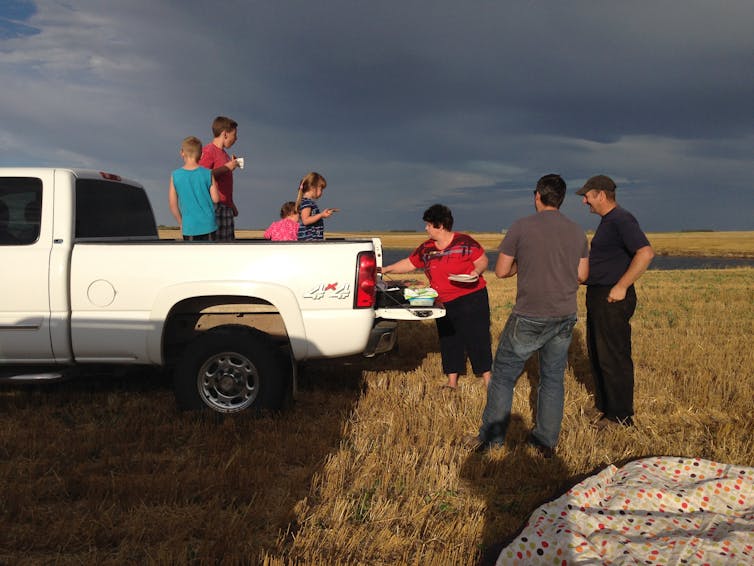
Bringing kids onto the farm is an opportunity to expose them to farm culture. (Kendra Ulmer), Author provided
Our research team conducted in-depth interviews with 11 rural Saskatchewan farm parents and found that they see a lot of benefits to exposing their kids to farm work. These include: meeting the family’s needs for child care and family time; building work ethic, responsibility and pride; and the positive impacts of involvement in the family’s agricultural heritage.
Unfortunately, previous health promotion efforts haven’t really acknowledged these benefits or the parent’s perspective in weighing out the positives.
Imagine you are a farm parent taking care of the kids during a busy harvest season. You have been with the kids at home for the morning and need to bring a meal out to those working in the field. Do you bring the kids with you, or leave them in the house?
On one hand, there could be tractors and other heavy machinery, ponds and the general rush and hustle of adults focused on completing the task at hand. On the other hand, kids who see farm work get a chance to connect to farm culture and can gradually learn to take on these tasks, plus they’ll be taught how to do tasks safely. Bringing the kids along also avoids leaving young kids at home alone.
Different parents might make different choices in these situations, but all parents are faced with balancing the pros and cons in their family context based on their experiences and family characteristics.
Lead author of the study, Valerie, grew up as a farm kid and raised her own children on the farm, so she understands the tricky tradeoffs that parents face.
Complex decision-making
While studying how farm parents balance the potential risks with the perceived benefits of farm life, we discovered a complex decision-making process that involves weighing risk-reward tradeoffs. After talking with farm parents, we developed a framework showing a scale — balancing potential risks and benefits.
“Tipping the scales” to make a decision about bringing kids into the farm environment depends on parental perceptions, and these perceptions are in turn influenced by a personal history in agriculture, prior knowledge, past experience, characteristics of children and safety norms in their family and community.
If we have a better understanding of how farm parents make these decisions, we’ll have a better chance of working together to find strategies that work.
Even though many farm parents were raised on farms themselves and recognize the importance of farm safety for their families, serious child injuries and deaths continue to occur. The study showed us that parental decisions of whether to bring children into the farm work area depend on context.
Our hope moving forward is that this framework will contribute to future prevention strategies aimed at harm reduction, by considering both the perceived risks and benefits that play a role in farm parents’ decision-making.







