


 Asian Stocks Slide as Oil Surge, U.S.-Iran Tensions and Fed Rate Bets Weigh on Markets
  Yaskawa Electric Shares Slide as Weak Profit Overshadows Strong AI Demand
  U.S. Imposes 25% Tariff on Select Brazilian Imports After Section 301 Trade Investigation
  Apple Intelligence China Approval Lifts Alibaba and Baidu Shares
  Port of Los Angeles Posts Record June Cargo Volume as Importers Rush Ahead of U.S. Tariffs
  Asian Stocks Rise as Softer U.S. Inflation Boosts Sentiment Despite Middle East Tensions
  UBS Boosts China Tech Bets, Adds Kuaishou and Meituan to Focus List
  South Korea’s KOSPI Enters Bear Market Despite Remaining 2026’s Best-Performing Major Stock Index
  ASML Raises 2026 Outlook as AI Chip Demand Lifts Q2 Earnings
  Oil Prices Rise as U.S. Strikes on Iran Raise Strait of Hormuz Supply Fears
  Gold Price Holds Near Record High as Cooling U.S. Inflation Offsets Fed Caution
  Jamie Dimon Warns Anthropic's Mythos AI Poses National Security Risks
  xAI Sues Man for Allegedly Using Grok to Generate AI Child Abuse Deepfakes
  Uber to Acquire Delivery Hero in $14.8 Billion Deal to Expand Global Food Delivery Business
  Apple Intelligence Cleared for China as Alibaba and Baidu AI Power iPhone Features
  Airbus Signs Cloud Deal With Scaleway to Power Secure AI and Defense Applications
  Alibaba Stock Jumps as China Approves Apple Intelligence Powered by Qwen AI


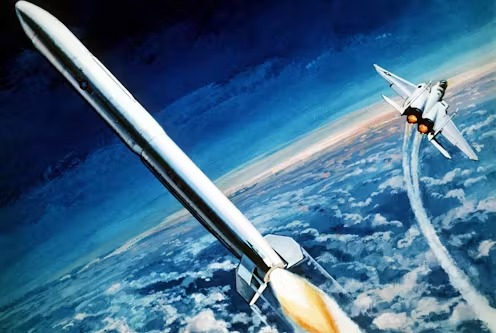


As conflict rages on Earth, an arms race may be underway in outer space. On May 30, a US diplomat warned that Russia had launched a “weapon into orbit”, something Russia’s deputy foreign minister, Sergey Ryabkov, branded as “fake news”. It follows on from accusations in recent months by US and Russian officials that both countries are attempting to place nuclear weapons in space.
Such action, if it is true, will contravene the UN’s 1967 Outer Space Treaty, under which all parties agreed “not to place in orbit around the Earth any objects carrying nuclear weapons or any other kinds of weapons of mass destruction”. The treaty is now ratified by 114 countries, including leading space powers such as the US, Russia, China, India, France, Japan and the UK.
News of possible nuclear weapons in space is concerning, especially at a time when the race to land and settle humans and exploit resources on the Moon, Mars and beyond has intensified. The potential weaponisation of space has raised fears among many that the freedom to explore and use outer space peacefully is being eroded.
Weaponising space would not only be dangerous for world peace, it also threatens to hinder technological development on Earth. If the arms race in space escalates into a fully-fledged war, it could lead to the use of weapons that can destroy valuable assets such as satellites. This would disrupt our communications, navigation and other innovations.
The UN Security Council has become a battleground over how to control the rhetoric of space weaponisation and warfare. The security council is comprised of 15 countries, including five members with veto power, and is responsible for maintaining international peace and security.
In response to reports that Russia had developed an anti-satellite nuclear weapon to put in space, the US and Japan put forward a draft resolution in April 2024 calling on all countries to prevent an arms race in outer space. Russia vetoed the resolution, but said it was “firmly committed” to the existing 1967 treaty. The veto prompted the US to question whether Moscow was hiding something.
Then, in May 2024, Russia and China drafted a similar resolution that underscored the need to “prevent the placement, threat or use of any weapons in outer space”. This resolution received seven votes in favour and seven votes against. Hence, it failed to pass.
Weaponising space
Military interests, assets and personnel have always been at the forefront of exploring and using outer space. In fact, fears that the first satellites and humans to orbit Earth could give the Soviet Union a military and strategic advantage inspired the US to consider space an extension of the arms race during the cold war.
Following a series of nuclear tests in outer space in the 1960s by both the US and the Soviet Union, a shared understanding of their destructiveness and threat to the Earth’s atmosphere subsequently produced the Outer Space Treaty. But, although the treaty exclusively bans weapons of mass destruction in outer space, it leaves room for ambiguity regarding other forms of weapons.
As a consequence, the US and the Soviet Union tested several anti-satellite weapons both during and after the cold war. China and India have carried out missile tests against space satellites too, while the UK, France, Israel, Japan, North and South Korea, and Iran are also considered capable of developing anti-satellite weapons.
It was only in 2022 that the US became the first country to announce a ban on such missile tests, saying they were reckless. The tests create space debris, which pose a risk to active satellites and humans in orbit.
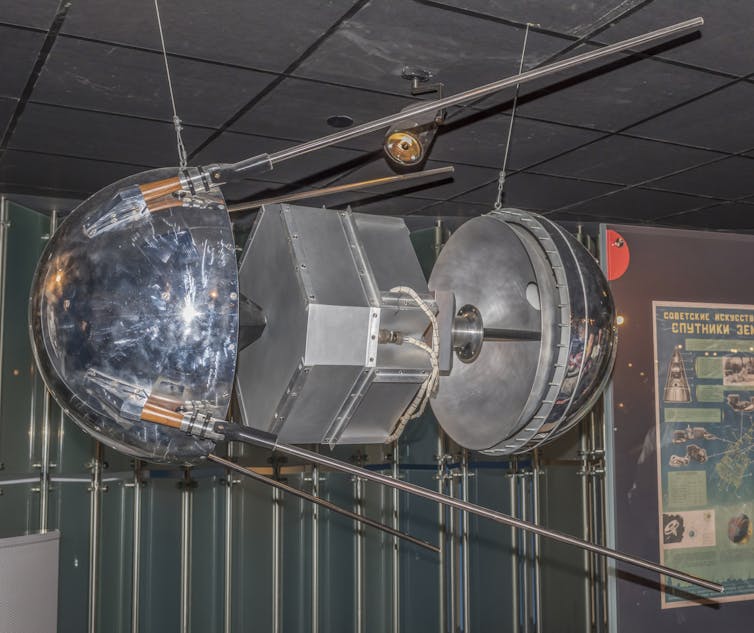
The first artificial Earth satellite, Sputnik, in a museum in Moscow. Aleks49/Shutterstock
The weaponisation of space presents a significant threat to the inclusiveness and shared benefits of exploring and using outer space. Low-Earth orbit has become increasingly crowded, with an astronomical rise in the number of satellites launched both by established and emerging space nations.
According to UN records, over 80 countries have together put nearly 18,450 objects into orbit since 1957. And no fewer than 15 African countries have orbited 58 satellites in the last three decades, with 100 satellites in different stages of production on the continent. These are significant investments driven by the desire for some degree of independence in access to space for socioeconomic development and security.
It is not only countries that share the benefits of space. The private sector is becoming increasingly involved in space activity. Elon Musk’s SpaceX, for instance, has launched 6,500 Starlink satellites, of which 6,050 were still in orbit as of May 2024. This initiative aims to provide high-speed internet connections to remote and disconnected areas of the world.
That said, the collaboration between SpaceX’s Starlink and the US Department of Defense, which supports the activities of the Ukrainian army in their conflict with Russia, makes them a potential target in the event of a Russian nuclear attack in space.
The threat posed by an arms race in space must be realised and addressed. Renewed cooperation among the world’s leading powers and support for the UN framework are critical to guaranteeing the peaceful and inclusive exploration and use of outer space.







