


 NVIDIA's Feynman AI Chip May Face Redesign Amid TSMC Capacity Crunch
  NASA's Artemis II Mission: First Crewed Lunar Journey Since Apollo
  SK Hynix Eyes Up to $14 Billion U.S. IPO to Fund AI Chip Expansion
  Elliott Investment Management Takes Multibillion-Dollar Stake in Synopsys
  Elon Musk Announces Terafab: SpaceX and Tesla to Build Dual AI Chip Factories in Austin, Texas
  Rubio Directs U.S. Diplomats to Use X and Military Psyops to Counter Foreign Propaganda
  Nanya Technology Shares Surge 10% After $2.5 Billion Private Placement from Sandisk and Cisco
  Apple Turns 50: From Garage Startup to AI Crossroads
  TSMC Japan's Second Fab to Produce 3nm Chips by 2028
  OpenAI Pulls the Plug on Sora, Ending $1 Billion Disney Partnership
  SpaceX IPO Filing Expected This Week as Valuation Could Surpass $75 Billion
  Reflection AI Eyes $25 Billion Valuation in Massive $2.5 Billion Funding Round
  NASA Artemis II: First Crewed Moon Mission Since Apollo Takes Four Astronauts on 10-Day Lunar Journey
  Cybersecurity Stocks Tumble After Anthropic's Claude Mythos AI Leak Sparks Market Fears
  Nintendo Switch 2 Production Cut as Holiday Sales Miss Targets
  Meta Ties Executive Pay to Aggressive Stock Price Targets in Major Retention Push
  Golden Dome Missile Defense: Anduril and Palantir Join Forces on Trump's $185B Space Shield


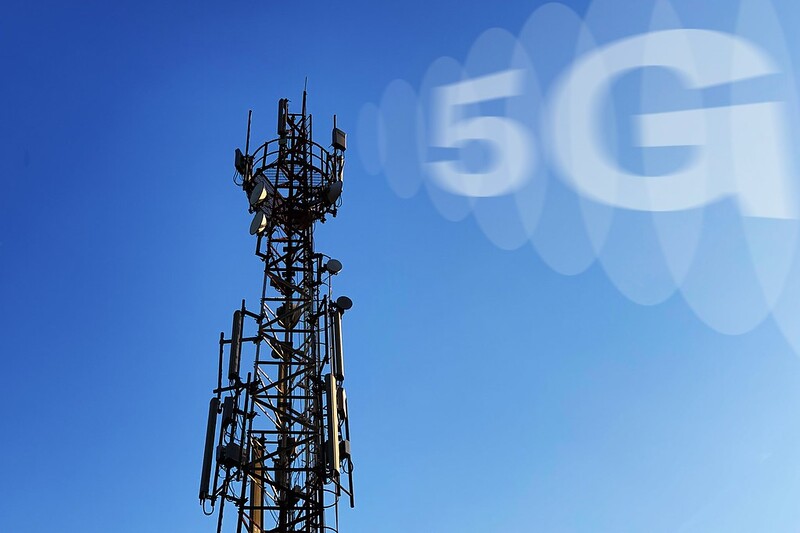

5G stands for fifth-generation cellular network technology.
It’s the technology that enables wireless communication – for example, from your cellular phone to a cell tower, which channels it to the internet. 5G is a network service provided by telecommunications carriers and is not the same thing as the 5 GHz band on your Wi-Fi router.
5G offers an order of magnitude – 10 times – more bandwidth than its predecessor, 4G. The greater bandwidth is possible because over and above low and medium frequency radio waves, 5G uses additional higher-frequency waves to encode and carry information.
Bandwidth is analogous to the width of a highway. The broader the highway, the more lanes it can have and the more cars it can carry at the same time. This makes 5G much faster and able to handle many more devices.
5G can deliver speeds of around 50 megabits per second, up to more than 1 gigabit per second. A gigabit per second connection allows you to download a high-definition movie in less than a minute. Does this mean no more bad cell connections in crowded places? The increased bandwidth will help, but just as increasing the number of lanes on highways does not always reduce traffic jams, as more people use the expanded highways, 5G is likely to carry a lot more traffic than 4G networks, so you still might not get a good connection sometimes.
In addition to connecting your phone and cellular-enabled laptop, 5G will be connecting many other devices ranging from photo frames to toasters as part of the Internet of Things revolution. So even though 5G can handle up to a million devices per square kilometer, all that bandwidth could be quickly used up and require more – a future 5.5G with even more bandwidth.
Flavors of 5G
5G can use low-, mid- and high-band frequencies, each with advantages and disadvantages. Lower-frequency waves can travel farther but are slower. Higher-frequency waves travel faster but can go only limited distances. Higher-frequency 5G can achieve gigabit-per-second speeds, which promises to render ethernet and other wired connections obsolete in the future. Currently, however, the higher frequency comes at a higher cost and thus is deployed only where it’s most needed: in crowded urban settings, stadiums, convention centers, airports and concert halls.
A type of 5G service, Ultra-Reliable and Low-Latency Communications, can be used where data needs to be transmitted without loss or interruption in service – for example, controlling drones in disaster areas. One day, after the technology is more robust, it could even be used for remote surgery.
Prasenjit Mitra receives funding from the National Science Foundation, and the Department of Energy.







