


 Snowflake Forecasts Strong Fiscal 2027 Revenue Growth as Enterprise AI Demand Surges
  OpenAI Hires Former Meta and Apple AI Leader Ruomin Pang Amid Intensifying AI Talent War
  The Pentagon strongarmed AI firms before Iran strikes – in dark news for the future of ‘ethical AI’
  Hyundai Motor Group to Invest $6.26 Billion in AI Data Center, Robotics and Renewable Energy Projects in South Korea
  Samsung and SK Hynix Shares Hit Record Highs as Nvidia Earnings Boost AI Chip Demand
  Samsung Electronics Stock Poised for $1 Trillion Valuation Amid AI and Memory Boom
  U.S. Deploys Tomahawks, B-2 Bombers, F-35 Jets and AI Tools in Operation Epic Fury Against Iran
  OpenAI Secures $110 Billion Funding Round at $840 Billion Valuation Ahead of IPO
  OpenAI and U.S. Defense Department Update Agreement to Clarify AI Usage Terms
  OpenAI Faces Scrutiny After Banning ChatGPT Account of Tumbler Ridge Shooting Suspect
  Apple to Begin Mac Mini Production in Texas Amid $600 Billion U.S. Investment Plan
  Synopsys Q2 Revenue Forecast Misses Expectations Amid China Export Curbs and AI Shift
  Australia Targets AI Platforms With Strict Age Verification Rules
  Trump Orders Federal Agencies to Halt Use of Anthropic AI Technology
  Hyundai Motor Plans Multibillion-Dollar Investment in Robotics, AI and Hydrogen in South Korea
  Nvidia to Launch New AI Inference Processor to Boost OpenAI Performance
  AWS Data Center in UAE Hit by Fire After Objects Strike Facility Amid Regional Tensions




Recently, there has been a flurry of publicity about the planned upgrades to OpenAI’s ChatGPT AI-powered chatbot and Meta’s Llama system, which powers the company’s chatbots across Facebook and Instagram.
The technology behind these systems is known as a large language model (LLM). These are artificial neural networks, a type of AI designed to mimic the human brain. They can generate general purpose text, for chatbots, and perform language processing tasks such as classifying concepts, analysing data and translating text.
They acquire these abilities through an intensive process known as training, where the AI system is exposed to vast amounts of data in an effort to improve what it does. OpenAI and Meta are expected to release the newer versions of their chatbots – called GPT-5 and Llama 3, respectively, before the end of summer 2024. But how will these differ from their predecessors and what value will they add?
Like its predecessor GPT-4, GPT-5 will be capable of understanding images and text. For instance, users will be able to ask it to describe an image, making it even more accessible to people with visual impairments.
However, GPT-5 will have superior capabilities with different languages, making it possible for non-English speakers to communicate and interact with the system. This includes greater mastery of language translation. The upgrade will also have an improved ability to interpret the context of dialogue and interpret the nuances of language.
Compared to its predecessor, GPT-5 will have more advanced reasoning capabilities, meaning it will be able to analyse more complex data sets and perform more sophisticated problem-solving. The reasoning will enable the AI system to take informed decisions by learning from new experiences.
Hence, it will be able to provide more accurate information to users. For instance, the system’s improved analytical capabilities will allow it to suggest possible medical conditions from symptoms described by the user. GPT-5 can process up to 50,000 words at a time, which is twice as many as GPT-4 can do, making it even better equipped to handle large documents.
It will feature a higher level of emotional intelligence, allowing for more empathic interactions with users. This could be useful in a range of settings, including customer service. GPT-5 will also display a significant improvement in the accuracy of how it searches for and retrieves information, making it a more reliable source for learning.
It is said to go far beyond the functions of a typical search engine that finds and extracts relevant information from existing information repositories, towards generating new content.
GPT-5 is also expected to show higher levels of fairness and inclusion in the content it generates due to additional efforts put in by OpenAI to reduce biases in the language model.
It will be able to interact in a more intelligent manner with other devices and machines, including smart systems in the home. The GPT-5 should be able to analyse and interpret data generated by these other machines and incorporate it into user responses. It will also be able to learn from this with the aim of providing more customised answers.
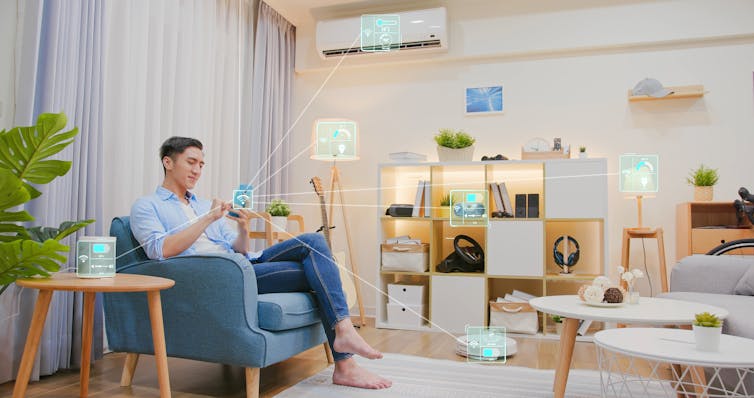
GPT-5 could communicate with connected devices in smart homes. Aslysun / Shutterstock
This could enable smarter environments at home and in the workplace. GPT-5 will be more compatible with what’s known as the Internet of Things, where devices in the home and elsewhere are connected and share information. It should also help support the concept known as industry 5.0, where humans and machines operate interactively within the same workplace.
GPT-5 will feature more robust security protocols that make this version more robust against malicious use and mishandling. It could be used to enhance email security by enabling users to recognise potential data security breaches or phishing attempts.
Overall, the upgrade from OpenAI should be more versatile, more energy efficient in its computations and offer a more adaptable and personalised service.
Meta’s Llama upgrade
Llama-3 is Meta’s competitor to GPT-5. It features several improvements compared to its predecessor, Llama-2. It is a more capable model that will eventually come with 400 billion parameters compared to a maximum of 70 billion for its predecessor Llama-2. In machine learning, a parameter is a term that represents a variable in the AI system that can be adjusted during the training process, in order to improve its ability to make accurate predictions.
Llama-3 will also be multimodal, which means it is capable of processing and generating text, images and video. Therefore, it will be capable of taking an image as input to provide a detailed description of the image content. Equally, it can automatically create a new image that matches the user’s prompt, or text description.
It will be able to perform tasks in languages other than English and will have a larger context window than Llama 2. A context window reflects the range of text that the LLM can process at the time the information is generated. This implies that the model will be able to handle larger chunks of text or data within a shorter period of time when it is asked to make predictions and generate responses.
Meta is planning to launch Llama-3 in several different versions to be able to work with a variety of other applications, including Google Cloud. Meta announced that more basic versions of Llama-3 will be rolled out soon, ahead of the release of the most advanced version, which is expected next summer.
The transition to this new generation of chatbots could not only revolutionise generative AI, but also mark the start of a new era in human-machine interaction that could transform industries and societies on a global scale. It will affect the way people work, learn, receive healthcare, communicate with the world and each other. It will make businesses and organisations more efficient and effective, more agile to change, and so more profitable.













