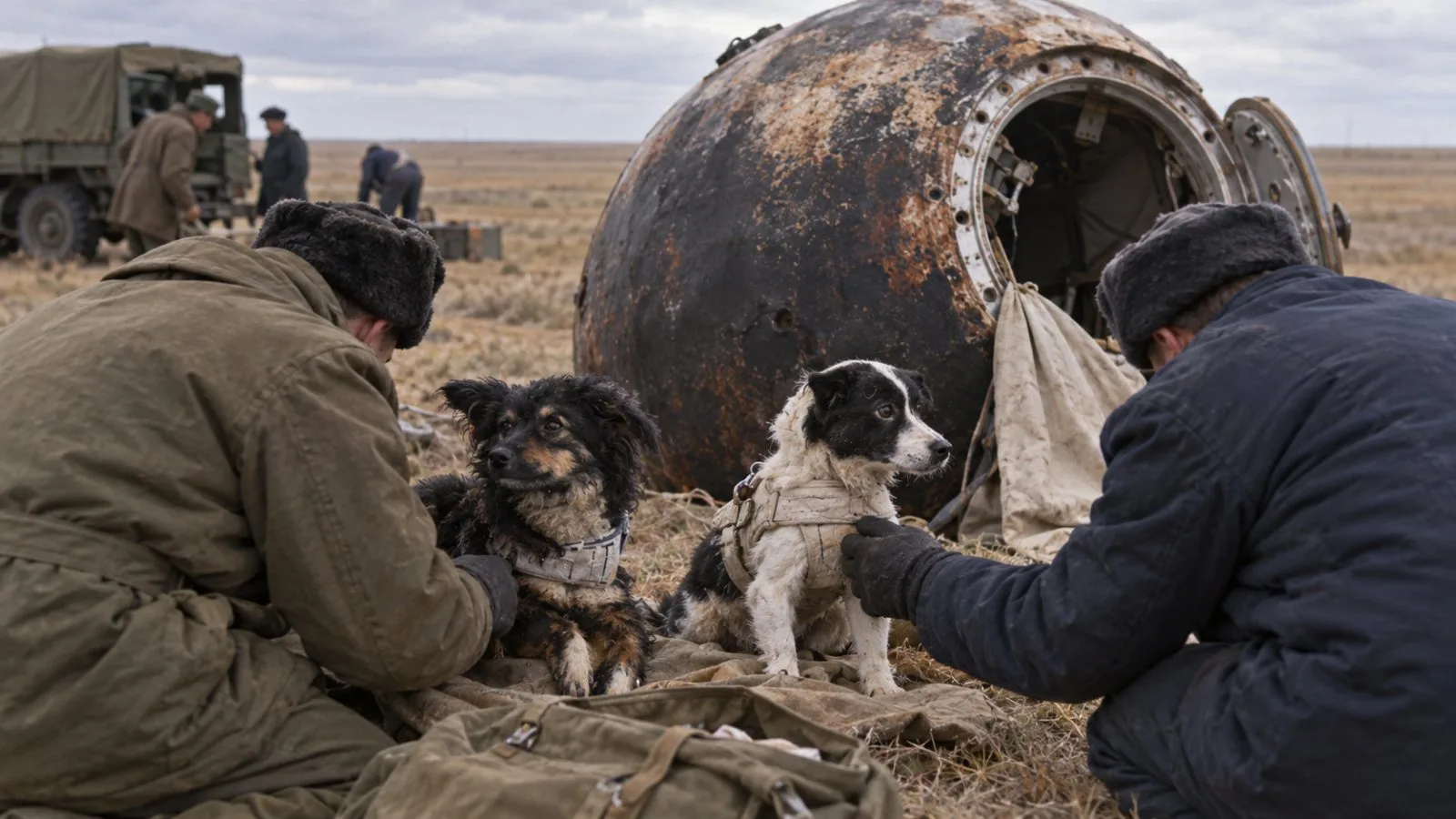
A report on Soviet dogs Veterok and Ugolyok documented muscle and calcium loss and temporary movement problems after a roughly 22-day orbital mission, offering evidence on the physical effects of prolonged spaceflight.
Cosmos 110 launched Feb. 22, 1966, and landed March 16 after 330 orbits, according to a contemporaneous TASS notice. The notice put the flight at about 22 days and said the dogs were in good condition after landing. It also said the spacecraft’s systems operated normally.
A Pravda-published report dated May 17 said X-rays detected calcium loss from the dogs’ bones. Although investigators found they had received adequate food, they linked most of the weight reduction to muscle loss and dehydration. By eight to 10 days after landing, the dogs’ movement had returned to its earlier level.
Pulse rates dropped and steadied after 10 to 14 days in orbit, then rose after the dogs returned to Earth. Circulation normalized by the fourth or fifth day on the ground, and digestive disruptions had ended within six to eight days. The report’s authors called the changes “reversible” and urged caution in applying animal findings to people.
NASA’s history of the Soviet space program says Cosmos 110 tested life-support equipment for a planned crewed Voskhod 3 mission. The dogs’ flight was intended to last 25 days but ended early after cabin-air composition began to deteriorate, according to the history.
The TASS notice said researchers were studying the effects of prolonged space exposure and passage through Earth’s radiation belts at altitudes of up to 900 kilometers. NASA’s 1966 chronology, citing TASS and Aviation Week, reported that electronic sensors continuously tracked blood pressure, pulse and respiration. For radiation measurements, the spacecraft carried 300 thermoluminescent dosimeters and 10 nuclear-emulsion sets.