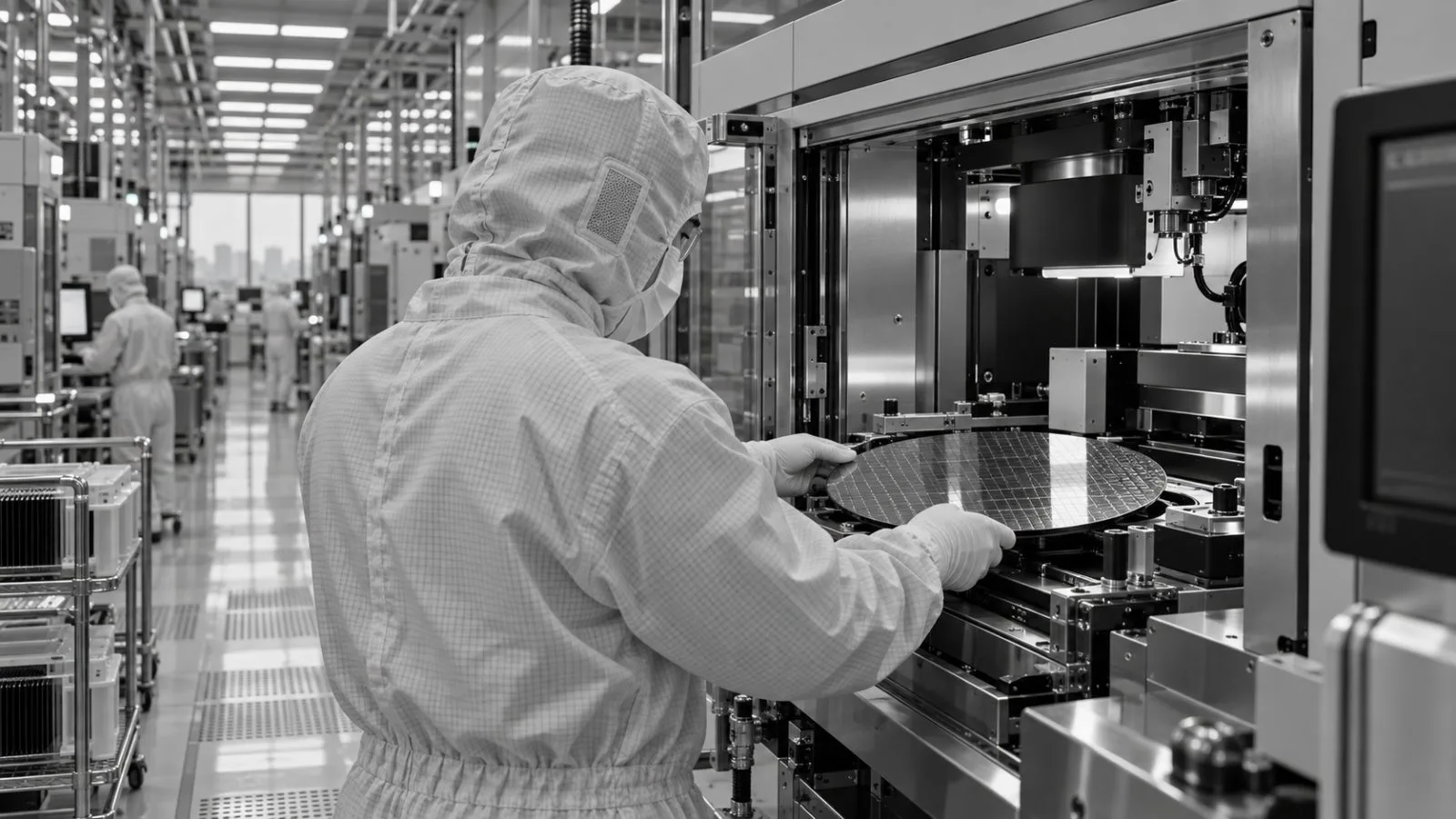
Semiconductor capital equipment stocks tumbled Monday after reports that China has begun mass-producing domestically developed immersion deep ultraviolet (DUV) lithography machines, raising concerns about the future dominance of leading chip equipment suppliers such as ASML, Applied Materials (NASDAQ: AMAT), Lam Research (NASDAQ: LRCX), and KLA Corp (NASDAQ: KLAC).
The sector had started the day on a positive note, supported by easing geopolitical tensions in the Middle East and reports that Nvidia is discussing up to $250 billion in financing for an OpenAI data center project. However, sentiment shifted sharply after The Information reported that a Shanghai-based, state-backed company has started producing homegrown immersion DUV lithography systems.
According to the report, the company plans to manufacture five DUV machines this year and 20 more in 2027 for major Chinese chipmakers, including SMIC, CXMT, and Hua Hong. The development comes as the U.S. Congress advances the MATCH Act, legislation designed to restrict China’s access to advanced DUV equipment, prompting investors to question whether domestic alternatives could weaken export controls.
The news triggered a broad sell-off across semiconductor equipment stocks. ASML, Applied Materials, Lam Research, and KLA each dropped roughly 7% at their intraday lows before trimming losses. By late trading, ASML was down about 5.8%, Applied Materials 4%, Lam Research 4.5%, and KLA 3%.
Despite the sharp decline, Wall Street analysts argued the market reaction was excessive. BofA Securities maintained a Buy rating on ASML, saying China still faces significant challenges in matching the company’s productivity, precision, and manufacturing scale. The firm estimated that even if China deploys 20 domestic DUV tools next year, the impact on ASML’s revenue would be limited.
JPMorgan also described the sell-off as disproportionate, emphasizing that producing a small number of machines is far different from delivering reliable, high-volume manufacturing equipment capable of supporting advanced semiconductor fabrication.
BNP Paribas added that China’s growing chip production capacity will require hundreds of lithography systems over the coming years. Given ASML’s limited production capacity, domestic Chinese tools could complement supply rather than fully replace the Dutch chip equipment leader, leaving its medium-term business outlook largely intact.