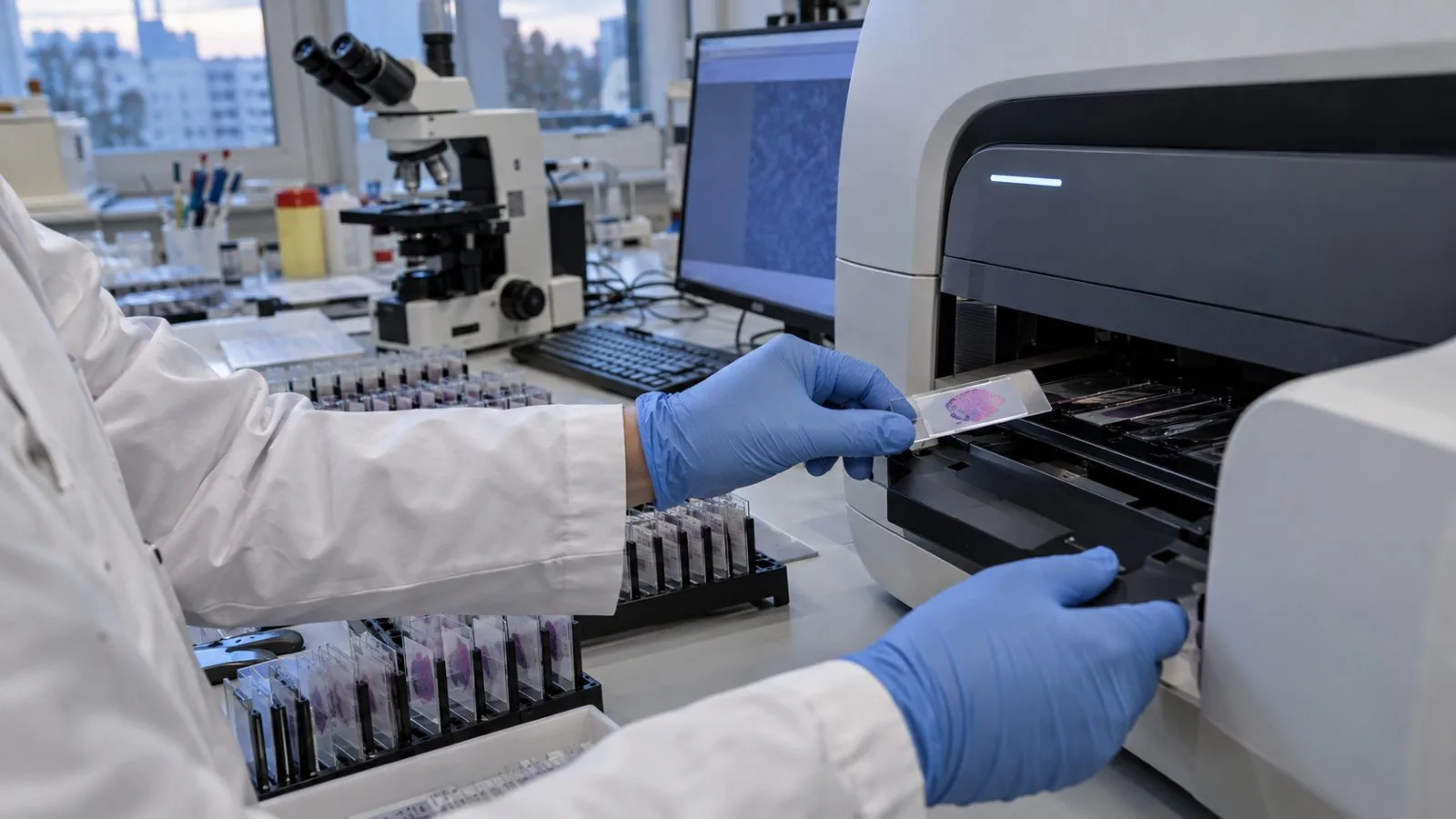
Aignostics introduced four AI tools on Friday, Oct. 16, for examining pathology slides, giving laboratories software to assess features that may guide tissue selection for molecular testing. The products are designated for research use only and are not for diagnostic procedures.
The tools analyze whole-slide images stained with hematoxylin and eosin (H&E). HETA Quality Control checks slide quality, HETA Tumor Detect marks tumor regions, and HETA Mitosis counts mitoses. HETA Tumor Cellularity estimates tumor cellularity and proposes a tissue region with sufficient tumor content for molecular analysis. Aignostics says the suite draws on its HETA platform, previously known as Atlas H&E-TME.
After consulting pathologists at academic medical centers and precision medicine labs, Aignostics put the share of molecular tests that fail because of low tumor content at 10% to 20%. The company did not cite a study behind the estimate. A 2024 working group of thoracic pathologists said there is no consensus standard for assessing tumor cellularity, and that required proportions can vary with an assay’s detection limit and sequencing panel.
A separate four-month retrospective study at one academic laboratory found that 150 of 683 specimens failed next-generation sequencing. At slide review, 97 of those failures were attributed to specimens with less than 20% tumor cellularity or no tissue. The single-lab result does not establish an industry-wide failure rate.
An arXiv preprint evaluating cell classification on the HETA platform reported a macro F1 score, which averages performance across cell categories, of 0.74, compared with 0.71 for expert pathologists on average against an immunohistochemistry-informed reference. The preprint did not assess whether the four HETA Clinical products reduce test failures or turnaround times.
Techcyte said HETA Tumor Cellularity is available in its Fusion AP workflow in the United States. Both the product and Fusion AP are for research use only and not for diagnostic use; the workflow lets pathologists review tumor-rich regions and set scraping boundaries for histotechnicians to follow. Aignostics plans to release more HETA Clinical products and add integrations with image management systems over time, but gave no schedule.