The latest data compiled by the Spanish National Institute of Statistics show that the number of homeless people has grown by 25% in Spain in the last ten years. This social problem has gone from affecting 22,900 people in 2012 to more than 28,500 people in 2022. The average age of people in this situation in Spain is 42.7 years.
Numbers do not look much better across Europe. The European Parliament highlights the precarious living situation of more than 700,000 people facing homelessness every day (and night) across Europe. There has been a 70% increase in just a decade.
Beyond the basic need for shelter, housing is key to the development of a life project. That is why it is a fundamental human right.
Not having a permanent place to live increases inequalities in the access to basic citizenship rights. This includes the right to health care.
How does one become homeless?
Many factors can lead to homelessness. Sometimes they are individual or family related, such as divorces, periods of mournings, mental illness, domestic violence or substance abuse. Structural factors are also involved, such as difficulty to access affordable housing, unemployment (or precarious employment) and discrimination.
In addition, the European Federation of National Organisations working with the Homeless (FEANTSA) stresses that institutional factors such as a lack of coordination between services or an inadequately structured welfare system may be behind homelessness.
Homeless people live almost two decades less
According to a Polish study, homeless people have an average life expectancy of 17.5 years less than the rest of the population. They have also been found to have between 2 and 50 times more physical health problems, and their living conditions lead to multiple or chronic illnesses. Mental illness, addictions and communicable infectious diseases are particularly prevalent in this group.
The main problem detected is that most homeless people do not have access to primary health care services, do not have a family doctor, and are usually treated through emergency services when they reach a serious or extreme situation. The direct consequence is an average age of death that has been estimated at 52 years for women and 56 for men. An Irish study based on homeless people in Dublin reduced it further: 36 years for women and 44 for men.
This is especially tragic when we learn that around one in three deaths of homeless people are due to causes that could be avoided with timely and effective health care.
In particular, cancer is the second most common cause of death among the homeless population. Cancer mortality is twice as high among homeless people, compared to the general adult population in high-income countries. This is not only because of lack of treatment, but also because these individuals often do not have access to prevention and early detection, which is essential to increase the chances of survival, reduce morbidity and reduce the cost of therapy. In addition, they are more exposed to chronic stress and poor nutrition.
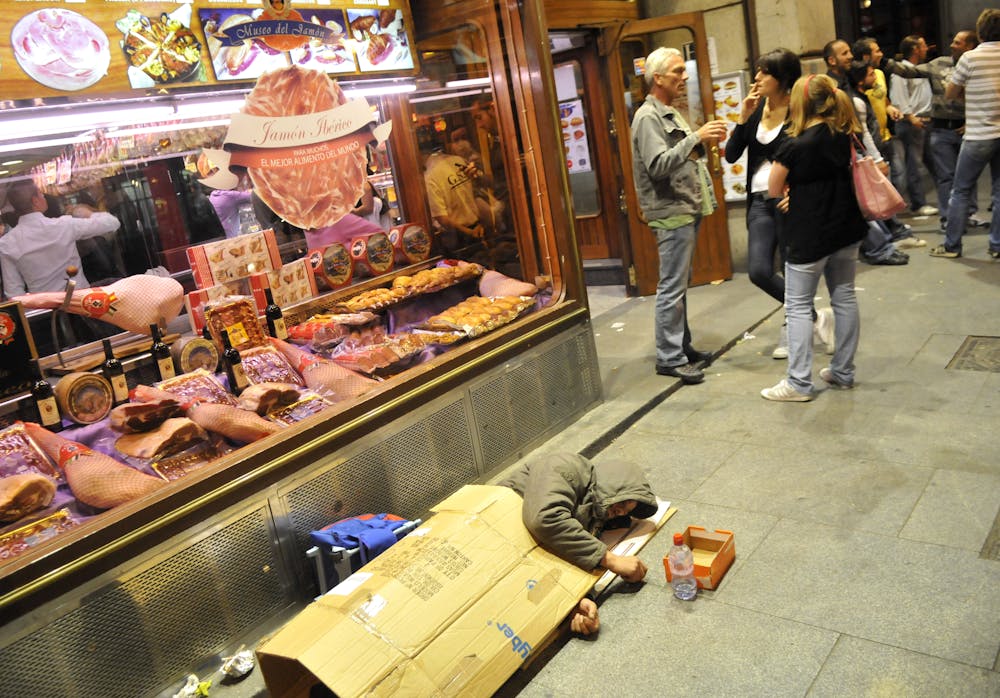
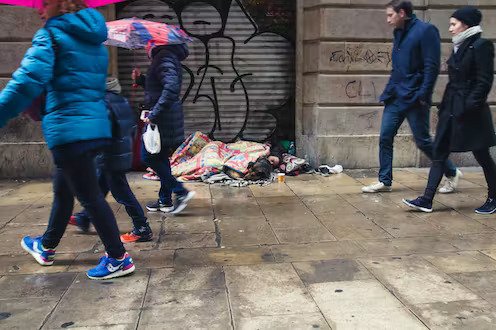
A homeless person in front of a bar in the centre of Madrid. Shutterstock / Bumble Dee
The poorest live shorter lives and get sicker
If homeless people are not to be hit by cancer, it is essential to make them visible to public systems. With this aim in mind, several Spanish, Greek, Austrian and British institutions have recently launched the EU-funded pilot project Cancerless together with FEANTSA.
Until the end of 2023, they will work with 1,500 homeless people in Madrid, London, Athens and Vienna, trying to increase their capacity to make better and more informed decisions about their own health. This involves, among other things, running workshops on healthy habits to prevent cancer and including all homeless people in screening programmes such as mammograms, cervical or colonoscopies.
Combining health education and social support is the best way to ensure that homeless people are not excluded from the process of early detection of cancer through prevention. To this end, the pilot activates a coordination figure between the social services system and the primary health care system called Health Navigator. This model implements actions to overcome health inequalities by working individually with those affected both in centres for the homeless and in health care centres.
The ultimate goal is to achieve health equity, i.e. that people can develop their full health potential regardless of their social position or other circumstances determined by social factors.