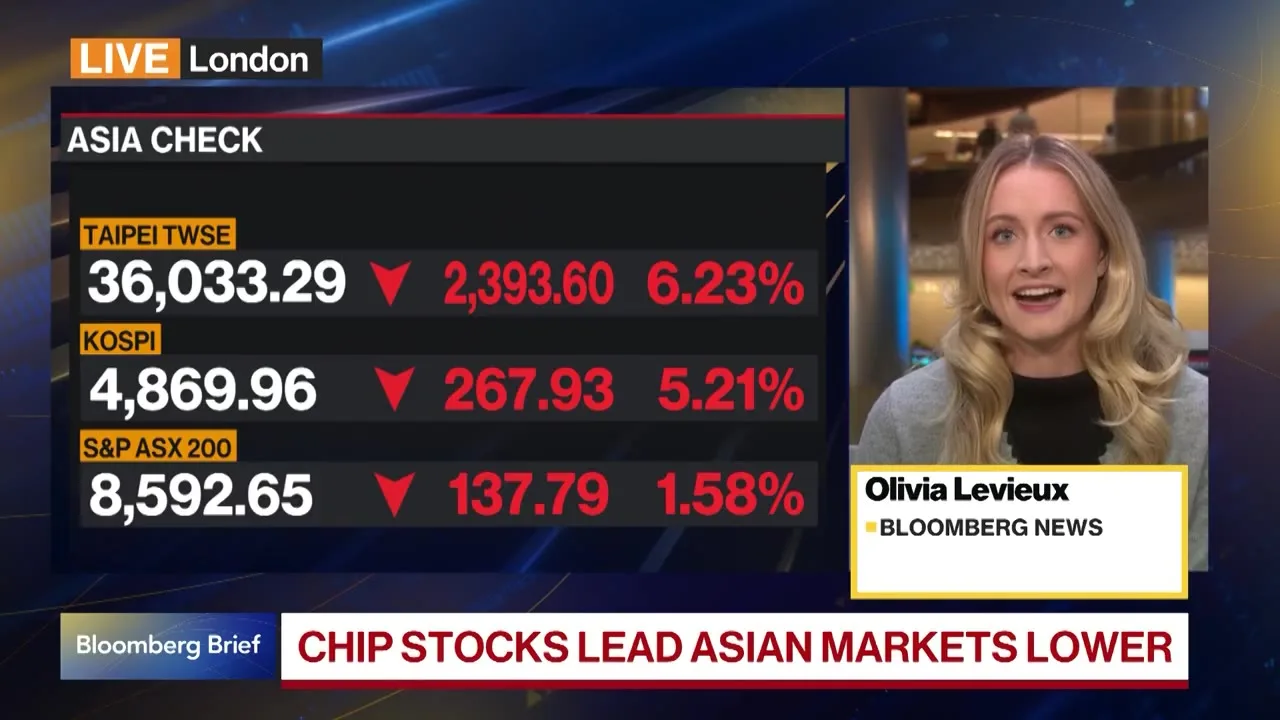
Asian stocks suffered their worst week since the pandemic as technology shares plunged, with South Korea’s Kospi losing more than 5% and Japan’s Nikkei nearly 9%, Bloomberg Television reported on Nov. 20.
Taiwan’s market fell by its most since 1991 despite short-selling restrictions, while bonds rallied across the region as investors sought safer assets. South Korean bonds were particularly strong, and India’s equity index outperformed during the session.
Anthropic fell 6.6% in premarket trading after rising above its initial offering price on its first day. The shares were trading near $90, compared with an offering range of $70 to $78 and an initial sale at $83.
Matt Bloxham said the debut still represented a success after investors had questioned whether the company could complete an initial public offering. He said Anthropic offered exposure to a software company focused directly on artificial intelligence, while other businesses supplying chips, data centres and energy faced pressure.
The technology selloff reflected several concerns, including rising U.S. regulatory risks for data centres, a leadership change at Nvidia, a short report on AMD and possible further restrictions on chip sales to China. Those issues have increased the risk to earnings across the artificial intelligence sector.
A Franklin Templeton representative said Anthropic’s offering helped answer questions about demand but did not provide a broad reading of investor sentiment. Only about 7% of the company’s shares were available for trading and retail investors received about 20% of the allocation.
Franklin Templeton said many artificial intelligence shares had traded at high valuations before the U.S. midterm elections. Investors were now reducing positions and revising their estimates as regulatory uncertainty around Nvidia increased.
The S&P 500 and Nasdaq broke below their 200-day moving averages, which the representative said could precede a period of weakness. The market could trade sideways in coming sessions while investors awaited more clarity on Nvidia.
Bloxham said a new Nvidia chief executive could reassure investors, while U.S. government investigations and findings about possible wrongdoing could also affect the sector. He said the timing of those developments was uncertain.
SpaceX sold $32 billion of bonds to finance Nvidia artificial intelligence chips, with yields topping 8%, in a deal structured to keep much of the borrowing off its balance sheet. Apple was also building an autonomous artificial intelligence agent able to browse the internet, control applications, write code and handle multistep tasks, potentially by the end of next year.
Copper faced its weakest selloff in a decade as doubts grew about artificial intelligence-driven demand. Weaker Chinese consumption, a stronger dollar and expectations for U.S. import tariffs added pressure.
In a separate segment, Bloomberg Television said Grand Theft Auto VI could support the video-game industry but would not solve its deeper problems. Analysts estimated that 18 million to 20 million people had preordered the game, producing about $2 billion in revenue for Rockstar Games.
Preorders could double to about 50 million over the next year. An online version could follow after players complete the story, allowing the company to generate further revenue through in-game purchases.