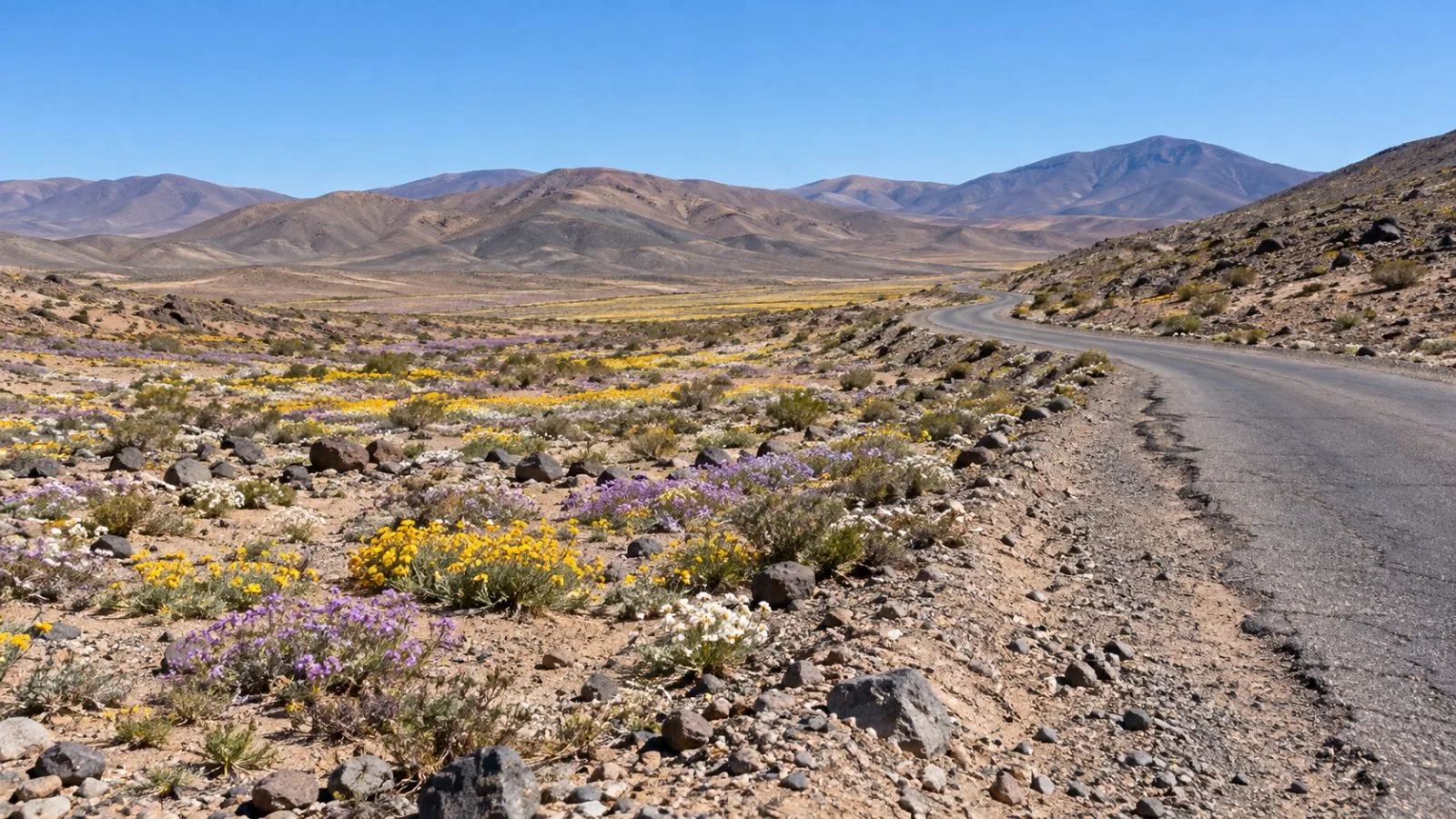
Chile’s Atacama region has begun its 2026 wildflower season, and a government-backed forecast projects plant activation across about 23% of the region, involving more than 200 native species.
The Atacama Regional Government said first flowers appeared in the second half of August, with larger fields visible from early September. A projection attributed to Corporación Nacional Forestal (CONAF), Chile’s national forestry corporation, and Servicio de Biodiversidad y Áreas Protegidas (SBAP), its biodiversity and protected areas service, put the minimum germplasm-activation area at approximately 17,667 square kilometers. Peak diversity and abundance were forecast around mid-October.
The projected activation footprint is distinct from a measured flower-coverage area. The Associated Press separately estimated visible bloom across about 17,000 square kilometers and reported that CONAF expected the season to be the most intense and extensive since 1997. A 2019 satellite study identified 13 Atacama greening events from 1981 to 2015, with its largest event in 2011 covering 11,136 square kilometers. That vegetation measure cannot be directly compared with either 2026 figure.
NASA’s Global Precipitation Measurement (GPM) Mission estimated that July-September precipitation was 150% above the seasonal average, or 2.5 times normal. The three-month total includes rain after the first flowers emerged in August. NASA said much of the precipitation fell Aug. 18, when a cutoff low steered tropical moisture toward the region. The agency cautioned that the connection between El Niño and the broader 2026-27 rainfall pattern may take years to evaluate.
Chile’s Servicio Nacional de Turismo (Sernatur), the national tourism service, said in an Oct. 16 release that accommodation occupancy stood at 75.2% in Bahía Inglesa–Parque Nacional Pan de Azúcar and 74.3% in Valle de Copiapó y Cordillera de Atacama, compared with 52.2% nationally. Sernatur linked visitor interest to the bloom but did not state the period covered by the occupancy figures.
CONAF directs visitors to travel by vehicle on Route C-382, stay on trails and leave native plants in place. The agency says collecting native flora threatens seed production for later blooms, and notes that plants and invertebrates can remain dormant beneath the sandy surface. The regional government said some species could continue flowering into the second half of November.