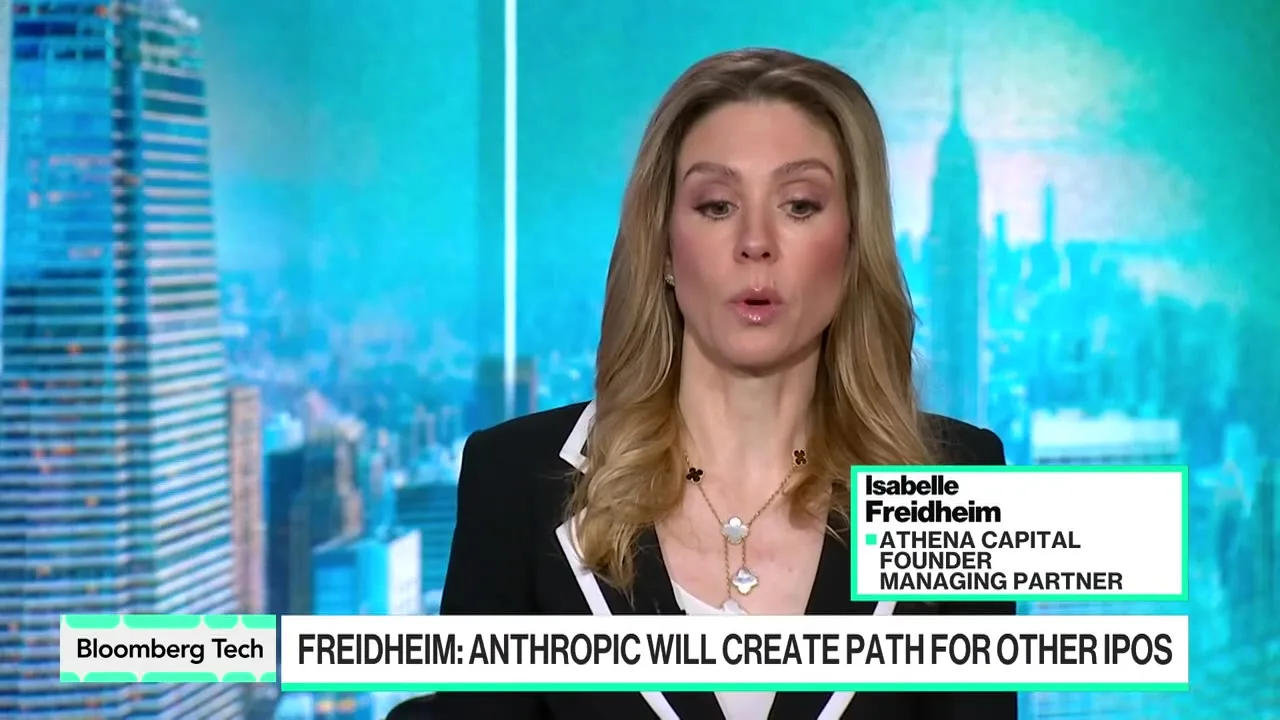
Private investors have captured much of the growth in artificial intelligence companies before public shareholders can buy in, Isabelle Freidheim, founding and managing partner of Athena Capital, said on Bloomberg Technology on Nov. 17.
Initial public offerings once tended to mark the start of an investment story, Freidheim said. Now, they more often give early investors and employees a way to sell their holdings.
Freidheim said a possible $1.4 trillion in value had accumulated in private markets before Anthropic reached public investors. She did not specify the basis for the figure.
Other companies considering listings will watch Anthropic's performance, she said. Some had been ready to go public five to seven years ago but had remained private, she said.
Freidheim said privately held companies valued at $1 billion or more reportedly had a combined valuation of $10 trillion. She did not identify the source of that figure.
Athena invests in businesses that help companies use AI more cheaply and efficiently, Freidheim said. They operate between the large language models that power AI tools and the data centers that provide computing capacity.
She put valuations for companies in that part of the industry at $10 billion to $20 billion. Some could be ready for a public listing or an acquisition soon, she said.
Freidheim said Athena invests in companies that are 12 to 36 months from a potential sale or listing. She said profitability matters for younger companies entering public markets, where investors may have less access to the early growth once available in technology stocks.
Profitable younger companies with a clear path to generating cash have yet to enter public markets, she said. Freidheim said she hoped that would happen soon, probably in 2027.
Companies go public to raise money and allow shareholders to sell, Freidheim said. She said Anthropic was raising almost $90 billion through an IPO and a private placement, more than private markets could absorb.
A listing can also help companies attract and compensate employees, provide shares for acquisitions and give management and early investors a way to sell their holdings, she said.
Freidheim said Anthropic was still losing money and had committed about $900 billion to computing. She identified computing costs, regulation and competition as risks to its business model.
“A company can be an extraordinary company,” Freidheim said, but that does not make it an extraordinary investment at any valuation. She did not say how Anthropic would perform after a listing or whether its business model would prove viable.