The Commonwealth Scientific and Industrial Research Organisation (CSIRO) estimates feral rabbits impose A$200 million in annual economic damage in Australia, as farms and native ecosystems bear the costs of a population that spread from a Victorian estate.
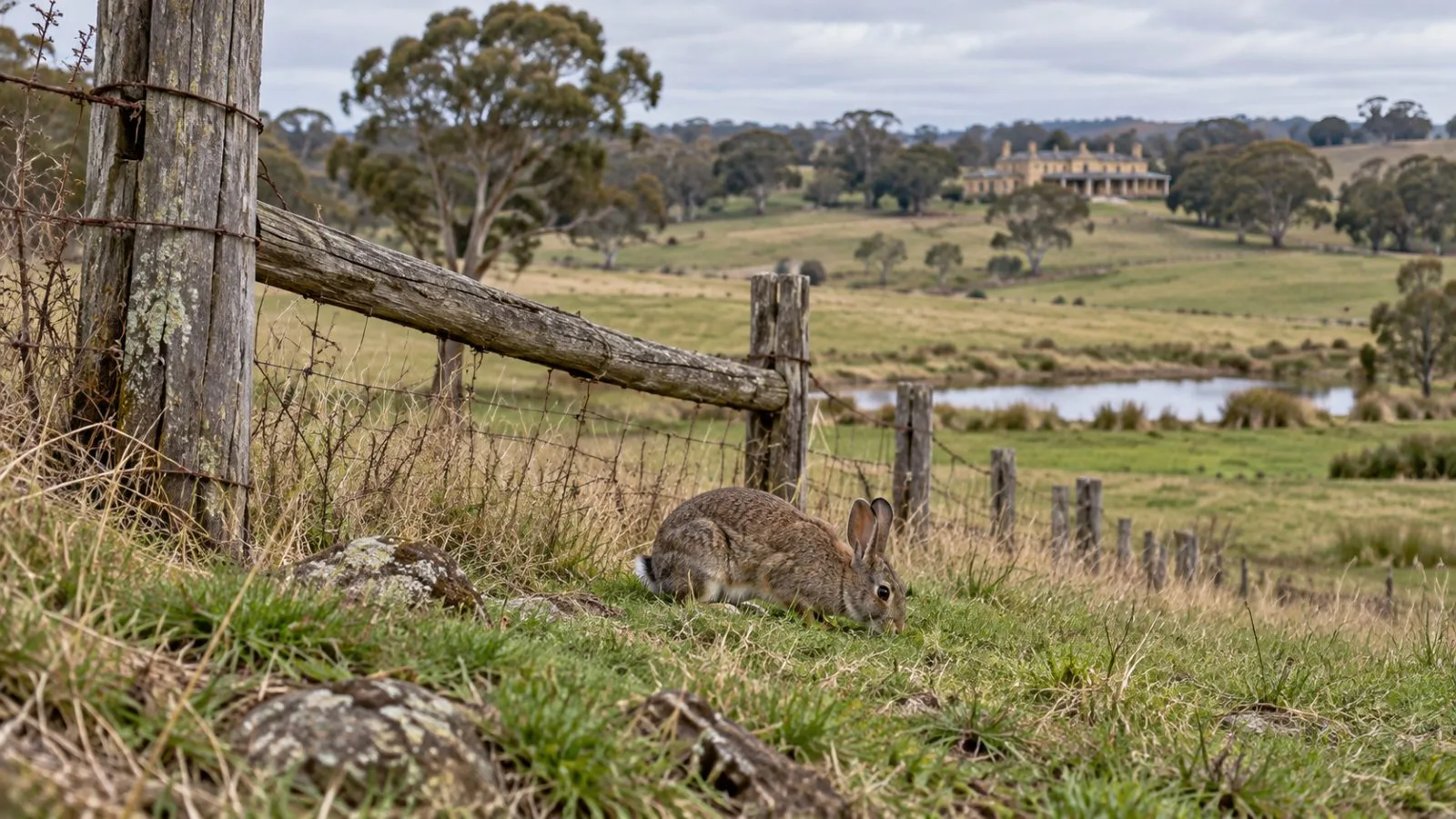
One pivotal release took place at Barwon Park in Victoria. In its history of the introduction, the National Museum of Australia credits Thomas Austin with releasing 13 wild European rabbits at Barwon Park on Dec. 25, 1859, as game for hunting. The Australian Government’s 2017 pest animal strategy instead attributes the release of 24 rabbits that day to the Victorian Acclimatisation Society. The federal agriculture department’s 2016 paper records 24 rabbits arriving from Europe and says 13 or more were let loose at Barwon Park.
The sources also use the figure 14,000 for different measures. The museum says hunters had killed that many rabbits on Austin’s estate by 1866. The federal background paper says Victoria’s rabbit population exceeded 14,000 within six years.
The museum dates the rabbits’ arrival across the Murray River into New South Wales to 1880, in Queensland to 1886 and in Western Australia to 1894. It says rabbits spread across two-thirds of Australia within 50 years; the federal paper says they dominated two-thirds of the continent within 70 years. The federal paper cites native burrows, farming-related habitat changes, few natural predators and further human introductions as factors that aided their spread.
Hunters gained a new quarry. The museum says rabbits supplied food during the 1930s Depression, while a separate museum feature describes pelts as another use. Farmers and ecosystems faced grazing pressure, competition with livestock, weed spread and erosion, according to CSIRO.
Western Australia’s 3,256-kilometer rabbit-proof fence was built from 1901 to 1907, but the museum says rabbits had already entered the state and fence damage left places they could cross. CSIRO says myxomatosis was released in 1950 and rabbit haemorrhagic disease virus (RHDV) in 1996. Rabbits developed resistance to earlier controls, and CSIRO says research and disease monitoring continue.