
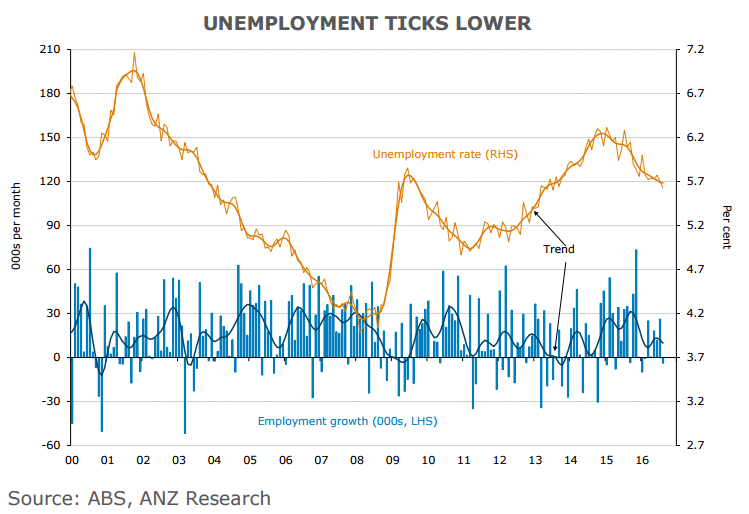
Data from the Australian Bureau of Statistics on Thursday showed Australia’s unemployment rate fell to a three-year low of 5.6 percent in August from 5.7 percent in July, and well below levels of more than 6.0 percent a year ago. 3,900 net new jobs were lost in August, a sharp contrast to forecasts of a 15,000 gain. Full-time positions rose 11,500 in August but the rise was not enough to make up for a plunge in July.
Hours worked fell and underemployment rose in Australia's labor market. The underemployment rate reached a record high of 8.7 percent in August, while the monthly hours worked decreased by 3.9 million. Participation rate of those in work or actively seeking employment fell along with employment. Participation rate, a measure of labor force as a share of population, declined to 64.7 percent from 64.9 percent, missing economists’ forecasts for 64.9 percent.
“Where you have an unemployment rate being brought down by the participation rate ... that is not the ideal way to say it’s a reduction,” said shadow treasurer, Chris Bowen.
The Reserve Bank of Australia (RBA) has already cut interest rates twice this year in response to falling inflation. The RBA recently forecast that inflation will remain below its 2 percent-3 percent target band over coming years, which means interest rates are more likely to fall than rise. Today's data shows spare capacity in the labour market is likely to depress wages and inflation as high spare capacity limits the ability of workers to push for pay rises.
“The continuing softness in full-time jobs and record-low nominal wages growth may partly explain why too many Australians say the economy doesn’t feel as strong as the good GDP growth data suggests,” said Shane Oliver, chief economist at AMP Capital Markets.
Australian shares rose for a second straight session on Thursday, the S&P/ASX 200 index closed up 0.2 percent, or 12.21 points, at 5,239.9. AUD/USD was trading at 0.7476 at around 11:15 GMT. Technical indicators on weekly charts are heavily bearish, scope for more downside. Break below 200-DMA at 0.7396 could see downside upto 0.7145 levels.


