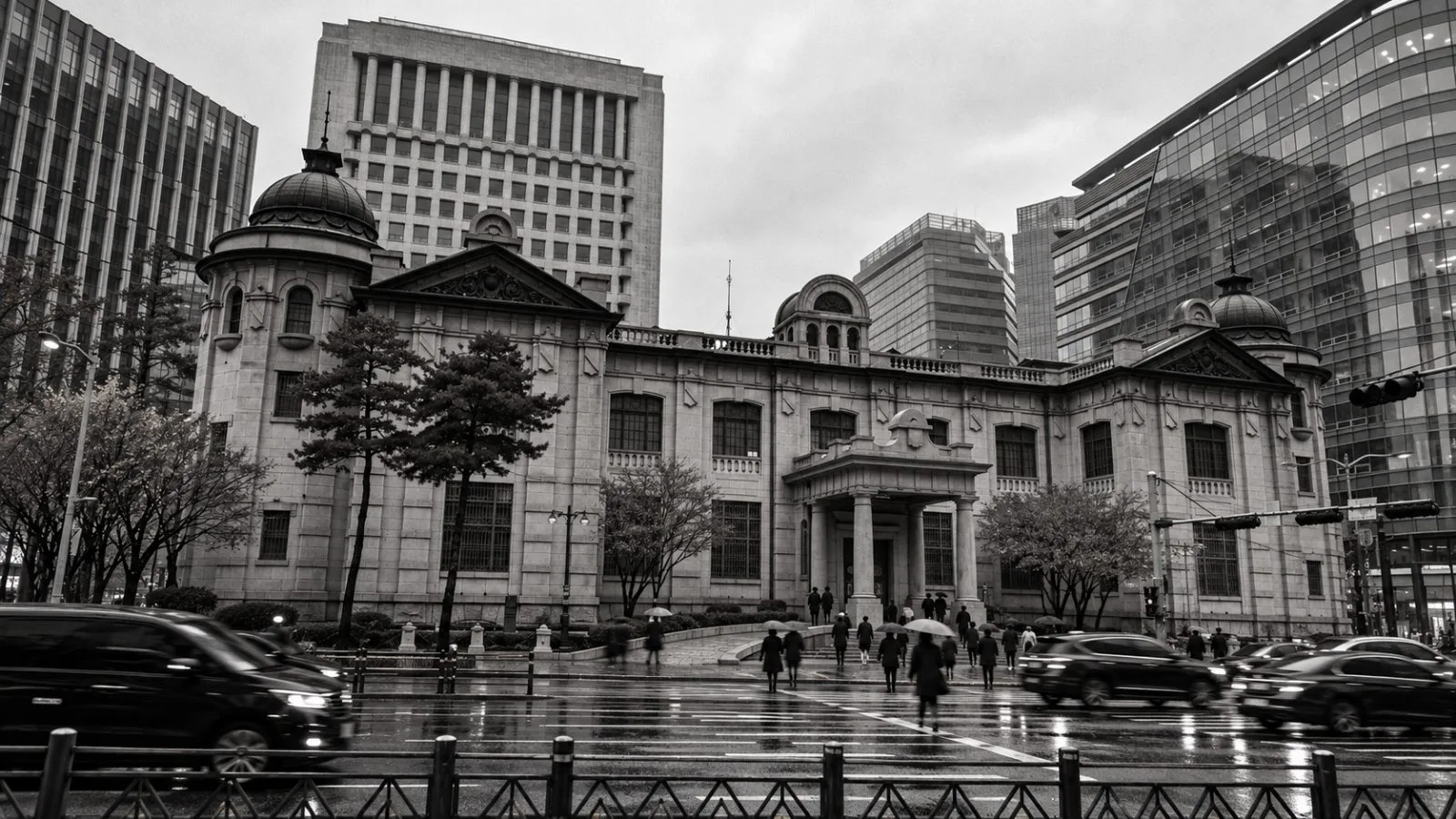
South Korea’s central bank, the Bank of Korea (BOK), held its benchmark rate at 3% Thursday, weighing inflation above target against housing debt risks as it assesses the effects of two recent increases.
Consumer prices rose 2.9% from a year earlier in September, down from 3.1% in August. Core inflation, which excludes food and energy, slowed to 2.8% from 3.4%, the Ministry of Data and Statistics reported. Both measures remained above the BOK’s 2% target. The central bank said accumulated cost increases were still feeding into prices and firmer demand could prolong above-target inflation. It cited oil prices, exchange rates, domestic demand and wage growth as sources of uncertainty.
Household borrowing showed mixed trends. The Financial Services Commission (FSC) reported that loans across all financial sectors declined by 2.2 trillion won in September, even as home-backed mortgages rose by 3.3 trillion won and bank-sector household loans increased by 0.6 trillion won. The Korea Herald reported that loans at the five major banks totaled 783.59 trillion won on Oct. 22, up 2.76 trillion won from the end of September. The outlet also reported concern that higher borrowing costs could weigh on lower-income households.
All seven members of the BOK’s Monetary Policy Board voted to hold the rate, the bank said. Two 25-basis-point increases in July and August had lifted it from 2.50% to 3.00%. The BOK cited uncertainty around the Middle East and policies in major economies as reasons to assess the effects of its earlier moves. The Korea Herald and Reuters reported that the back-to-back increases were the BOK’s first consecutive hikes since January 2023.
The BOK said growth in 2026 and 2027 was expected to exceed its August projections of 3.3% and 2.9%, respectively, but gave no revised estimates. It cited exports and investment, particularly in semiconductors, along with a gradual recovery in consumption.
The bank said it would weigh inflation, economic activity and financial stability before deciding whether and when to raise rates again. Its next policy meeting is scheduled for Nov. 26.