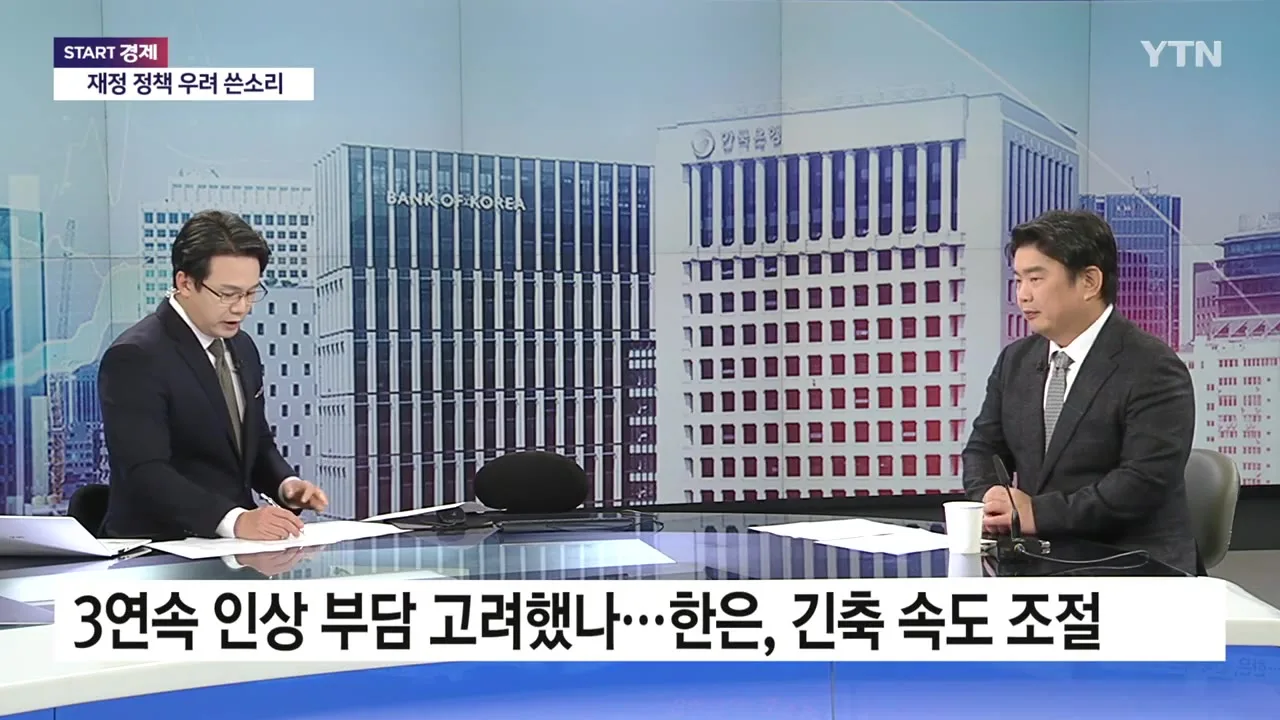
South Korea’s central bank is likely to raise interest rates in November after holding its benchmark at 3%, Lee Jung-hwan, an economics and finance professor at Hanyang University, said.
The pause followed increases in July and August and did not mark an end to efforts to contain inflation. Earlier increases had given the central bank room to leave rates unchanged.
Lee spoke on YTN’s Start Economy programme, published Oct. 22, following the Bank of Korea’s unanimous decision the previous day. He expected another increase if inflation stayed around its current level.
“Many expect one more increase in November if inflation stays at this level,” he said, in remarks translated from Korean. Strong economic growth could support demand and make further price increases harder to contain.
The debate over consecutive increases concerned how quickly to act. Raising rates early could restrain prices sooner, while a slower approach would allow policymakers more time to assess economic data.
Higher borrowing costs also create uneven burdens. Households with debt face larger repayment costs, while people with more savings can benefit from higher deposit rates.
Small businesses face weaker spending when rates rise, adding to difficulties for those already earning little. Construction is particularly sensitive because developers can postpone projects while they assess financing costs.
A construction slowdown could affect other industries and put pressure on future apartment supply. Lee gave no timetable for those effects.
Turning to government spending, he interpreted the central bank governor’s comments as an objection to funding permanent welfare commitments with temporary tax receipts from a semiconductor boom.
Welfare programmes are difficult to change once established. Spending obligations could therefore outlast the revenue that initially paid for them, leaving a shortfall when tax receipts fall.
One-time cash payments can support consumption briefly, but he questioned their benefit when the economy is already growing. He gave no estimate of their effect on spending or growth.
On petroleum price ceilings, Lee argued that prolonged controls could weaken incentives to conserve energy. Higher market prices encourage lower consumption and investment in technologies that use less energy.
He expected tight monetary policy to continue in both South Korea and the United States, linking that outlook to oil prices and demand. He did not specify the size of future rate increases.
On shares, Lee attributed recent weakness more to uncertainty over artificial intelligence investment and foreign investors taking profits than to the rate decision. He expected a rapid rebound to be difficult despite continuing company earnings, but gave no recovery date.