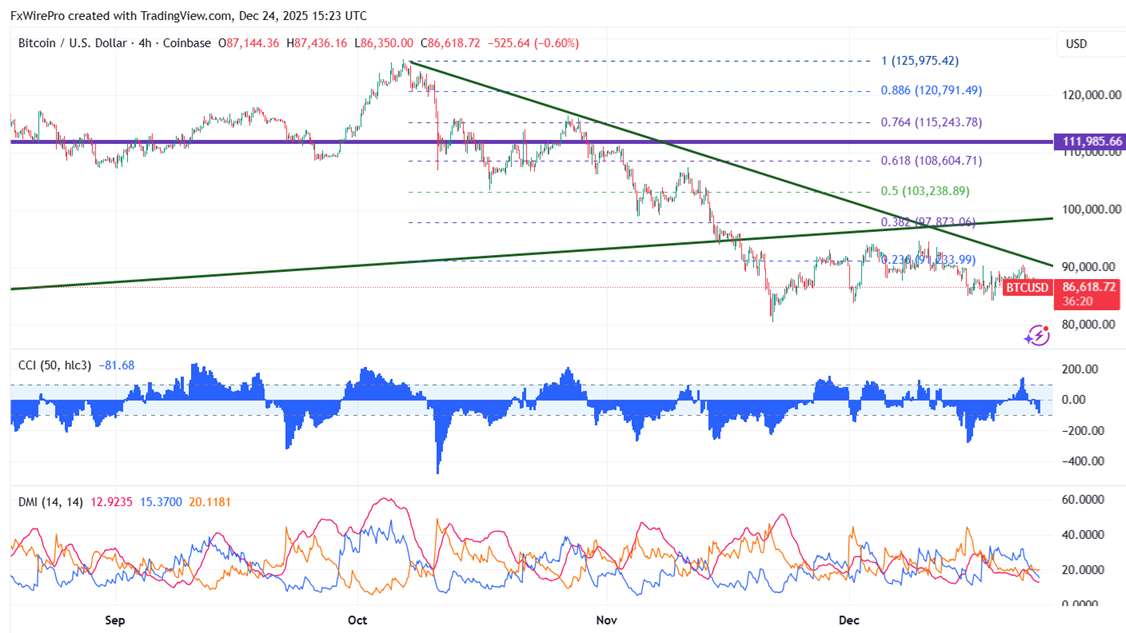
BTCUSD trades weak on ETF outflows. It hits an intraday low of $86450, and at the moment, it is around $86965.
Persistent net outflows from U.S. spot ETFs and less activity from major holders—thus producing a short-term demand vacuum—help to explain Bitcoin's recent fall below $87,000 mostly. November saw net outflows of $3.5 to $3.8 billion, the highest since February, with mid-December seeing ongoing redemptions—including days exceeding $300 million and one $161 million outflow—reflecting institutional profit-taking and year-end rebalancing. According to on-chain data, whales—those holding 10,000+ BTC—have sold nearly 36,500 BTC in December alone, with selling pressure up over 130%; their holdings are down 161,000 BTC net over the past year—a pattern commonly seen during corrections rather than recoveries. Moreover, the number of addresses having at least 1 BTC has dropped 2.2% since March, pointing to weakening belief among more powerful participants. Analysts point to ongoing downside risk or erratic range-bound activity until outflows stabilize and whales restart accumulation, estimating at requiring around $1 billion weekly to drive significant upside.
Oscillators and moving averages to forecast the trend of BTCUSD
CMP- $86965
EMA (4-hour chart)
55-EMA- $88160
200-EMA- $90786
365-EMA- $94870. The pair trades below the short-term and long-term moving averages.
Major Support - $85000. Any breach below $85000 will drag the pair down to $83000/$80000.
Major Resistance - $90000. Any break above $90000 confirms minor bullishness, a jump to $95415/$97400/$98500/$10000.
Indicators (4-hour chart)
CCI(50)- Bullish
ADX- Neutral
5. Investment Strategy for BTCUSD
It is good to buy on dips around $85000 with a stop loss around $80000 for target profits of $100000/$107000.