


 Robinhood Buys $25 Million in Bitcoin for Corporate Treasury
  BlackRock’s Rick Rieder Favors Bonds Over Stocks as Treasury Yields Surge
  Fed Unveils Stablecoin Rules Under GENIUS Act
  Litecoin Marks 15 Years as Grayscale Backs LTC ETF Push
  XRP Whale Activity Drops 27% in Eight Days Amid Market Sell-Off
  Australia Consumer Confidence Plunges as RBA Rate Hike Hits Households
  BOJ Raises Interest Rate to 31-Year High as Yen Weakens
  Solana Targets 200ms Block Time in Major Network Upgrade
  Yen in Focus as BOJ, Fed Rate Hikes Reshape Currency Markets
  Jameson Lopp Downplays AI Threat to Bitcoin Cryptography
  Fed’s Logan Signals 50 Basis Points More in Rate Hikes


 Add as a preferred source on Google
The Bank of Japan has kept monetary policy on hold at its meeting on 6-7 October, and maintained its overall economic assessment in the policy statement. The c.bank acknowledged risks from a slowdown in emerging markets but otherwise made little concession to recent weak data. The statement signals some genuine BoJ optimism in Japan's economy, reducing the chances of additional QQE at the end of this month.
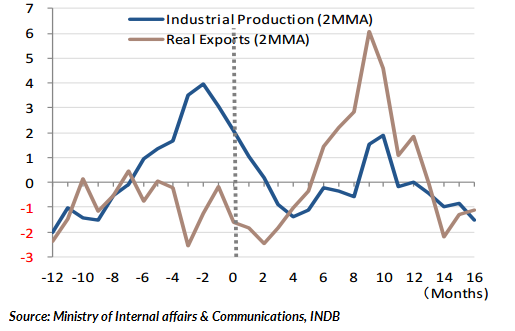
That said, the BoJ has been relatively slow compared to the Govt in revising down its assessment on the economy despite weak economic indicators. Skimming over some recent data, it is seen that August production was weak, declining for a second consecutive month, mainly due to the unstable export environment, especially to emerging economies including China. The latest Q3 BoJ Tankan survey confirmed that both manufacturers and non-manufacturers are cautious about Japan's business outlook.
Japanese government has already revised down its overall assessment on production, explaining that "Industrial Production has weakened", as opposed to "Industrial Production fluctuates indecisively" in the previous assessment. This implies that production is now weakening as a trend. The production data for September (to be announced on 29 October) is likely to show further weakness.
The BoJ is set to update its growth and inflation forecasts at the end of October meeting, with large downgrades widely expected, fueling expectations of additional QQE measures. The International Monetary Fund has also warned earlier this week that the central bank should ease monetary policy soon if it wants to hit Japan's inflation bull's-eye. However, the c.bank is likely to wait and see until end-October when the results from September economic indicators are released.
"The FY16 inflation projection will likely be revised down sharply from +1.9% and the central bank may finally admit that the 2% target will be difficult to achieve within the indicated time-frame. With regards to additional QQE measures, we expect the BoJ to increase the annual monetary base target to ¥85trn on an annual basis, up from ¥80trn, with the increase mainly directed at risk assets, including ETFs (about ¥3trn yen)", says Societe Generale in a research note.
Data today showed that Japan's machinery orders unexpectedly fell in August in a worrying indication that capital expenditure is weaker than many policymakers expected, which could increase the chances of new fiscal and monetary stimulus. Core machinery orders, a leading indicator of capital expenditure, fell 5.7 percent in August versus the median estimate for a 3.2 percent increase, and followed a 3.6 percent decline in the previous month.
USD/JPY extended the bearish momentum for a third straight session on Thursday. Nikkei dropped 0.99 pct to close at 18,141.17, triggering fresh demand for the yen. USD/JPY was trading at 119.80 and EUR/JPY was at 135.32 at 1010 GMT. Strong support for USD/JPY seen at 119.6O levels, breaks below could see the pair at 118.80 levels.

- News

- Economy

- Central Banks
- Investing
- Research
- Roundups
- Digital Currency
- Insights
- Technical Analysis
- Technology
- Business
- Law
- Health
- Nature
- Fintech
- Science
- Topic
- Opinions
- ©Econometrics LLC . All Rights Reserved.
BoJ to wait-and-see until end-Oct for additional QQE measures
Thursday, October 8, 2015 10:35 AM UTC
Editor's Picks



- Market Data
Most Popular




