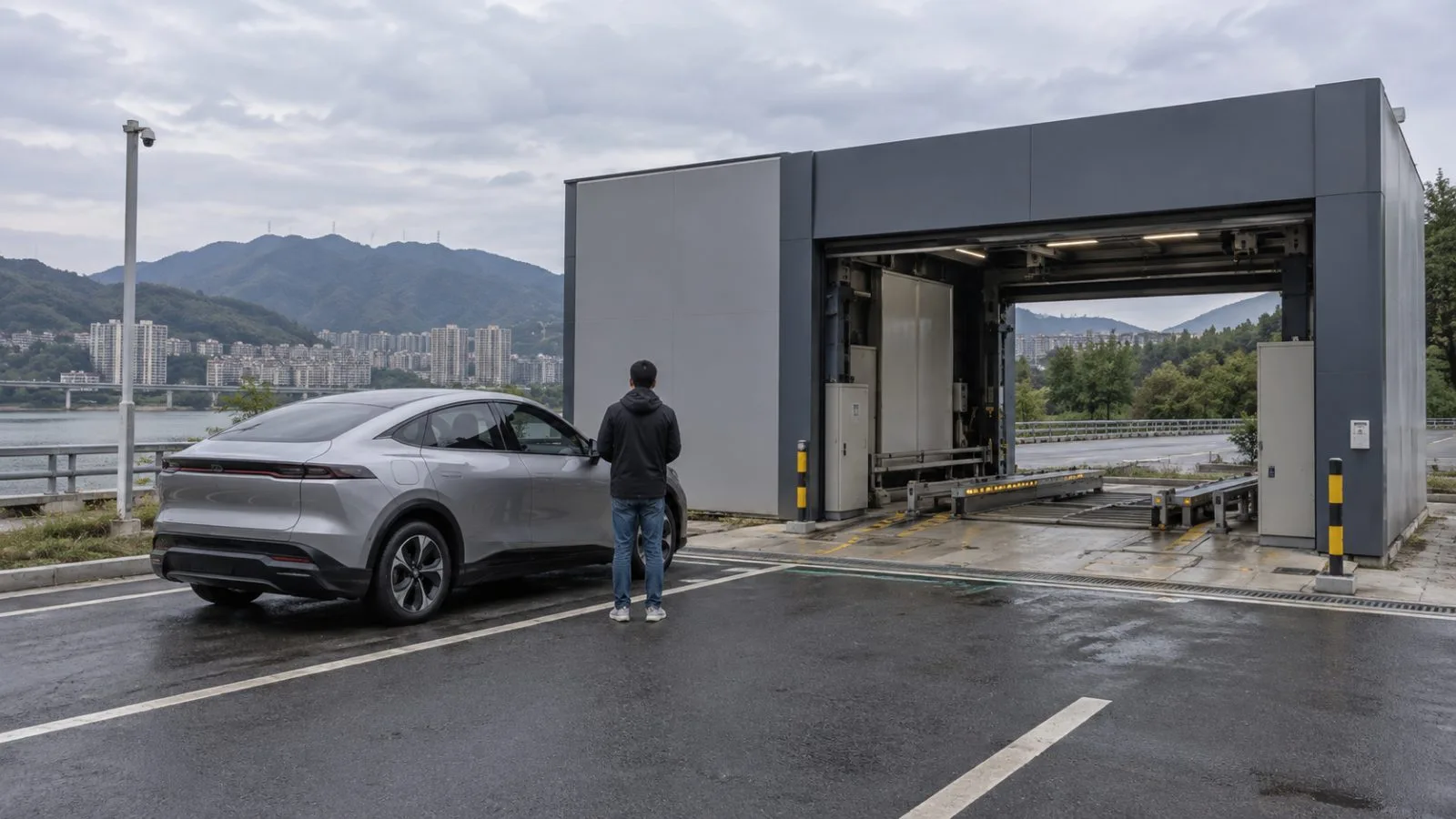
Contemporary Amperex Technology Co., Limited (CATL) plans a Chinese heavy-truck battery-swap network, targeting 900 sites by year-end 2026 and 2,000 by year-end 2027 in a bid to reduce freight downtime.
CATL introduced its QIJI Energy heavy-truck swapping system in 2023. The company says QIJI carries out battery changes automatically and takes only minutes. CATL separately agreed with Huawei-backed Yinwang on a program linking smart driving with battery swapping.
After switching trucks in July, Wang Bing told The Guardian a battery exchange takes about five minutes, compared with roughly 90 minutes to charge his former electric truck. The Hainan driver moves about five tonnes between Haikou and Dongfang on runs spanning roughly 500 kilometers round trip, the newspaper reported. “I don’t even need to leave my truck when the battery is being swapped,” he said.
A rental model can also lower the initial cost for truck buyers. Researcher Mao Shiyue of the International Council on Clean Transportation told The Guardian that a battery accounts for about 40% of an electric truck’s price; renting it can reduce the buyer’s upfront expense.
The network’s usefulness depends on station access and compatibility. Xue Lulu, a senior associate at World Resources Institute China, told The Guardian that battery designs and exchange methods vary among providers, potentially tying drivers to particular networks. Mao said swapping has worked best on predictable routes connecting ports, factories and nearby cities, while less predictable long-distance trips are harder to support.
The Guardian also reported that some drivers wait one to two hours outside swap stations to avoid peak-hour prices. Battery swapping has been used for smaller electric vehicles as well: Nio commercialized the model nearly a decade ago, the newspaper noted.
CATL and Octopus Energy announced their Swaptopus joint venture to develop a European battery-swapping network for electric trucks. The partners expect the first U.K. hubs in 2027 and plan more than 30 locations across Europe by 2035.