CERN’s LHCb collaboration has found evidence that a neutral B⁰ meson decays into two muons, a rare process that may reveal effects of particles beyond the collider’s direct reach.
CERN announced the result Nov. 3, calling it the first evidence for the decay from a single experiment. The combined signal reached 3.2 standard deviations. CERN says a result must reach five standard deviations to confirm the decay.
The LHCb paper reports that data collected in 2024 and 2025 during Run 3 produced a 3.0-standard-deviation signal on its own. The analysis used 18 inverse femtobarns of proton-proton collisions at an energy of 13.6 teraelectronvolts. Adding nine inverse femtobarns from Runs 1 and 2, gathered between 2011 and 2018, raised the combined significance to 3.2.
The measured branching fraction, the proportion of B⁰ mesons that undergo the decay, was 1.14 × 10⁻¹⁰. Its statistical uncertainty was +0.42/−0.39 × 10⁻¹⁰, and its systematic uncertainty was +0.06/−0.05 × 10⁻¹⁰. The paper gives the Standard Model prediction as (1.03 ± 0.05) × 10⁻¹⁰ and says the measurement is consistent with it.
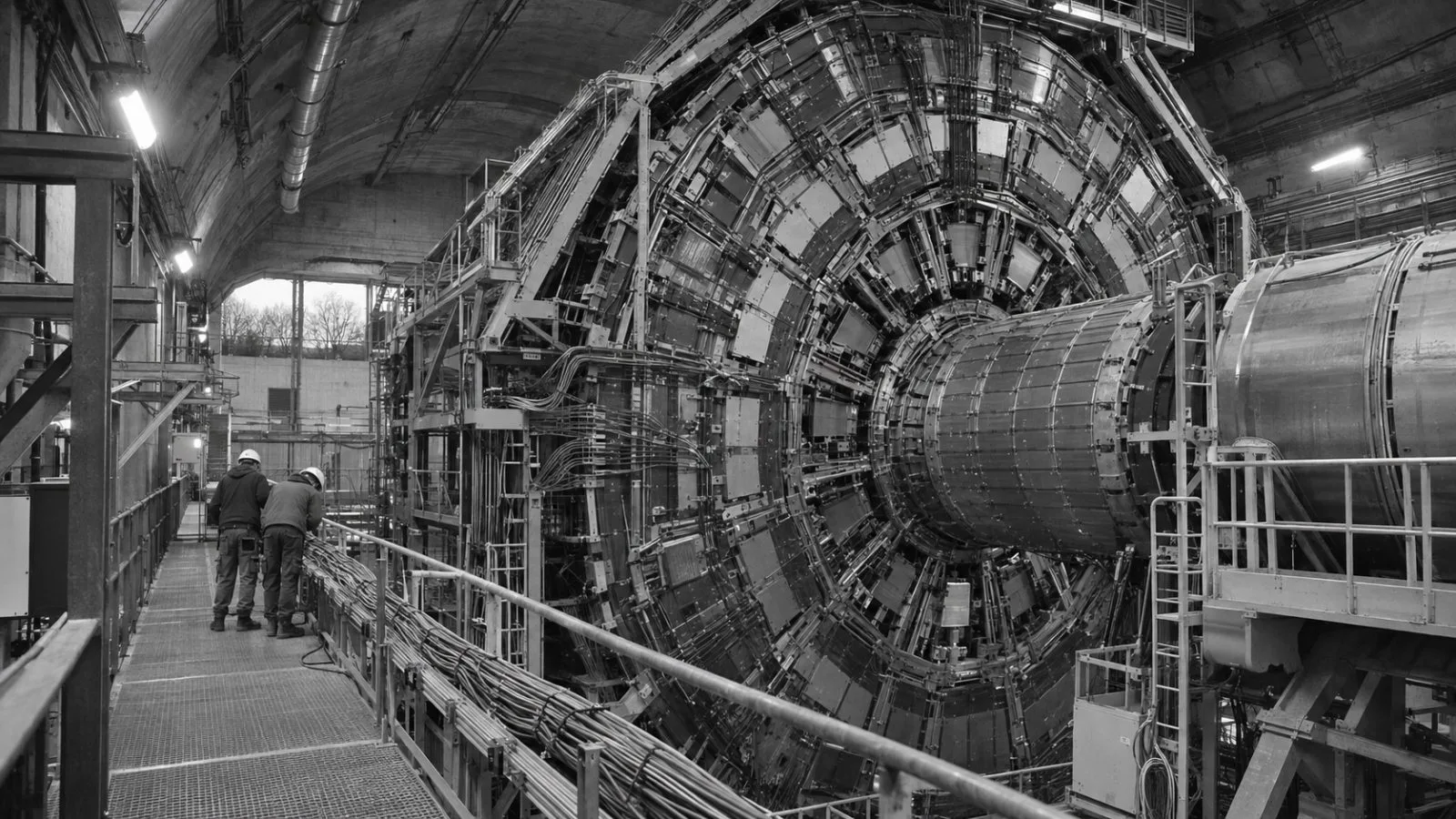
Because the Standard Model strongly suppresses this decay, a more precise measurement could reveal indirect effects from particles too heavy to produce at the Large Hadron Collider, the paper says. CERN said an LHCb upgrade in 2024 enabled the experiment to collect data at five times its 2010-18 rate. Improved particle identification and machine-learning methods also helped researchers distinguish the rare signal from background events.
The search began with the CLEO experiment in 1984. A joint LHCb and CMS result raised the possibility of evidence in 2015, but later analyses did not substantiate that finding.
CERN says further research will aim to reach five-standard-deviation significance. CERN says the High-Luminosity LHC’s planned 2030 startup and an LHCb upgrade planned for the mid-2030s could increase LHCb’s data-collection rate tenfold.