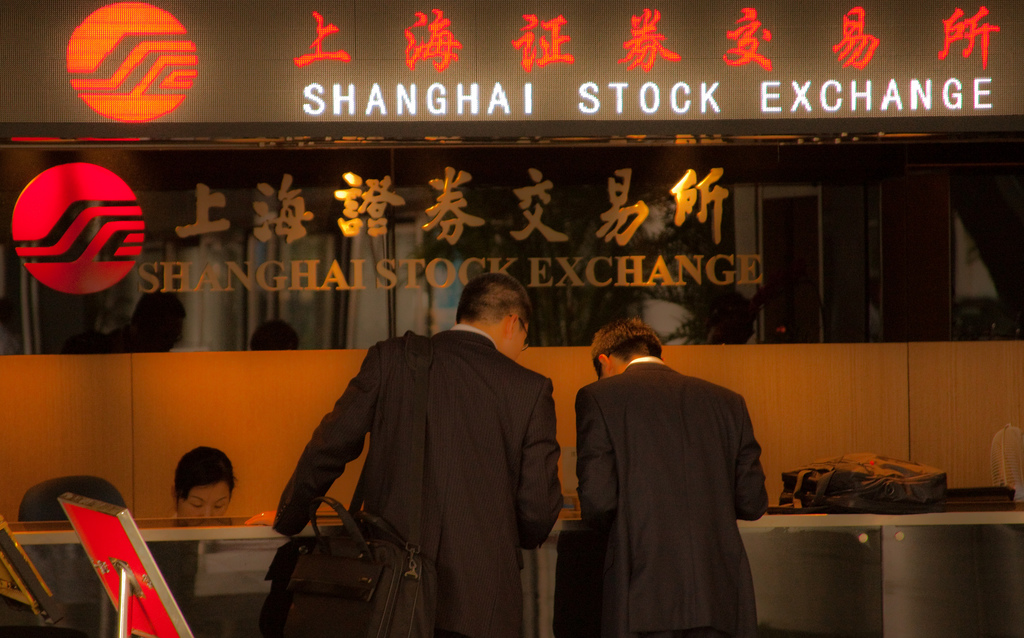
The Shanghai stock market has had a rough start to the New Year. Bourses are down and trading was halted on its opening day after the market plunged, triggering the new circuit-breaker mechanism designed to limit volatility. It looks as though 2016 will be no less turbulent for China’s stock market than 2015.
The Shanghai composite index is proving to be one of the most volatile markets in the world. It started at a value of 3,350 in January 2015, rising to a peak of 5,178 in June, then falling to a low of 2,850 in August. It then rose again to 3,650 and has now retracted to 3,290 – magically taking us back to where we started one year ago. A truly wild ride.

As I’ve tried to make clear in previous analyses, the dynamics of the Shanghai stock market are more akin to those of a casino than to those of a functional stock market. The January 4 drop was caused by a combination of fundamental and technical factors: weak manufacturing figures, lower expectations for China’s GDP growth this year, even lower credibility of official macro statistics and, paradoxically, the implementation of the new circuit-breaker regulation.
The new circuit-breaker mechanism, which was instituted for the first time on January 4, is one of a number of new rules recently introduced by Chinese regulators to try and minimise volatility, guarantee stock trading functionality and avoid irrational price swings. The mechanism offers a good example of how difficult it is for the Chinese government to control China’s volatile stock market – and some of the unforeseen consequences of doing so.
Under the circuit-breaker, trading in all stocks will be halted if the Shanghai main index, the CSI300, rises or falls by a certain percentage. Previously, trading in individual stocks would be halted only if that particular stock would swing by +/-10%, regardless of what was happening to other stocks or to the market as a whole. The new rule, instead, suspends trading in all securities, even if swings in a particular stock do not exceed the threshold.
The idea behind the circuit-breaker is that if the overall market index, the CSI300, experiences high volatility, then there must be something unusual in the market as a whole and the whole show must be halted.
The halting mechanism works in two stages: if the CSI300 rises or falls by 5%, then trading in all stocks is halted for a period of 15 minutes – to allow investors to “cool down”. Trading is then resumed after the 15-minute break. Should the market rise or fall by an additional 2%, to bring the daily swing to +/-7%, trading is halted for the whole day, as was the case on January 4.
Side-effects
As is often the case with policies that are hastily conceived, the circuit-breaker mechanism causes counter-intuitive side effects that may have the opposite effect of what was originally intended. The main goal of the circuit-breaker is to limit downward swings in the Chinese stock market. The side-effect, however, is that shareholders on the margins have an incentive to sell stocks more quickly than was the case before.
Under the old regulations, investors would find no buyers of their shares if only a particular share was suspended for volatile fluctuations in price. Now, under the new circuit-breaker mechanism, there is a second scenario under which sellers can find no buyers. Hence the greater potential for a sell-off at the prospect of a trading being suspended in a kind of race to the bottom. This increased propensity to sell would trigger more downward volatility, the opposite of what Chinese policy makers are hoping to achieve with the circuit-breaker.
If we combine this technical aspect of the stock market with the continuing deterioration of growth in the Chinese economy, the growth of alternative investment vehicles, such as bonds, and the gradual opening up of the capital account that would offer Chinese investors more room to choose international-based assets, we can expect further volatility in the Shanghai stock market. The Chinese government will continue to put fixes in wherever possible. But, as we’ve seen with the circuit-breaker, these can have unforeseen results.
 Michele Geraci does not work for, consult, own shares in or receive funding from any company or organization that would benefit from this article, and has disclosed no relevant affiliations beyond the academic appointment above.
Michele Geraci, Head of China Economic Policy Programme, Assistant Professor in Finance, University of Nottingham
This article was originally published on The Conversation. Read the original article.