


 Circle Stock Falls 4% as Crypto Selloff Overshadows SAP Pay Expansion
  DogecoinVM Makes DOGE Transactions 300x Faster
  Kazakhstan and Tether Explore Tenge Stablecoin and RWA Tokenization
  Bitmine to Stop Ethereum Buying After Reaching 5% ETH Supply
  XRP Whale Activity Drops 27% in Eight Days Amid Market Sell-Off
  Solana Price Drops 3% Despite Samsung USDC Partnership
  Dogecoin Liquidations Surge as DOGE Bulls Face Heavy Losses
  Bitcoin Rebounds to $82K as Trump Eases Iran War Fears
  Cardano Price Eyes $0.30 as ADA Whale Activity Surges
  Zcash Privacy Demand Rises as AI Exposes Bitcoin Transactions
  Chainlink Price Drops 3% Despite New CCIP Vault Launch
  XRP Ledger Activates New Security Feature for Banks and Stablecoins
  Evernorth XRPN Nasdaq Listing Delayed to October 12


 Add as a preferred source on Google
Recent price action at the long end has also prompted many market participants to raise concerns about a sharp selloff as China reduces its Treasury holdings. We believe the impact on long-term rates is unlikely to be significant for a few reasons.
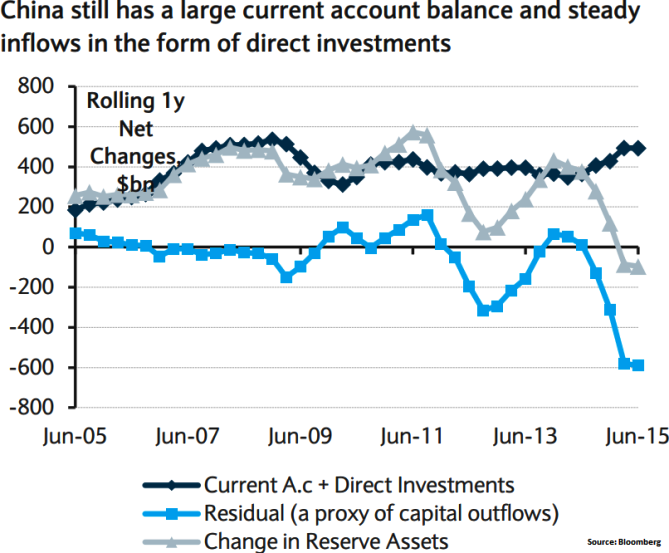
First, China is still running a large current account balance and continues to see steady inflows related to direct investments. Figure shows that over the past year (ending June 15) the two have accounted for roughly $490bn in inflows (Current Account = $290bn + Direct Investments = $200bn). With the currency weakening, the trade balance is likely to grow (even if it stays unchanged as a share of GDP, it should still grow in absolute terms). Hence, China can withstand significant amount of capital outflows, before having to significantly reduce its FX reserves, in our view. Note while reported FX reserves declined roughly $300bn between June 14 and June 15, the actual decline in reserves was only $96bn; the rest was due to currency adjustments. In fact in Q2 15, reserves rose $13bn.
Second, while in recent days, there may very well have been a reduction in China's Treasury holdings, we believe that should not have had much of an effect on long rates. Since the distribution of China's holdings is not reported, we use this as a proxy. The average maturity in mid-2014 was four years with 75% of holdings less than five years and this maturity profile has remained stable, suggesting a desire by official investors to keep the portfolio relatively in the front end. Hence, any reduction should not have been a major duration supply event. In fact, China's (+Belgium's) Treasury holdings have been already been declining since the middle of last year without much of an effect, in our view.

- News

- Economy

- Central Banks
- Investing
- Research
- Roundups
- Digital Currency
- Insights
- Technical Analysis
- Technology
- Business
- Law
- Health
- Nature
- Fintech
- Science
- Topic
- Opinions
- ©Econometrics LLC . All Rights Reserved.
Chinese monetary policy measures may disrupt treasury holdings
Friday, August 28, 2015 11:58 AM UTC
Editor's Picks



- Market Data
Most Popular




