Across 240 physical robot trials, programs developed with Anthropic's Claude Opus 5.5 succeeded 221 times without live model guidance, testing whether AI-built instructions can operate after the coding stage ends.
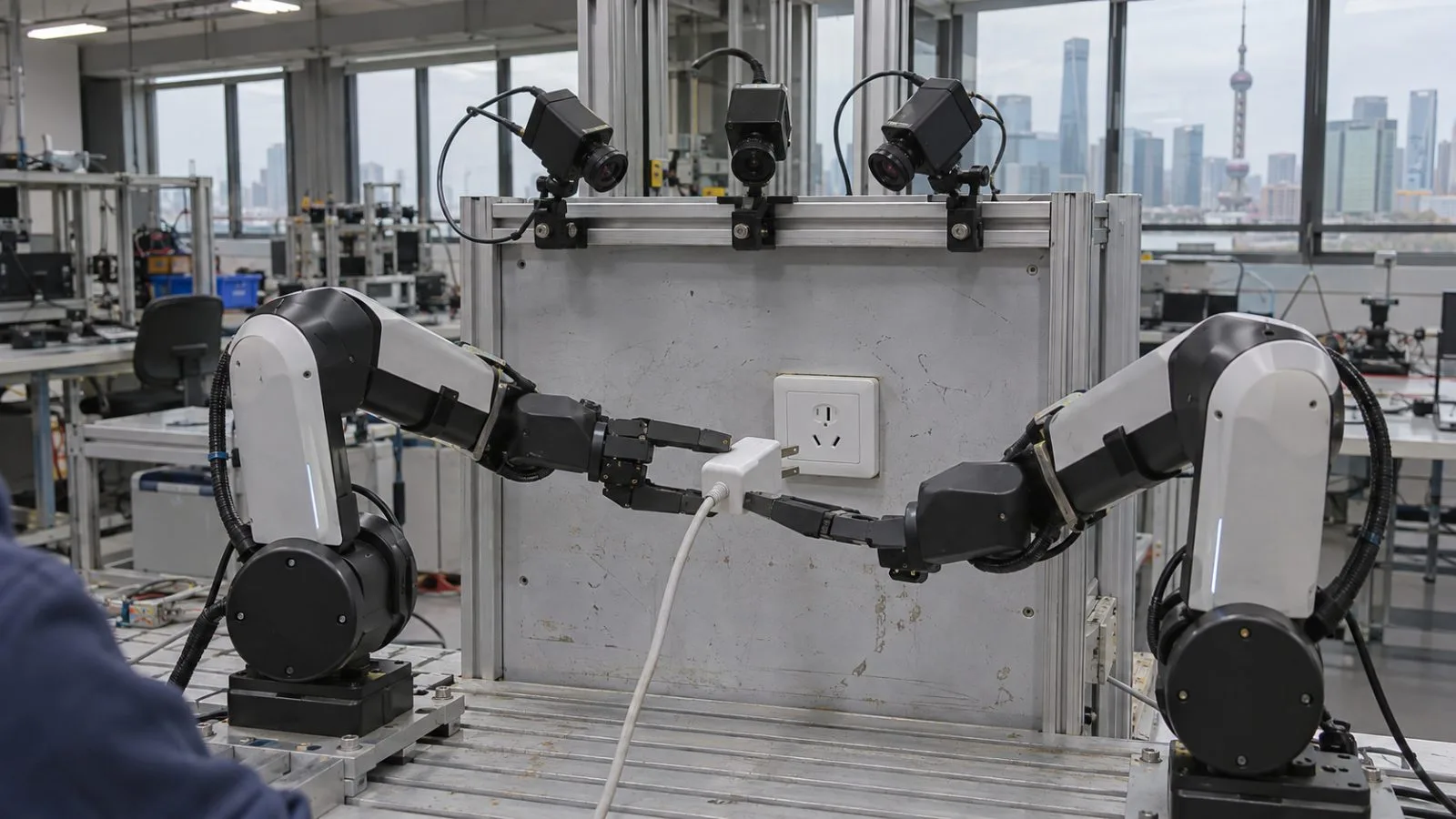
The ACE-CaP Team submitted the preprint Nov. 12. It reports a 92.1% success rate across eight tasks, each run 30 times on a dual-arm platform fitted with three cameras.
The robot performed trials without people or the coding agent directing its movements, and each task's program stayed unchanged through all 30 attempts. Runtime observations could change the values and actions produced by the fixed rules.
The setup paired two Agilex PIPERX arms with three Orbbec DaBai DC1 cameras. The tasks spanned packing bread and shoes, inserting a charger and a flower, uncapping a bottle, nesting cups, plating chicken and reorienting a parcel.
Bread packing had the fewest successes, with 25 of 30; chicken plating logged 29, while charger insertion succeeded 30 times. Parcel reorientation and cup nesting each reached 28, while shoe packing, flower insertion and bottle uncapping each recorded 27.
Mean physical execution times were shortest for parcel reorientation at 0.97 minutes and longest for shoe packing at 2.27 minutes. Because no live-model comparison group was tested, the paper cannot show whether the fixed programs were faster than keeping a model active during execution.
The paper frames the approach as a resource trade-off: repeated model calls can extend a task, while physical trials use robot time and may need human-assisted resets. During development, people gave written guidance and demonstrations, and the coding agent tested revisions in simulation. Each task had a cap of 10 scene resets with human help, while resets for collecting demonstrations fell outside that limit.
The results come from eight tasks on one dual-arm platform. The study did not test reuse under new conditions, and the team wrote that “consistency across independent development runs remains to be established.” The investigation involved one development run per condition for one task.