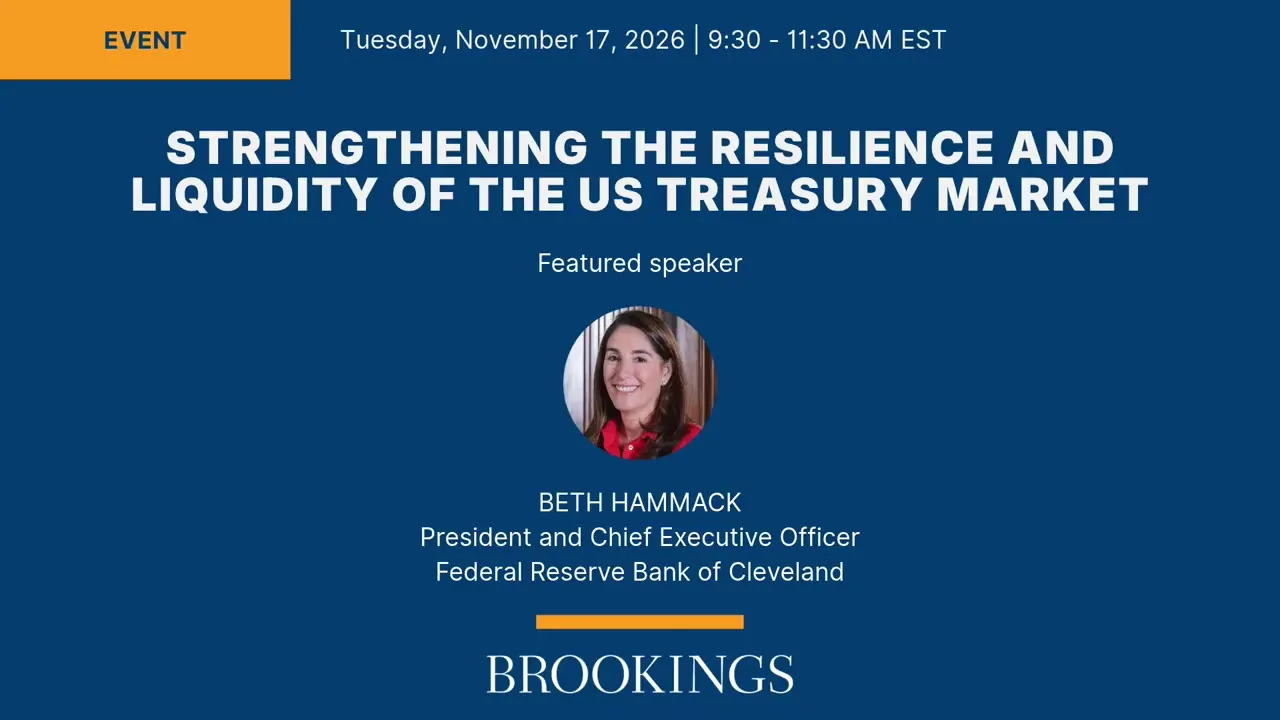
Federal Reserve Bank of Cleveland President Beth Hammack called for advance guidance on intervention in the roughly $32 trillion U.S. Treasury market, drawing on lessons from the pandemic, at a Brookings Institution event published Nov. 18.
Hammack said policymakers should agree on when the Federal Reserve would intervene, what form its action would take and how it would explain the decision. Clearer communication could also help the public understand when support would end.
Speaking at “Strengthening the Resilience and Liquidity of the US Treasury Market,” she said the government bond market underpins borrowing costs for households and businesses. Treasury securities also serve as collateral for loans, holdings that can be readily sold, and assets held in reserve around the world.
The Cleveland Fed president said problems in that market could spread to the economy. Treasury yields help determine rates on mortgages and corporate bonds, among other forms of borrowing.
The Securities and Exchange Commission is the primary regulator of the Treasury market, while several agencies share oversight. The Fed participates through the New York Fed’s trading operations and conducts Treasury auctions and buybacks on the government’s behalf.
Hammack said the Fed has the operational experience and funding capacity to intervene when trading conditions deteriorate. The Treasury funds its buybacks through planned debt sales, she said.
The Fed bought $775 billion in Treasury securities in March 2020 after increasing the size and frequency of its daily market operations, Hammack said. She said the actions helped restore order after the pandemic disrupted markets and the economy.
Those purchases initially aimed to improve market functioning, but economic conditions soon required purchases to support monetary policy, she said. Over time, the overlapping purposes made it harder for market participants to distinguish between them.
A clearer distinction would help the public understand when intervention was no longer needed and when the Fed would sell the securities it bought, Hammack said. She also called for an explanation of how policymakers determined that market stress was abnormal and why the Fed was suited to address it.
She said the Fed could create a separate portfolio to distinguish purchases for financial stability from those intended to provide monetary stimulus. A temporary facility for supporting market functioning was another possible approach, though she said the Bank of England’s 2022 model would not translate directly to the United States.
Hammack said the U.S. market for repurchase agreements, short-term loans backed by securities, is broad enough for the Fed to work through its usual bank and dealer counterparties. The Fed also has standing facilities, including one introduced in July 2021 to help keep short-term rates within its target range.
She did not set out a specific threshold for intervention or commit the Fed to establishing a separate portfolio or facility. She said her views were her own and did not necessarily represent those of the Federal Reserve or her colleagues on its policy committee.