Most Americans express strong support for environmental protection in surveys, yet far fewer consistently practice conservation behaviors. This gap between intention and action represents one of the central challenges in addressing climate change at the household level. When sustainable choices require ongoing effort or constant vigilance, even well-intentioned individuals struggle to maintain those behaviors over time.
Research in behavioral psychology reveals why this happens. Conservation fatigue occurs when sustainable choices demand continuous conscious decision-making rather than becoming automatic defaults. The most successful environmental technologies succeed not by appealing to environmental conscience, but by making conservation the path of least resistance. Companies like Irrigreen exemplify this principle in residential irrigation.
Consider technologies that have achieved mass adoption. LED light bulbs succeeded because they provided better light quality, longer lifespan, and lower costs. Programmable thermostats gained traction by improving comfort and reducing bills, with conservation happening as a byproduct. These technologies make sustainable choices easier, cheaper, or more convenient than wasteful alternatives.
Residential irrigation represents an ideal testing ground for effortless conservation. Traditional approaches have relied on behavioral campaigns asking homeowners to manually adjust schedules, comply with restrictions, or accept brown lawns. These approaches achieve limited success because they require sustained willpower. Precision irrigation technology inverts this dynamic, making conservation the automatic default while delivering better results.
The Friction Factor: Why Traditional Conservation Requires Constant Vigilance
Traditional water conservation approaches fail at scale because they misunderstand how most homeowners interact with irrigation systems. Manual schedule adjustment represents the most common recommendation: reduce watering during cool periods, extend it during heat waves, pause after rainfall, and adjust seasonally. This assumes homeowners maintain constant awareness of weather conditions and possess time to make frequent controller adjustments.
The reality differs dramatically. Most people program their irrigation controller once and rarely adjust it again. The controller sits in a garage or utility closet, often requiring cryptic button sequences to modify settings. By the time homeowners notice their lawn needs adjustment, visible stress or waste has already occurred. The cognitive burden competes with countless other household responsibilities.
Rain sensors represent the most common technological intervention. These devices theoretically pause irrigation when precipitation occurs. In practice, rain sensors add friction rather than removing it. They require installation, maintenance, battery replacement, and calibration. Many homeowners disconnect them after sensors malfunction.
Drought-tolerant landscaping offers a more permanent solution, but requires aesthetic preference shifts that many resist. Cultural preferences for green lawns run deep across American suburbs. The upfront cost and effort of landscape renovation create another barrier.
Behavioral restriction campaigns represent municipal responses to drought. "Water only on odd days," "limit to twice weekly." These rules rely on continuous voluntary compliance, with effectiveness varying by individual willingness. Enforcement proves difficult and often inequitable.
The exhaustion problem compounds over time. Initial enthusiasm erodes as novelty wears off and ongoing effort accumulates. Research on habit formation shows that behaviors requiring continuous conscious effort rarely persist beyond a few months. Traditional conservation approaches ask homeowners to maintain indefinite vigilance against their irrigation system's default behavior.
This creates a perverse dynamic where waste becomes the default state and conservation requires active intervention. Systems run during rainstorms unless someone remembers to pause them. Sprinklers water at full duration during mild weather unless someone manually reduces runtime. Each conservation opportunity depends on homeowner awareness.
Set-and-Forget Intelligence: The Irrigreen Automation Advantage
Precision irrigation fundamentally inverts the friction dynamic by making conservation the automatic default. After initial setup, taking perhaps an hour, the system optimizes continuously without requiring user input. Waste becomes the action requiring active override, rather than conservation being the choice demanding vigilance.
Weather responsiveness eliminates the most obvious source of waste. The controller integrates local weather forecasts—pausing or adjusting watering when rain is detected. When overnight storms provide adequate moisture, the next scheduled cycle cancels automatically. The homeowner never needs to remember to pause the system.
The system's smart technology uses weather forecasts and algorithms, paired with information on each area of the lawn, to determine just how much water is actually needed. During hot, dry periods, it extends watering duration automatically. During cool, humid periods when evaporation slows, it reduces the application. These adjustments happen continuously based on actual conditions.
The app's weather intelligence makes smarter decisions over time, and users can easily adjust watering levels through intuitive app controls. As daylight hours lengthen in spring and grass growth accelerates, homeowners can increase schedules with simple slider adjustments. As fall approaches and growth slows, they can scale back just as easily—no complex reprogramming required.
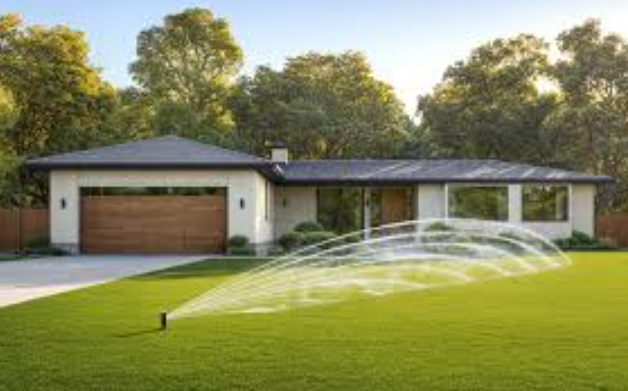
Boundary intelligence represents perhaps the most visible automation benefit. Traditional systems cannot distinguish between grass and hardscape, spraying water onto driveways and sidewalks. Precision systems program spray patterns during initial setup to conform exactly to lawn boundaries, then maintain that precision indefinitely.
The user experience perspective reveals why this matters. One homeowner reported: "I haven't touched the settings in eight months and the lawn looks better than when I was constantly adjusting my old system." This liberation from irrigation management represents the core value proposition. Conservation happens automatically as a byproduct of pursuing healthier lawns.
The "accidental environmentalist" phenomenon captures an important insight about successful conservation technology. Many adopters initially focus on convenience, lawn quality, or cost savings rather than environmental impact. They discover only after installation that they're conserving thousands of gallons annually without conscious effort. This alignment of individual convenience with collective environmental benefit represents ideal technology design. User communities frequently document this experience, emphasizing convenience benefits that yield environmental impact as a byproduct.
Remote control accessibility removes final friction points. Forgot to pause irrigation before vacation? Traditional systems require physically visiting the controller. Precision systems pause through smartphone apps from anywhere. Notice the forecast predicting rain? Delay the scheduled cycle remotely. Visual documentation from users consistently shows the transformation from wasteful traditional systems to precision delivery.
Scaling Conservation Through Technology: When Individual Convenience Creates Collective Impact
Individual household convenience matters for utility bills and lawn health, but broader significance emerges when examining what happens as adoption scales. If sustainable choices are easier than wasteful alternatives, adoption accelerates beyond environmentally conscious early adopters into the mainstream market.
Historical parallels illuminate this pattern. Hybrid vehicles achieved scale not through environmental marketing but when Toyota emphasized reliability and low operating costs. The Prius became aspirational for reasons having little to do with emissions reduction. Conservation happened as a byproduct.
Precision irrigation follows this trajectory. Initial buyers include tech enthusiasts and conservation-motivated homeowners. The growing market encompasses convenience seekers and cost-conscious households who discover smart irrigation delivers better results with less effort.
The potential impact becomes clear through mathematics. The United States has approximately 40 million residential irrigation systems installed. If 25% adopted precision technology, achieving 50% water reduction, annual savings would reach 45 billion gallons. Compare this to alternative approaches requiring behavioral compliance: achieving even 10% sustained voluntary behavior change proves extraordinarily difficult. Irrigreen installations demonstrate this scalability potential, with each system contributing to collective water conservation without ongoing user effort.
Municipal implications reveal why technology-enabled conservation offers advantages over restriction-based approaches. Drought response traditionally depends on voluntary restraint enforced through restrictions and penalty pricing. Compliance varies significantly, enforcement proves difficult, and burden falls inequitably. Technology-enabled reduction delivers reliable savings without requiring ongoing behavior change.
Utility perspectives reinforce this advantage. Every gallon not consumed through efficiency improvements is a gallon that doesn't require extraction, treatment, and distribution. For municipalities facing pressure to expand water supply through expensive desalination or imported water, residential irrigation efficiency offers lower-cost alternatives. Some water districts now offer rebates of $500-1,500 for high-efficiency irrigation installations.
The climate adaptation framework provides the final context for why effortless conservation matters increasingly. Communities face false choices between brown landscapes and unsustainable consumption. Precision irrigation enables a third path: maintaining quality of life with green spaces while reducing resource consumption to sustainable levels.
The best environmental technologies become invisible in daily life, working quietly while users enjoy improved outcomes. Precision irrigation achieves this ideal by removing friction from sustainable choices. Homeowners never think about irrigation management, yet they achieve healthier lawns with half the water. That alignment of convenience with conservation represents effective climate adaptation infrastructure delivered at the household scale.