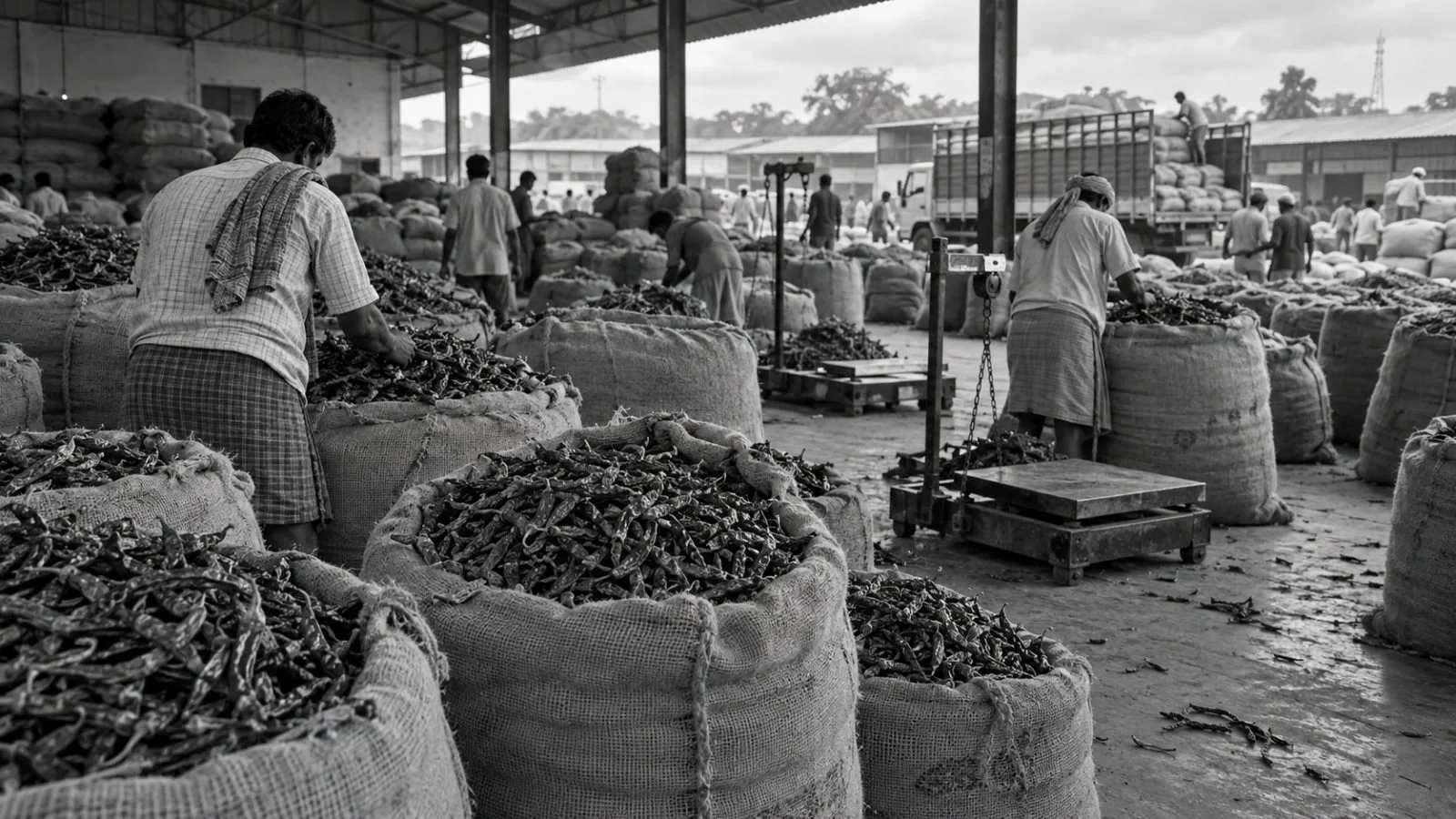
Delayed red chilli planting in two southern Indian states may shift a major wave of new supply to February 2027, prolonging reliance on existing stocks, agricultural market researcher FarMart said.
The India Meteorological Department (IMD) recorded 542.0 millimeters of rainfall across the south peninsula during the June-September 2026 southwest monsoon, 76% of its long-period average. The total was the region’s second lowest since 2001.
FarMart said inadequate rain delayed sowing in Andhra Pradesh and Telangana by about a month. It now projects substantial arrivals from those states in February 2027 instead of January. The delayed supply could support chilli prices in the near term, according to the firm’s outlook.
Existing inventories are also lower. FarMart cited industry estimates putting chilli stocks below year-earlier levels by 23% in Guntur, 24% in Khammam and 29% in Warangal. The firm linked the decline in stocks to reduced cultivation last season.
Madhya Pradesh could provide an offset. FarMart said attractive prices encouraged farmers there to expand chilli acreage, which has almost doubled, and that new-crop arrivals had begun. How much that crop eases supply pressure will depend on the harvest.
Turmeric faces a different timetable. FarMart expects supplies left from earlier harvests to cushion the market through 2026, though reduced water in wells and canals poses a risk to some irrigated crops. The Spices Board says farmers grow turmeric under both irrigated and rain-fed conditions. FarMart also noted that a weak 2023 monsoon preceded a turmeric price spike in 2024.
India’s Ministry of Statistics and Programme Implementation reported a provisional 7.74% year-over-year rise in the Consumer Food Price Index in September 2026, up from 5.97% in August. Those national figures do not establish how much, if at all, chilli or turmeric contributed. The Spices Board said chilli accounted for 27% of the value of India’s spice exports in 2025-26, and turmeric for 7%.
For October through December, the IMD says rainfall is most likely to be within 88% to 112% of the long-period average in the five southern meteorological subdivisions covered by its outlook. Telangana is outside that forecast area. The department plans to issue its November outlook toward the end of October.