


 Oil Prices Rise as Houthi Attacks Threaten Middle East Supply
  UK Finance Minister Healey Calls for Fiscal Discipline Amid Global Risks
  Mike Rogers Calls for End to US-Canada Tariff War
  France to Release 10 Million Barrels of Diesel to Ease Fuel Prices
  US Dollar Near 18-Month High Ahead of Inflation Data
  Bangladesh GDP Growth Accelerates to 4.6% on Industrial Rebound
  Iran Refuses to Halt Uranium Enrichment Amid US Nuclear Demands
  Gold Prices Rise Above $4,200 as Russia-Ukraine Energy Truce Eases Oil Concerns


 Add as a preferred source on Google
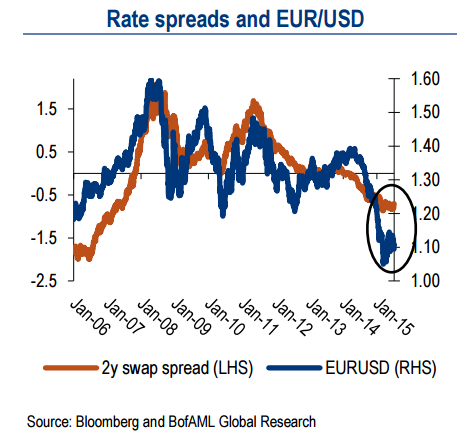
Euro has remained relatively resilient, despite a substantial deterioration of the situation in Greece. Although Grexit risks are negative for the Euro, data and divergence of monetary policies are more important drivers. Improving US data and diverging monetary policies to weaken the Euro by the year-end
Relative data surprises have recently started turning in favor of the US, but are still consistent with a stronger Euro. Short-term rate differentials would also justify EUR/USD well above current levels.
"We project EUR/USD at parity by the end of the year, expecting the first Fed rate hike in September and low Eurozone inflation to keep the ECB's QE commitment strong. Greek risks, negative Bund net supply and light positioning also pose short-term EUR risks." says BofA Merrill Lynch in a research note.
The introduction of Greece capital controls and the 'No' vote in the referendum have weakened the Euro, but the impact was smaller than many investors may have expected. The Euro will weaken in response to Greek risks only if periphery rates and European equities sell-off substantially
"We still believe that Grexit will be negative for the Euro, although we don't necessarily expect a sharp adjustment." notes BofA Merrill Lynch
The dovish Fed and the not dovish-enough ECB have been more important EUR/USD drivers. This does not necessarily suggest that the Euro will not weaken during Grexit. Indeed, the ECB will be more likely to ease policies further in response to Grexit, than the Fed to postpone its first rate hike.
EUR/USD currently trades at 1.1025, down around a third of a percent, having topped $1.11 in the Asian trade. Focus will be on proposals expected from Athens for a deal to keep Greece and its banks financially afloat. A fall in U.S. yields following the release of minutes of the Federal Reserve's June meeting offered little hope to dollar bulls. The dollar index dipped as low as 96.123 in Asian trade.

- News

- Economy

- Central Banks
- Investing
- Research
- Roundups
- Digital Currency
- Insights
- Technical Analysis
- Technology
- Business
- Law
- Health
- Nature
- Fintech
- Science
- Topic
- Opinions
- ©Econometrics LLC . All Rights Reserved.
Divergent monetary policies a more powerful EUR driver than Greek risks
Thursday, July 9, 2015 9:43 AM UTC
Editor's Picks



- Market Data
Most Popular




