When racing season arrives, everyone becomes an expert on the horses that are the stars of the spectacle.
TV personalities, professional pundits and form guides talk confidently about the favourite’s “will to win”. In close races, the equine contestants “battle it out”, demonstrating “heart”, “grit” and “determination”.
But do horses even know they are in a race, let alone have a desire to win it? Do they understand what it means when their nose is the first one to pass the post?
Based on decades of experience and everything we know about horse behaviour, I think the most plausible answer is “no”.
From the horse’s perspective
From a horse’s perspective, there are few intrinsic rewards for winning a race.
Reaching the end might mean relief from the pressure to keep galloping at high speed and hits from the jockey’s whip, but the same is true for all the horses once they pass the finishing post. If the race is close, the horse that eventually wins might even be whipped more often in the final stages than horses further back in the field.
So while being first to reach the winning post can be crucially important to the horse’s human connections, there is very little direct, intrinsic benefit to the horse that would motivate it to voluntarily gallop faster to achieve this outcome.
So does a horse even know it’s in a race? Again, the answer is likely “no”.
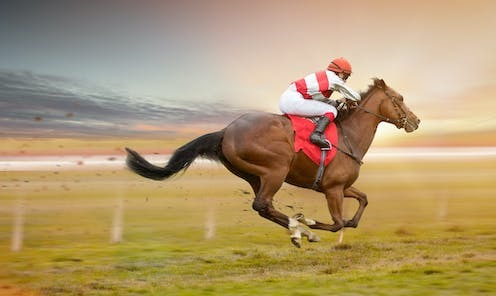
Running (cantering or galloping) is a quintessential horse behaviour and horses voluntarily run together in groups when given the opportunity – even in races without jockeys. However, there are a number of reasons to think horses have not evolved a desire to “win” during a group gallop.
Horses are social animals. In the wild, to minimise their individual exposure to predators, they synchronise their movement with other horses in their group.
This synchronisation includes maintaining similar speeds to other group members (to keep the group together), being alert to the positions of their own body and their neighbours’ to avoid collisions, and adapting their speed to the terrain and environmental cues that indicate upcoming danger or obstacles. In the wild, “winning” – that is, arriving first, long before other group members – could even be a negative, exposing the “winner” to an increased risk of predation.
This collective behaviour is the opposite of what owners, trainers and punters want from horses during a race.
The horse’s preferences (and how riders override them)
Horse races depend on two horse-related factors: the horse’s innate tendency to synchronise with other horses, and its ability to be trained to ignore these tendencies in response to cues from the jockey during a race.
Trainers and jockeys also harness the preferences of individual horses. Some horses are averse to bunching up with others during the race, so jockeys let them move to the front of the field (these are “front runners”). Other horses seek the security of the group, so jockeys let them remain in the bunch until closer to the winning post (these are “come-from-behind” winners).
Jockeys use several different interventions to override the horse’s innate tendency to synchronise. These might include:
-
directing the horses to travel much closer to the other horses (risking the sometimes fatal injuries we sometimes see at the track)
-
travelling at speeds not of the horse’s choosing (usually at far higher speeds and for longer durations, and often maintained by use of the whip)
-
preventing the horse from changing course to adapt its position relative to other horses in the field (directing its path via pressure on the mouth from the bit or taps from the whip).
During the early stages of a race, jockeys rely on horses’ innate desire to remain with the group to ensure they maintain the physical effort required to keep in touch with the front runners. This tendency may then be overruled so the horse will act independently of the group, leave it behind and come to the front to hopefully win.
No concept of being in a race
So horses most likely have no concept of being in a “race”, where the goal of their galloping is to get to a certain location on the track before any of the other horses. However, they undoubtedly know what it’s like to be in a race. That is, they learn through prior experience and training what is likely to happen and what to do during a race.
And with jockeys and trainers who understand the individual preferences of their horses to maximise their chances during the race, there will always be one horse that reaches that part of the track designated the winning post before the other horses in the group.
But as for winning horses understanding they are there to “win”? It’s far more likely it is the combination of natural ability, physical fitness and jockey skill that accounts for which horse wins, rather than any innate desire by that horse to get to the winning post before the other horses.