Drones have changed the way researchers study whales and dolphins. While we were once confined to the decks of boats and observation platforms, glimpsing the backs of surfacing animals, we can now watch them from above. Gaining a bird’s eye view of whales and dolphins has already taught us so much about their physiology and behaviour.
However, there is a darker side to drone use in marine research.
My doctoral research investigates the behaviour of beluga whales in the St. Lawrence Estuary. I have hundreds of hours under my belt as a drone pilot, flying over these amazing and endangered animals. As a PhD student at the University of Windsor, I use drone footage of these whales to help us better understand their behaviour and social structure, particularly differences between males and females.
Observing behaviour
While using drones to conduct research, I quickly noticed that the drones we flew sometimes seemed to disturb the belugas. Other colleagues sometimes observed sudden dives, where most of the animals below the drone suddenly dove, often with considerable splashing. These responses appeared to be particularly common when the drone was flown at low altitudes, around 20 meters above the water.
We were concerned that this disturbance could impact our ability to study the whales, and worse, could have a negative impact on the whales themselves.
We conducted research into our observations, and our findings were published in Marine Mammal Science. We examined whether a series of variables relating to drone piloting impacted the likelihood of the belugas responding to the drone.
We predicted that responses to the drone would increase at low drone altitudes, when the drone’s speed increased (increasing the noise of the rotors), when the drone approached the whales head-on, when wind speeds were low (making the drone more easy to hear), and on the first flight of the day.
We also examined variables relating to the whales being observed and predicted that drone disturbance would increase when the whales were in small groups, when offspring were present and when the whales were resting.
Drone altitudes
We found that sudden dives were relatively rare, only occurring in about four per cent of observations. However, sudden dives appeared to increase when drone altitude decreased. Sudden dives were particularly common when the drone was flown below 23 metres in altitude. This finding made sense to us: we had observed the drone was much more noticeable when flying directly above our heads, compared to when it was flying at 100 metres of altitude.
We also found that sudden dives appeared to be more common when flying over large groups. This finding was unexpected: earlier studies on dolphins have suggested that small groups are more prone to disturbance.
However, a recently published study examining the impact of drones on bottlenose dolphins found the same trend of disturbance increasing with group size. These authors suggested this is due to the “many eyes” effect, where large groups are more vigilant because there are more animals scanning for threats.
We also found that sudden dives commonly occurred when the drone first approached the whales. This suggests that the whales may be spooked by the initial approach of the drone.
Observer effects
We also conducted a literature review examining the impact of drone altitude on other whale and dolphin species. We found that drone disturbance rarely occurred when the drone was flown above 30 metres in altitude.
Interestingly, drone disturbance seemed more likely to be reported when authors included detailed descriptions of how disturbance was assessed and measured, suggesting that drone disturbance may be missed when researchers are not specifically looking for it.
We also found that most studies examining the impact of drones on whales and dolphins used small drones (less than five kilograms) which are much more discrete than the large, over 10 kilogram drone models that are frequently used in modern research programs.
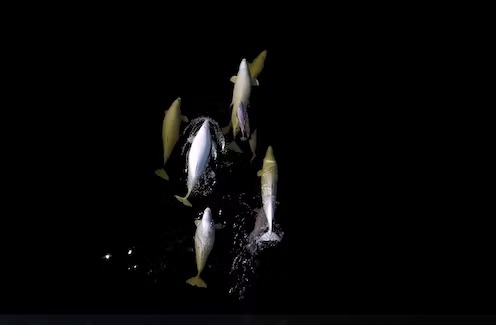
Drone footage of beluga whales chasing a fish.
Future recommendations
Our findings prompted us to make seven recommendations for future drone studies of whales and dolphins:
-
Drone studies of belugas should maintain an altitude of 25 metres or more.
-
Researchers using drones to study whales and dolphins should weigh the conservation benefit of low altitude flights against the potential for disturbance.
-
Pilots should use special caution when flying over large groups.
-
Pilots should use special caution when first approaching a group.
-
Pilots using large drones (those weighing more than 10 kilograms) should be particularly vigilant to drone disturbance and should report on the effects of large drones on whales and dolphins.
-
Future drone studies should clearly define the disturbance behaviours they will watch for.
-
Using a precautionary approach, drone pilots should avoid sudden accelerations, avoid approaching animals head-on and maintain special caution in low wind conditions.
By reducing the disturbance impact of research on whales and dolphins, we can help protect these amazing animals.