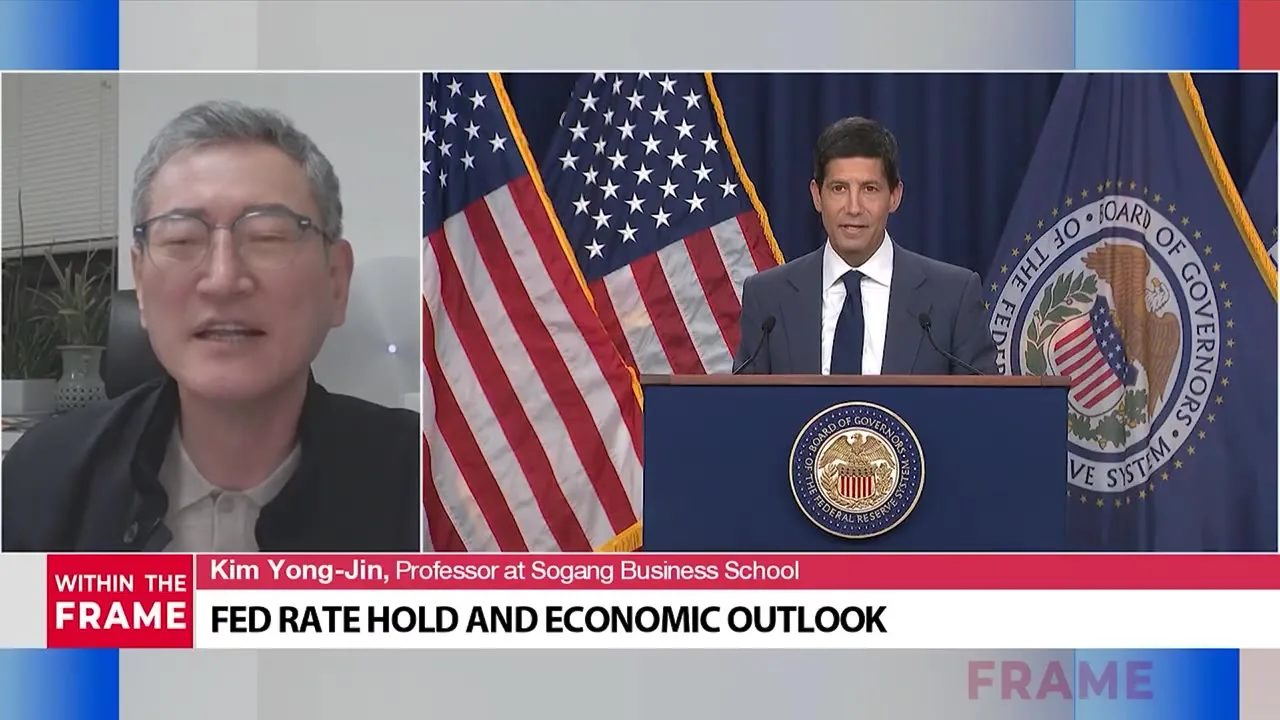
The Federal Reserve held its benchmark interest rate at 3.75% to 4% on Oct. 28 to assess earlier tightening, Kim Young-jin, a professor at Sogang Business School, said.
The pause followed a quarter-percentage-point increase in September. It gave policymakers more time to assess how higher borrowing costs and rising bond yields were affecting the economy.
Kim discussed the decision on Arirang News' Within the Frame, published Oct. 30, alongside Han-Young Lee, assistant professor of economics at Montclair State University. Their discussion addressed the competing demands of containing inflation and protecting employment.
Kim described the pause as a decision to wait for more information. He cited the delayed effects of the previous increase, tighter credit and disagreement within the central bank over whether another increase was necessary.
The Federal Reserve's decision passed by a 10-2 vote, compared with unanimous support at the previous meeting, Lee said. The dissenters favored higher rates, leaving disagreement over how much further the central bank should tighten policy.
Kim questioned whether current economic growth could last. Wealthier households and spending on artificial intelligence infrastructure were supporting activity, while expensive credit was weakening the finances of other consumers and small businesses.
He identified pressure on lower-income households, businesses needing to replace existing loans and a housing market constrained by expensive mortgages. Higher-income households had more protection against those borrowing costs.
“The current growth of the US economy faces a serious sustainability challenge,” Kim said. He expected growth to slow over the next two quarters rather than give way to an immediate recession.
Lee described a policy dilemma in which raising rates to contain prices could also make housing and other household expenses harder to afford. Slower hiring added to the difficulty of deciding whether further increases were necessary.
“The Fed has a very, very difficult decision,” Lee said. He identified underlying inflation, which excludes food and energy prices, as a measure to watch before the December decision.
Energy costs and geopolitical tensions could also affect that decision. Lee linked higher Treasury yields to additional strain on government finances and described growing consumer dependence on borrowing to cover purchases.
Kim then turned to whether artificial intelligence spending could produce lasting profits. He said sustained growth required companies to move from expensive hardware construction toward software that improved efficiency.
The discussion left the December rate decision unresolved. The supplied remarks also ended before Kim completed his assessment of artificial intelligence investment outside the technology industry, leaving that part of his argument unfinished.