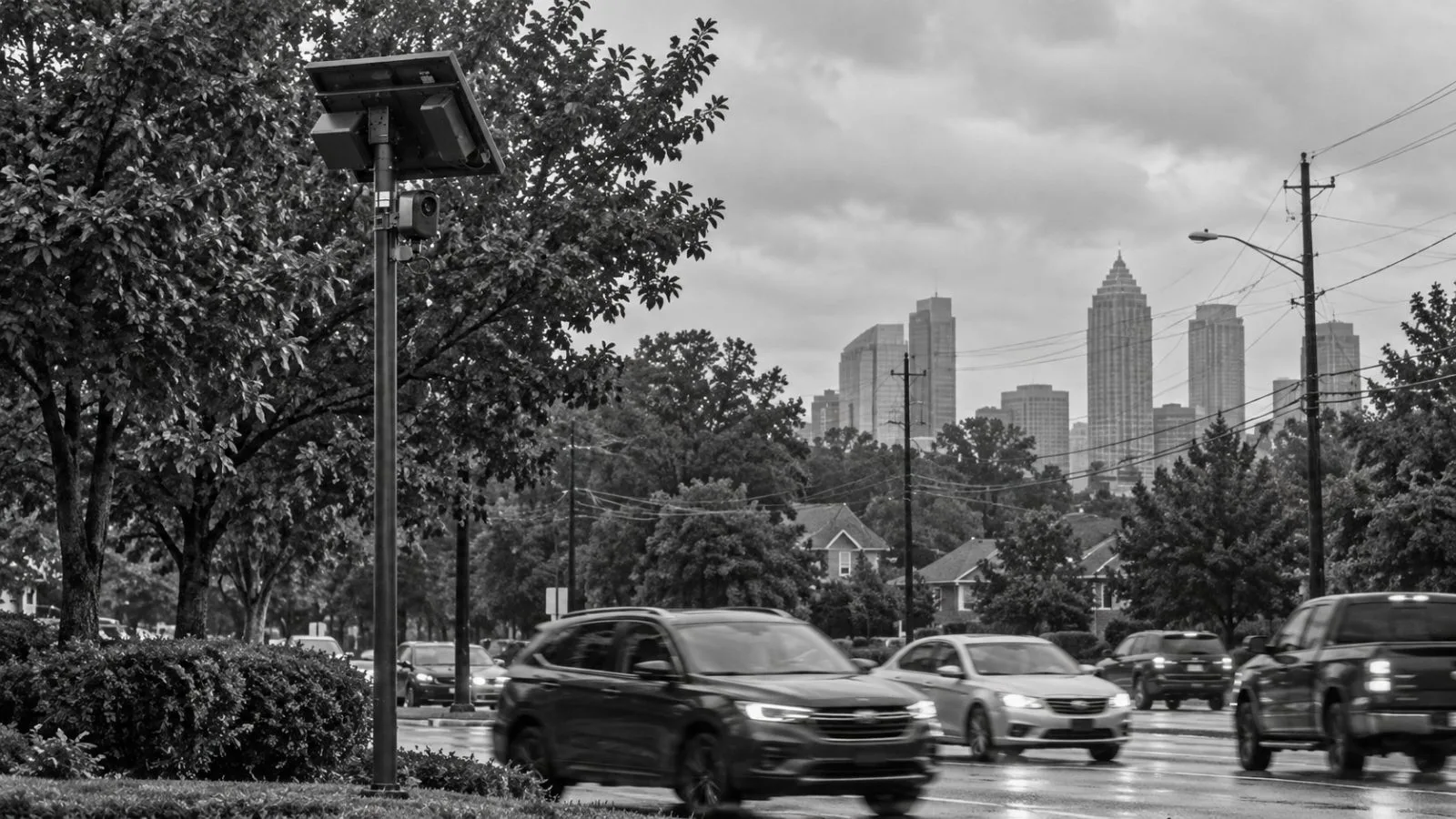
Flock Safety’s automated license plate readers have made surveillance policy part of Georgia’s gubernatorial race, where candidates disagree over new cameras as a September poll found concern across party lines.
Navigator Research’s online poll was fielded Sept. 10-14 by Global Strategy Group. It began with 1,000 registered voters, then added 375 interviews, bringing the total to 1,375. Overall, 62% said they were concerned about Flock cameras: 66% of Democrats, 70% of independents and 55% of Republicans. The stated margin of error was 3.1 percentage points for the full sample and higher for subgroups.
At an Oct. 7 debate, Democratic candidate Keisha Lance Bottoms said she was “not opposed to a moratorium” on new installations. Republican Rick Jackson opposed a pause, saying he did not want crime to rise and would address misuse. The gubernatorial election is Tuesday, Nov. 3.
Flock’s policy says its systems record plate and vehicle images, vehicle characteristics, plate number and state, and the time and location of each reading. Police can compare readings with hot lists that may include stolen vehicles, wanted people and vehicles of investigative interest, or search past readings to examine a vehicle’s movements. Flock says searches are logged with the user, time, purpose and search terms. Its materials say customers control access to records and decide whether to share them with other agencies. The policy lists seven days as the default retention period, subject to customer law or policy.
Those records may help police locate vehicles or investigate crimes, while also making drivers’ past movements searchable. Flock says its system assists in more than one million crimes solved annually. Flock also says law enforcement customers must adopt its Audit Assistance feature and require case codes for searches by the end of 2026.
A preprint working paper by Scott M. Mourtgos and Ian T. Adams examined fixed Flock camera deployments at 216 U.S. law enforcement agencies using crime data from 2017 to 2023. The researchers estimated an 11.0% decline in motor vehicle theft and a 15.9% increase in motor vehicle theft arrest clearance after deployment. Clearance was already rising in the three months before the first recorded deployment, the authors said, so they caution that the increase cannot confidently be credited to the cameras. The study found no detectable improvement in recovery timing when it counted all stolen vehicles, including those never recovered; recovery time declined modestly among recovered vehicles.
The paper’s background says subscription pricing helped bring the technology to smaller and midsize jurisdictions, while fixed cameras shifted plate reading from patrol use to permanent roadside networks. It cites an estimate that about two-thirds of U.S. law enforcement agencies with at least 100 sworn officers had patrol readers by 2013.
The Washington Post reported Sept. 23 that many incidents in its investigation involved Flock cameras. Its review of police and court records counted at least 100 police employees accused or charged in connection with unauthorized license plate reader use. Georgia voters choose a governor Tuesday, Nov. 3; Flock’s stated deadline for the customer safeguards is the end of 2026.