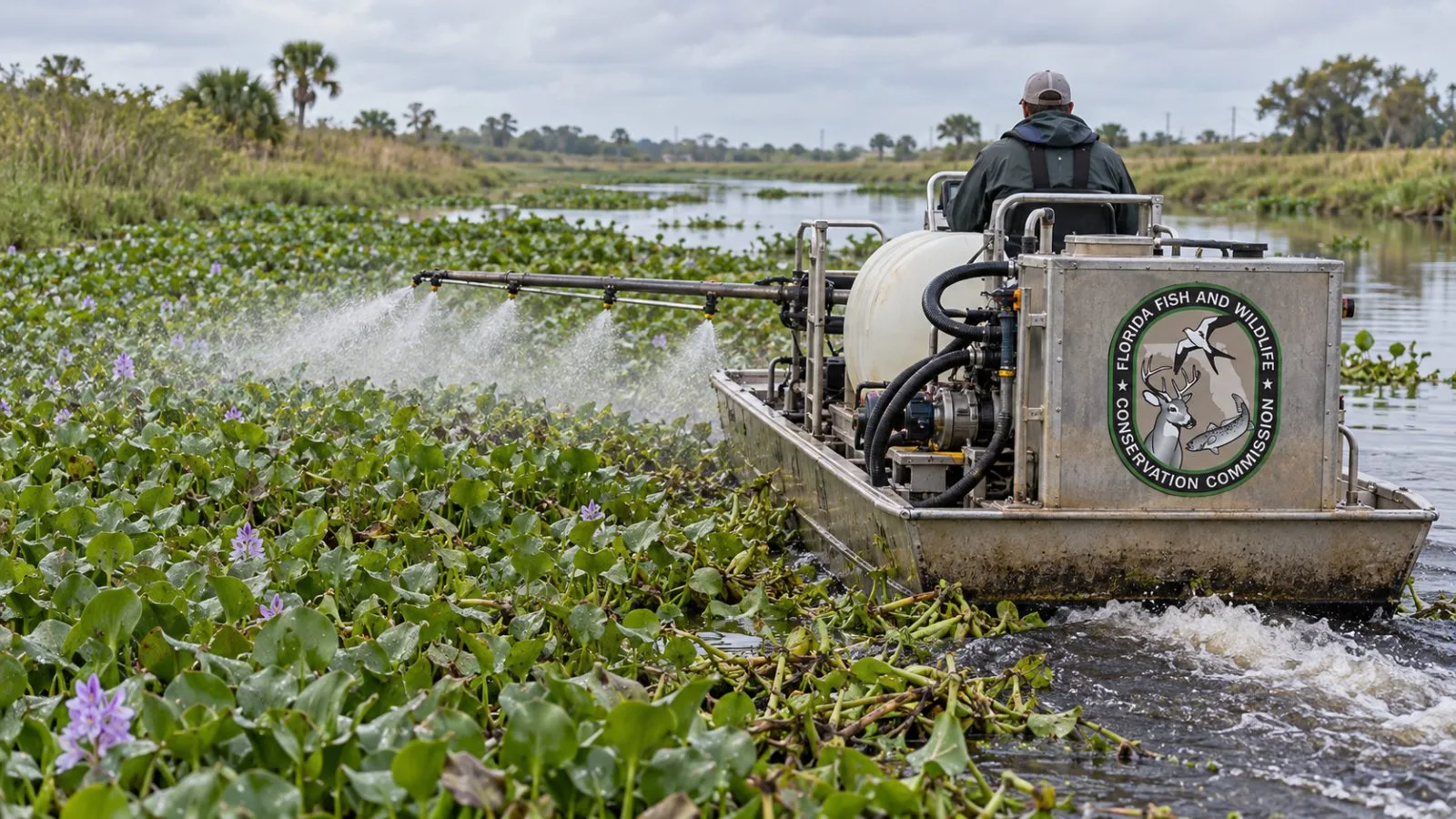
Florida spent $3,032,836 in FY 2024-2025 to treat floating invasive plants in public waters, as managers continue programs targeting water hyacinth and water lettuce, the Florida Fish and Wildlife Conservation Commission (FWC) reported.
FWC’s annual report covers July 1, 2024, through June 30, 2025. Managers treated 14,484 acres during that period, but treated acreage measures work performed, not the plants’ total standing coverage. Of the $3,032,836 spent, $2,901,361 came from state funds and $131,475 from federal funds.
FWC’s webpage estimates that water hyacinth covers about 2,000 acres statewide but does not give a date for that estimate. Separately, the agency’s 2025 tally puts water hyacinth and water lettuce together at about 1,484 acres across 282 public lakes and rivers. The figures have different scopes, and the 2025 count includes two species, so they are not directly comparable.
FWC’s annual report puts the plant’s historical peak above 125,000 acres in 1959. The University of Florida’s Institute of Food and Agricultural Sciences (UF/IFAS) identifies the Southern States Cotton Expo in New Orleans in 1884 as the first documented broad introduction of water hyacinth to the United States. Visitors received plants as souvenirs, and some later reached Florida.
FWC says Florida water hyacinth populations can double in as little as two weeks. Dense mats can obstruct boating and flood control, shade native plants and reduce dissolved oxygen that fish need.
The state’s maintenance-control approach for floating plants began in the early 1970s. FWC says established invasive plants can be difficult or very expensive to eradicate; its Invasive Plant Management Section calls “continuous maintenance” critical.
UF/IFAS says mechanical removal became costly and ineffective because crews could not harvest the plant as quickly as it grew. Current control combines herbicides with biological controls such as weevils, which slow growth and reproduction but cannot manage the plant on their own.