
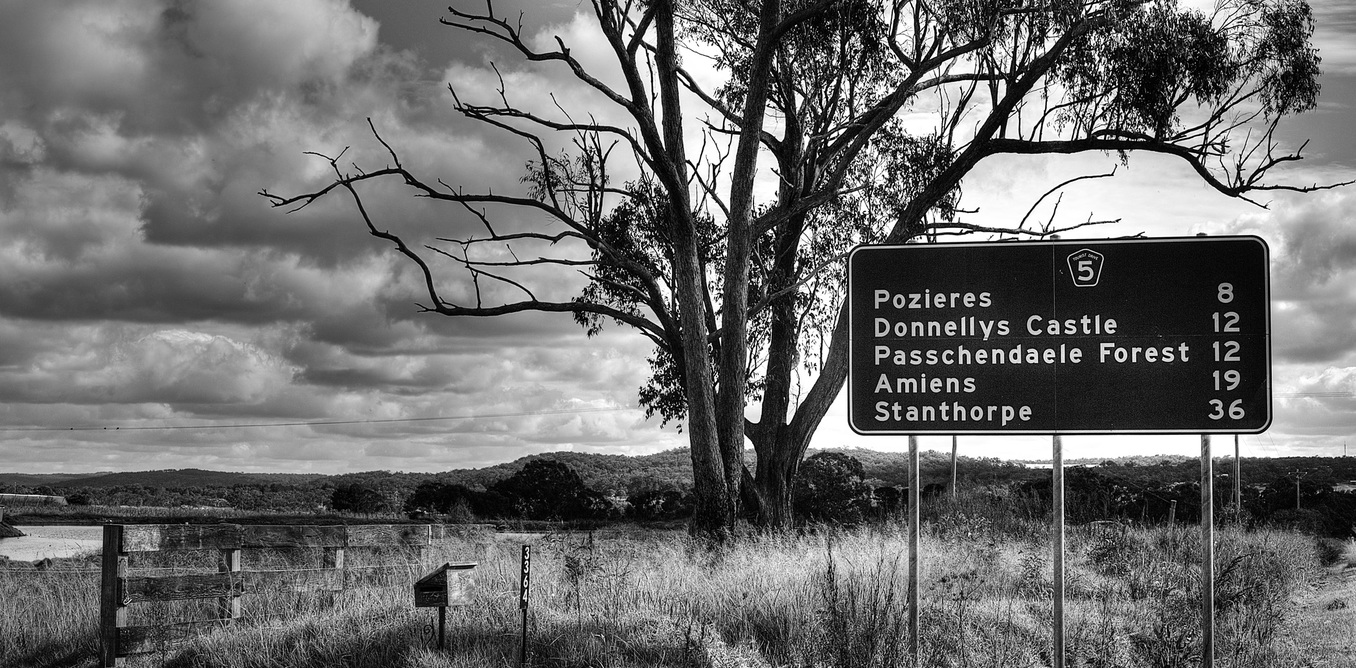
This year, as World War One centenary commemorations continue, attention has swung from Gallipoli to France and Belgium. Vast numbers of Commonwealth visitors have arrived in the villages that bore the brunt of the Western Front battles.
My photographic essay Camarade: The Earth juxtaposes photographs taken on the battlefields of the Western Front and in Queensland’s Granite Belt, where more than 500 Diggers were “resettled” after the war.
Forty six thousand Australians died on the Western Front and more than 150,000 were wounded. They died in the Battles of Pozieres, Bullecourt, Messines and Passchendaele.
After the war ended, the earth in Northern France and Belgium was littered with remnants of the battles. Millions of bodies were buried in the local farmers’ fields. Children grew up with warnings about the shrapnel that still remains underground.
Many Australian diggers came home to rebuild their lives in resettlement communities such as the Pikedale Soldier Settlement Scheme on the Granite Belt in southern Queensland. They paid £625 to purchase and run their farming block. They named the new settlement – its suburbs and train stations – after the places where they’d fought on the Western Front.
On the Amiens Branch Railway line that ran from Cottonvale to the terminus at Amiens, almost 20 km away, six railway sidings were named after memorable battlefields where men from the area died and are buried: Fleurbaix, Pozieres, Bullecourt, Passchendaele, Bapaume, and Messines.
Here, in Queensland, the returned soldiers had to fight the large granite boulders on the land they were given. They began a new battle, with the earth, to scrape a living out of cleared bushland.
Today, families continue to experience challenges in digging out a life from the land on both sides of the world. As it becomes harder to make a living from traditional farming, new industries, such as battlefield tourism and wineries, have flourished.
On the Western Front, poppies still grow by the sides of roads and in fields where the dead lie. In commemorating the war’s centenary, we seek to halt the erosion of memory.

Western Front. Louise Grayson, Author provided

Western Front. Louise Grayson, Author provided

The Granite Belt. Louise Grayson, Author provided

Western Front. Louise Grayson, Author provided

The Granite Belt. Louise Grayson, Author provided

Western Front. Louise Grayson, Author provided

The Granite Belt. Louise Grayson, Author provided

Western Front. Louise Grayson, Author provided

The Granite Belt. Louise Grayson, Author provided

Western Front. Louise Grayson, Author provided

The Granite Belt. Louise Grayson, Author provided

Western Front. Louise Grayson, Author provided

The Granite Belt. Louise Grayson, Author provided

Western Front. Louise Grayson, Author provided

The Granite Belt. Louise Grayson, Author provided

Western Front. Louise Grayson, Author provided

The Granite Belt. Louise Grayson, Author provided

Western Front. Louise Grayson, Author provided

The Granite Belt. Louise Grayson, Author provided

Western Front. Louise Grayson, Author provided

The Granite Belt. Louise Grayson, Author provided

Western Front, Europe. Louise Grayson, Author provided
Louise Grayson does not work for, consult, own shares in or receive funding from any company or organisation that would benefit from this article, and has disclosed no relevant affiliations beyond the academic appointment above.
This article was originally published on The Conversation. Read the original article.


