


 Urban studies: Doing research when every city is different
  Jay Clayton Named Trump’s AI Czar as XRP Past Resurfaces
  China’s Growth Faces Structural Challenges Amid Doubts Over Data
  China Shuts 670 Banks as Bitcoin Eyes Financial Risks
  Bitcoin Outflows From Binance Hit Three-Year High as Whales Accumulate
  Moldova Criticizes Russia Amid Transdniestria Energy Crisis
  ECB May Stop Rate Hikes After December, Capital Economics Says
  Fed Unveils Stablecoin Rules Under GENIUS Act
  BOJ Signals Faster Rate Hikes as Inflation Risks Grow
  US Futures Rise as Investors Eye Earnings, Inflation Data, and Wildfire Impacts
  Fed Rate Hike Threatens Housing as U.S. Growth Leans on AI, Citi Says
  Stellar Leads RWA Tokenization Growth With $36.4M Inflow
  Bitcoin Bull Cycle Still Early as XRP, NEAR Consolidate
  U.S. Treasury Yields Expected to Decline Amid Cooling Economic Pressures
  Weekly Crypto Pulse: $528M ETF Inflows Meet a Cooling US Economy


 Add as a preferred source on Google
Until just before the end of yesterday’s press conference ECB President Mario Draghi managed to ooze optimism and to successfully downplay the numerous risks for the euro zone growth and inflation outlook. As a result, the euro was initially able to appreciate moderately. If the journalists had not remained so stubborn on the subject of Italy this is probably how it would have ended.
However, with the last question about how the ECB would react if the EU budget row with Italy was to escalate further Draghi was finally cornered. Of course, he would have been able to carry on with his strategy and dispel this risk as an obstacle for the ECB’s normalisation plans.
The run-up to the crucial EU summit this week was marred by an unexpected impasse in Brexit talks as the government abruptly signalled that it could not support the draft withdrawal text that its officials and those of the EU had been working on.
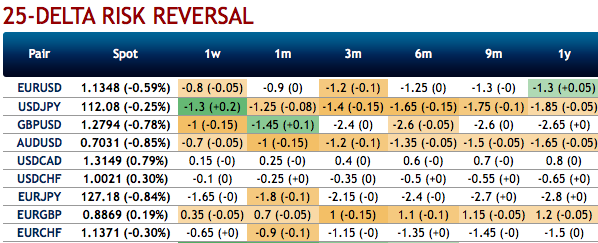
EUR- and EUR-bloc (USDNOK, USDSEK) risk-reversals are underperforming. Risk-reversals of euro crosses have been indicating increased bearish sentiments (refer above nutshell).
One could consider earning the risk premium on these surfaces for an Italian accident by selling riskies (shorting EUR puts, buying EUR calls) with an over-hedge on delta (i.e. short EUR forwards) to protect against a left tail event.
The advantage is that both the risk-reversal short and the delta-hedge are positive carry in nature, and could be complementary to existing short EUR directional option structures in macro portfolios. Courtesy: JPM
Currency Strength Index: FxWirePro's hourly EUR spot index is inching towards -27 levels (which is mildly bearish), hourly USD spot index was at 52 (bullish) while articulating (at 13:35 GMT). For more details on the index, please refer below weblink:







