


 Mexico's Undervalued Equity Market Offers Long-Term Investment Potential
  Morgan Stanley Predicts $10 Trillion RWA Market by 2030
  Hyperliquid (HYPE) Price Analysis: Can Bulls Push Above $88?
  Oil Prices Dip Slightly Amid Focus on Russian Sanctions and U.S. Inflation Data
  Bitcoin Price Drops as US Dollar Hits 18-Month High
  Arthur Hayes Announces FLOP Testnet Launch Within Weeks
  Bank of America Posts Strong Q4 2024 Results, Shares Rise
  Cardano Price Drops 15% as Whales Sell 110 Million ADA
  Gold Prices Fall Amid Rate Jitters; Copper Steady as China Stimulus Eyed
  NEAR Price Surges 11% as Trading Volume Doubles
  Crypto Derivatives Dashboard: Bulls Retain Control Amid $488M Liquidation Flush
  Urban studies: Doing research when every city is different
  Ripple Mints 19.6 Million RLUSD Amid Banking Expansion


 Add as a preferred source on Google
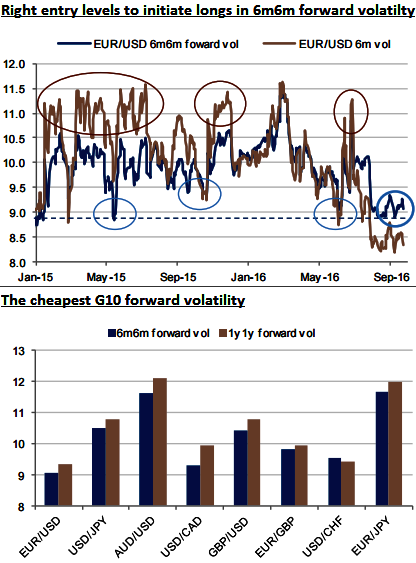
According to current market pricing, EURUSD has the cheapest forward volatility on both the 6m6m and 1y1y tenors (see above histograms).
From the vol study, it is reckoned that it seems to be a good entry point to buy forward volatility with a 6m-1y segment tighter than 0.5 volatility points, the EURUSD presents an attractive profile for forward volatility, which is currently priced at 9.1.
In contrast, EURUSD 6m volatility has frequently traded significantly above the current forward volatility level in recent months and is at the same time near its historical bottom (see ogive graph).
We also observe that volatility experienced several spikes when 6m6m forward volatility traded in the 9-9.5 region.
The aspects highlighted above do not necessarily suggest that volatility is going to rise imminently, but it could become more supported over the medium term.
If the options market starts sharing this belief, volatility curves will tend to steepen in their vega segment. It is, therefore, attractive to consider buying multi-month forward volatility.
EURUSD has the most value among FX G10 space, the universe of the most liquid currencies is constituted by the following eight pairs, in decreasing order: EURUSD, USDJPY, AUDUSD, USDCAD, GBPUSD, EURGBP, EURJPY, and USDCHF.
EUR/USD 6m volatility is currently trading at 8.4, and in this universe is closest to the lows observed since both the start of the year and 2012. Only USDCHF volatility is slightly closer to its bottom observed since 2012. Conversely, JPY volatilities are found to be the highest.
The only risk for this suggestion is that when Vega underperforms, the investors trading a FVA receive a straddle at the forward date and are exposed in mark to market to the difference between the traded forward volatility and the 6m implied volatility in six months.
Afterward, the losses are limited to the straddle premium, computed as per the initially traded forward volatility.







