


 UBS Projects Mixed Market Outlook for 2025 Amid Trump Policy Uncertainty
  U.S. Stocks vs. Bonds: Are Diverging Valuations Signaling a Shift?
  Goldman Predicts 50% Odds of 10% U.S. Tariff on Copper by Q1 Close
  China's Refining Industry Faces Major Shakeup Amid Challenges
  Stock Futures Dip as Investors Await Key Payrolls Data
  Mexico's Undervalued Equity Market Offers Long-Term Investment Potential
  Energy Sector Outlook 2025: AI's Role and Market Dynamics
  Urban studies: Doing research when every city is different
  Moldova Criticizes Russia Amid Transdniestria Energy Crisis
  Gold Prices Slide as Rate Cut Prospects Diminish; Copper Gains on China Stimulus Hopes
  Moody's Upgrades Argentina's Credit Rating Amid Economic Reforms
  Trump’s "Shock and Awe" Agenda: Executive Orders from Day One
  Wall Street Analysts Weigh in on Latest NFP Data
  China’s Growth Faces Structural Challenges Amid Doubts Over Data
  Indonesia Surprises Markets with Interest Rate Cut Amid Currency Pressure
  U.S. Treasury Yields Expected to Decline Amid Cooling Economic Pressures
  Fed May Resume Rate Hikes: BofA Analysts Outline Key Scenarios


 Add as a preferred source on Google
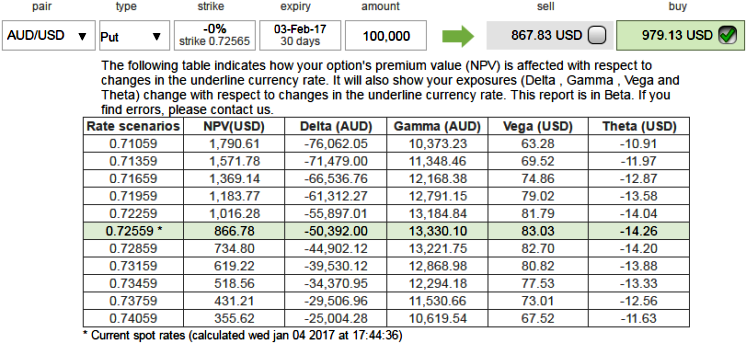
Before we begin with this write-up, please be informed that 1m AUDUSD ATM puts are flashing deltas around -0.50.
AUDUSD has been tumbling considerably of late, dropped from the highs of 0.7778 to the current 0.7159 levels, currently trading at 0.7255 sensing little strength from last two-three days.
So, the previous consolidation pattern that has begun since Jan’2016 now seems to have exhausted at this level owing to the potential changes in central banks’ monetary policy decisions in both AUS and the US continents.
As a result, the hedgers who intend to alter their hedging portfolios should be mindful of the premium adjusted spot delta.
During longer tenors, any hedging strategies to encompass both the FED & RBA easing cycles and other routine economic events. But let’s have a glance on 1m IV skewness, negatively skewed strikes are less likely to favor holders of such option (put) to serve the desired outcome, in other words, OTM put strikes have the higher likelihood of expiring in the money.
Well, to overcome this hindrance, the premium adjusted spot delta takes care of the correction induced by payment of the premium in foreign currency (USD in this case), which is the amount by which the delta hedge in foreign currency has to be corrected.
To quantify the hedge in a domestic currency we need to flip around the quotation and compute the dual delta.
As in the case of a spot delta, a premium payment in foreign currency leads to an adjustment of the forward delta. Note again that the premium adjusted forward delta of a call is not a drone function of the strike.
Forward delta conventions are normally used to specify implied volatilities because of the symmetry of put and call deltas adding up to 100%. Using forward deltas as a quotation standard often depends on the time to expiry T and the presence of an emerging market currency in the currency pair. If the currency pair does contain an emerging market currency, forward deltas are the market default.
This knowledge is crucial to understand the volatility construction procedure in FX markets. In FX option markets it is common to use the delta to measure the degree of moneyness.
Consequently, volatilities are assigned to deltas (for any delta type), rather than strikes. For example, it is common to quote the volatility for an option which has a premium-adjusted delta of 0.25.
These quotes are often provided by market data vendors to their customers. However, the volatility-delta version of the smile is translated by the vendors after using the smile construction procedure.







