


 China Shuts 670 Banks as Bitcoin Eyes Financial Risks
  Yen in Focus as BOJ, Fed Rate Hikes Reshape Currency Markets
  US Gas Market Poised for Supercycle: Bernstein Analysts
  Robinhood Buys $25 Million in Bitcoin for Corporate Treasury
  S&P 500 Relies on Tech for Growth in Q4 2024, Says Barclays
  Fed’s Hammack Says Bond Yield Surge Is Not Driven by Inflation Fears
  BOJ Set for 25-Basis-Point Rate Hike as Yen Weakness Fuels Inflation
  U.S. Banks Report Strong Q4 Profits Amid Investment Banking Surge
  Gold Prices Slide as Rate Cut Prospects Diminish; Copper Gains on China Stimulus Hopes
  UBS Projects Mixed Market Outlook for 2025 Amid Trump Policy Uncertainty
  Geopolitical Shocks That Could Reshape Financial Markets in 2025
  Bitcoin Price Falls Below $83K as Liquidations Hit $697M
  ECB May Stop Rate Hikes After December, Capital Economics Says
  RBI Uses $10 Billion Currency Swaps to Drain Excess Rupee Liquidity


 Add as a preferred source on Google
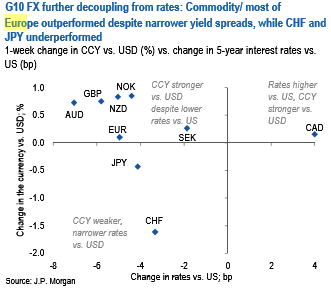
In global FX market, everywhere you see the only trendy voice that you could hear is that the US dollar weaker, weaker, weaker. USD only moves in one direction at the moment that is southwards. Be it against EUR, JPY or CNY: USD is easing on a broad basis. Against EUR it is slowly approaching the 1.20 mark. It is becoming gradually clear that the greenback is also suffering not only as a result of Fed’s recent guidance but also the President Trump’s weak government. It is unfair to give all credits on Fed’s kitty. Central banks’ policy divergence is the other predominant aspect to be considered.
The broad dollar ground lower in the recent times to make a fresh multi-month low even though the Fed indicated that balance sheet normalization is on the cards for September. The red flags for the currency came in on the back of a tweak in the Fed’s language on inflation was interpreted by markets as dovish and activity data beat expectations in Europe and Asia.
The US data released at the end of the week further reinforced bearish momentum for the dollar with the important quarterly employment cost index coming in below than expectations, thus indicating soft inflation pressures in the US.
The macro theme of Europe leading outperformance remained dominant with Scandis outperforming in G10 on strong data/higher oil prices and EMEA in EM. Other remarkable market moves came from:
i) Swiss franc (EURCHF made a new high since the SNB abandoned the floor) on possible M&A flow and SNB comments that while not a departure from their previous stance, reiterated that their policy stance remains unchanged putting them in contrast with several other DM central banks where policy is evolving, and
ii) The commodity prices with oil and base metals higher across the board, giving commodity currencies a lift as well, despite narrower yield spreads (refer above chart). Against this backdrop, the portfolio has fared well in the past week.
In G10, longs in Europe (EUR, NOK) vs USD and JPY have broadly paid off while the performance of EM trades has been more mixed.
Recent FX market moves in G10 have been primarily about a divergence in central bank policy, so a strengthening in currencies where central bank policy is likely to or has already started to pivot (ECB, BoC) vs. those where central banks are likely to keep policy unchanged and stay dovish (BoJ and possibly SNB).BoC) vs those where central banks are likely to keep policy unchanged and stay dovish (BoJ and possibly SNB).







