


 Yen Sinks as BOJ Rate Hike Fails to Impress Markets
  BOJ Raises Interest Rate to 31-Year High as Yen Weakens
  Stock Futures Dip as Investors Await Key Payrolls Data
  Bitcoin Outflows From Binance Hit Three-Year High as Whales Accumulate
  Lithium Market Poised for Recovery Amid Supply Cuts and Rising Demand
  Mexico's Undervalued Equity Market Offers Long-Term Investment Potential
  Fairshake Backs 32 Pro-Crypto House Candidates
  Fed’s Williams Signals One More Rate Hike Before Year-End
  Kalshi Withdraws PEPE Perpetual Futures Filing
  Strategy’s STRC Nears $100, Raising Prospects for Major Bitcoin Buys
  Stellar Leads RWA Tokenization Growth With $36.4M Inflow
  Bank of America Posts Strong Q4 2024 Results, Shares Rise
  UBS Projects Mixed Market Outlook for 2025 Amid Trump Policy Uncertainty


 Add as a preferred source on Google
The currency markets navigated two major events over the past week that left the broad dollar with no more directional clarity than before. The March FOMC under new Fed Chair Powell raised rates as widely anticipated and forecast an additional one-and-a-half rate hikes by the end of 2020, but any hawkish fallout for the dollar was contained by and the backloaded nature of projected rate increases and only a marginal upward revision to the implied neutral real rate relative to the December’17 SEP.
The collective economic outlook of the FOMC has become more optimistic in recent months. The new forecasts of economic activity assembled for the latest meeting showed an upward revision to GDP growth and a downward adjustment in the unemployment rate. In addition, the Committee added a sentence to the policy statement noting that the economic outlook has strengthened in recent months.
- Geopolitics will continue to make the headlines
- While US PCE inflation (expected to edge higher) the most important data, Fed-speak will be at least as important to digest the recent changes to the FOMC SEP.
- Expect liquidity to be thin as Easter gets closer
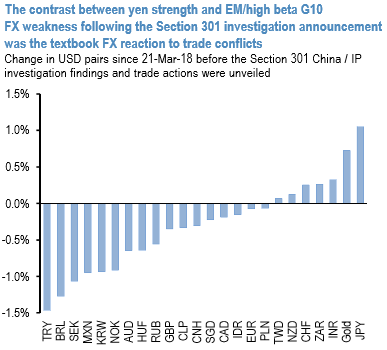
Any designs of re-loading USD-funded carry trades on this relatively benign FOMC outcome, especially given the recent spate of soft-side US inflation prints that had allayed fears of a behind-the-curve Fed, were however frustrated by the announcement of US trade actions following the findings of the Section 301 China/IP investigation that hit equities harder than anticipated.
The 3%+ tumble in SPX after the release led to predictably sharp rallies in JPY and gold and declines in EM and high-beta G10 (refer above chart), and validated our trade protectionism template of decoupling between reserve and non-reserve FX that we have frequently cited in these pages.
The trades portfolio has run relatively light on risk in recent weeks, with a slight defensive lean predicated on navigating the uncertainty of potentially disruptive US trade policy. This has helped sidestep head fakes in risk markets such as that following benign US CPI but has also missed participating in the extension of the yen rally after taking profits on AUDJPY shorts (in hindsight) too early around the VIX shock.
Having been sidelined in the yen since then in anticipation of a seasonal uptick in unhedged Japanese outflows in the new fiscal year, we are cautious about chasing USDJPY lower from current levels, especially without the tailwind of broader dollar weakness.
Long reserve FX exposure is instead focused in two of the relative laggards – EUR and CHF – via longs in EUR/antipodean crosses and a short in USDCHF that eked out only workmanlike gains over the past week but offer potentially more durable returns on divergent monetary policy cycles even if trade tensions ebb. The recent cooling in European dataflow is admittedly a risk to these trades, but one that still bears watching rather than acting upon in our view given the strong absolute level of activity. Courtesy: JPM
FxWirePro launches Absolute Return Managed Program. For more details, visit:







