


 Indonesia Surprises Markets with Interest Rate Cut Amid Currency Pressure
  Australia Consumer Confidence Plunges as RBA Rate Hike Hits Households
  Fed Unveils Stablecoin Rules Under GENIUS Act
  U.S. Stocks vs. Bonds: Are Diverging Valuations Signaling a Shift?
  Global Markets React to Strong U.S. Jobs Data and Rising Yields
  RBI Raises Repo Rate to 5.50% in Hawkish Shift on Inflation Risks
  BOJ Raises Interest Rate to 31-Year High as Yen Weakens
  Fairshake Backs 32 Pro-Crypto House Candidates
  Trump Demands Powell Resign Over Fed Renovation Cost Overruns
  Trump’s "Shock and Awe" Agenda: Executive Orders from Day One
  Bitcoin Outflows From Binance Hit Three-Year High as Whales Accumulate
  RBA Hikes Interest Rate to 4.60% as Inflation Risks Rise


 Add as a preferred source on Google
The key driving force of loonie remains the relative priced pace of policy normalization. The conjecture behind a partial retracement higher in USDCAD is the expectation that relative monetary policy pricing will converge somewhat in the coming quarters. Post the June/July repricing, BoC is now priced to hike 67bps in two years, compared to the 32bp priced for the Fed, which in other words anticipates the policy rate spread (currently 39bp) to disappear.
This current differential in expected pace of policy normalization appears largely due to differences in policy reaction functions priced by markets: As much focus as there has been on US disinflation, Canada’s inflation recent undershoot is as nearly as severe and as surprising: the cumulative core undershoot is very similar for both (1.5% in Canadian core CPI and US core PCE, having declined 0.5 over the past 9 months).
Only a handful of the analysts polled by Bloomberg expect a further Bank of Canada (BoC) rate hike today. All others, us included, believe that it will leave its key rate unchanged at 0.75%. The market reaction to the rate decision is going to be more pronounced than analysts’ forecasts suggest, as the market is pricing in a rate hike with a much higher probability (above 40%). So if the BoC was to leave everything unchanged today, CAD is likely to ease notably.
While Canada’s unemployment rate has fallen swiftly in the past 12 months (-0.7%-pts) it has remained roughly in-line with developments in the US (0.6%-pts), and BoC’s assessment is that there remains slack in Canada, whereas US is now well under NAIRU estimates.
While the US normalization cycle is well further along, historically Canadian rate cycles have lagged US ones and peaked at lower rates; In the past 20 years US-CA 2y spreads have never been negative in a tightening cycle (currently 7bp). A sustained narrowing of yields might be more convincing once the Fed does near the end of its tightening cycle, while BoC is still in the middle of its own. This is more likely to unfold after mid-18 and for that reason, and because of a projected 2H18 bounce in crude oil prices, we have CAD rebounding some to 1.30 in fresh 3Q’18 targets.
In particular, as its inflation outlook is based on stable exchange rates, but CAD is trading almost 6% above the level assumed by the BoC. Excessively aggressive rate hikes would risk an overshooting of the exchange rate.
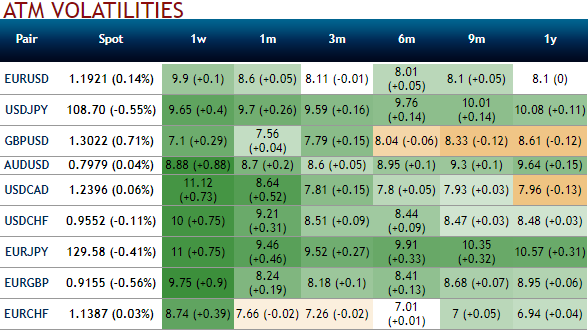
While the implied volatility remains among the three lowest G10 vols, seemingly options globally inexpensive. Despite the recent CAD appreciation, the USDCAD realized volatility has remained muted due to the low realized vol environment which makes knock-out barriers attractive.







